Rants and raves, San Miguel de Allende, Writings

The Log: April 19 — Fight the dark side: Dance, sing, read, write poetry

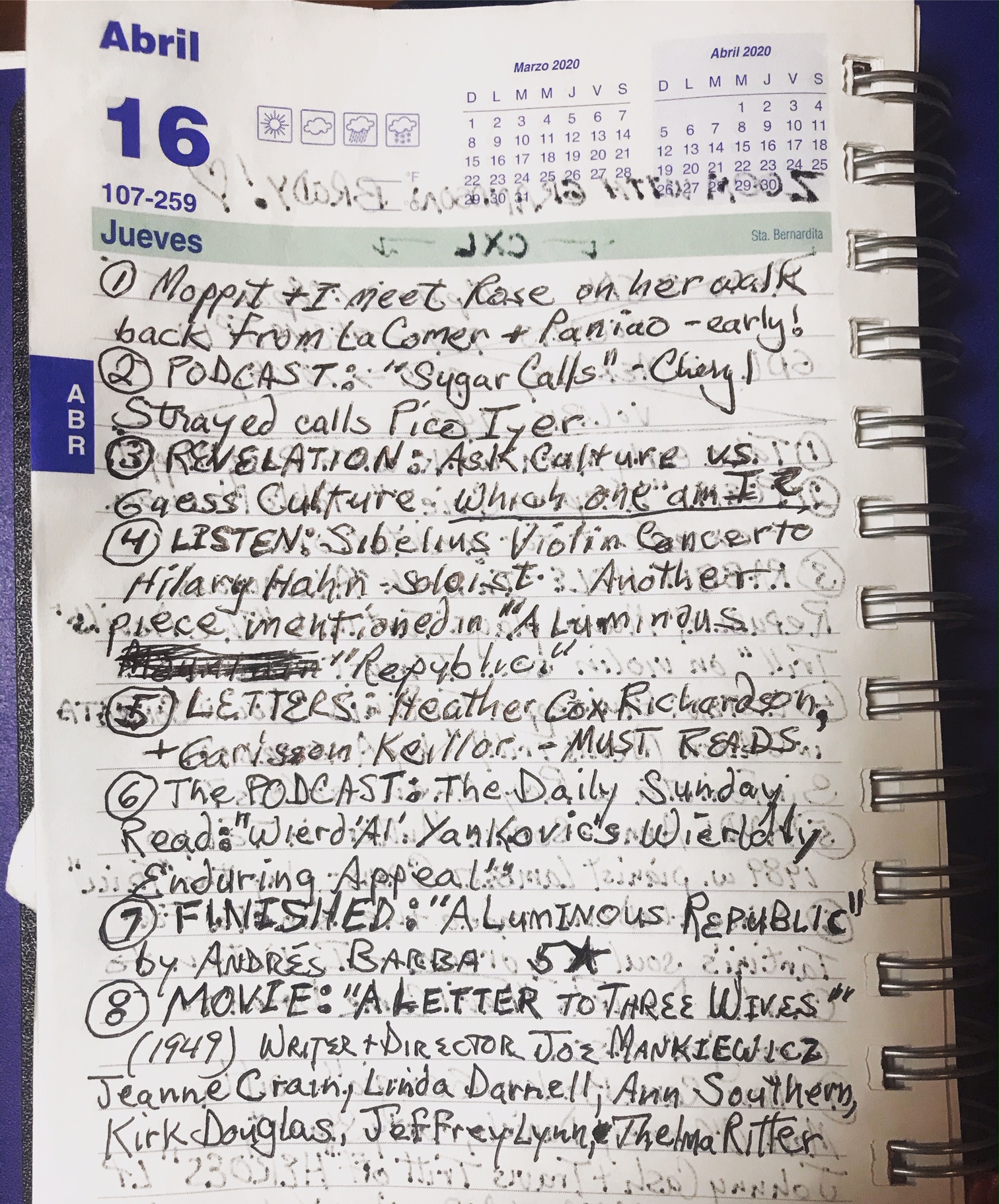
IMG_1393ANNOTATED LOG:

#1 CONNECTED: Rose Alcantara’s daughter, Caira Button, celebrates her birthday today, far from her Chicago home but in very good company in Western New York. Rose sang Happy Birthday to her from our home in Mexico. Technology rocks.

#1A FACETIME WITH FAMILY: Spent almost an hour in a video chat with Ryan and Larisa and grandson Augie, who is saying his first words! They remain in place in San Francisco where it can’t be easy. One of the world’s most beautiful cities outside your door … and you can only look out your window.

#2 BIG OOPS: The worst thing you can do upon waking is open up Facebook.  Trust me, bad news accumulates while you sleep. All this rage with no outlet …

A.Illinois governor forced to secretly buy badly needed medical supplies from China for fear Trump’s government will impound them.

B. Boston hospital team makes secret rendezvous in mid-Atlantic region to score protective medical supplies, as feds threaten to take them away.

C. Stimulus funds will reward more than 43,000 MILLIONAIRES with an average $1.6 million each.

#3 WELCOME RELIEF: Found in Garrison Keillor’s Letter from Manhattan.  Crafting good limericks and simplifying life — that’s the life. “It’s been a quiet week in apartment 12B.” That’s the stuff.

#4 TELEVISION: “CBS Sunday Morning” is like nestling in with an old friend. I can hear my blood pressure settling down for the day.

#5 DISCOVERY: Nobody has a lock on the truth about coronavirus — yet — but everyone has an opinion. I found a reasonable voice in Richard Lehman, professor of Shared Understanding of Medicine at the University of Birmingham.  His post in the British Journal of Medicine opinion page is calm, reasoned, informative, fact-based. I look for more from him.

#6 PAIRINGS:  Pink Floyd’s “Ummagumma” goes especially well with Gore Vidal’s 1977 essay “On Re-reading The Oz Books” from the New York Review of Books archives.

L. Frank Baum wrote 14 “Oz” books, the unevenness of which Vidal excuses because the man was writing 48 other books at the same time.

I’ll admit it, “Ummagumma” and me on psychedelics did not go well in late-1969. It goes better with the Wizard of Oz. Wish I knew that then …

#7 VIDEO: I’m not sure where I found it but there is an amazing video of liquid-limbed hipsters holding a dance-off to the Devil’s Music, jazz, baby. On further research, I found an 8-minute version that says this is a Sunday night party during the Jazz Roots Festival in Paris in 2015. Swing, baby, swing.

#8 I WROTE A POEM: Titled “Remembering to Dance Like Nothing Else Matters.” The first half was inspired by this video and the rest is based on something that happened to me in the early-1980’s in Rosarito Beach, Baja, Mexico.  I’m not a poet. These things just happen.

#9 PODCAST: While walking Moppit tonight, I tuned into the New York Times show “The Daily.” On Sundays, the program presents a spoken piece of long-form journalism borrowed from partner app AUDM. Today’s is “The Woman Who Might Find Us Another Earth.”  Sara Seger is a brilliant astrophysicist, a certified genius, but befuddled by the most common challenges of living on Earth.

#10 SHORT STORY: Edna Ferber’s “The Gay Old Dog”(1917). Chicago man becomes a Loop-hound. That is not a compliment, or, wasn’t back in the day.

#11  I leave you with this, the BEST PLAGUE PARODY SONG YET:
Standard
San Miguel de Allende, Writings

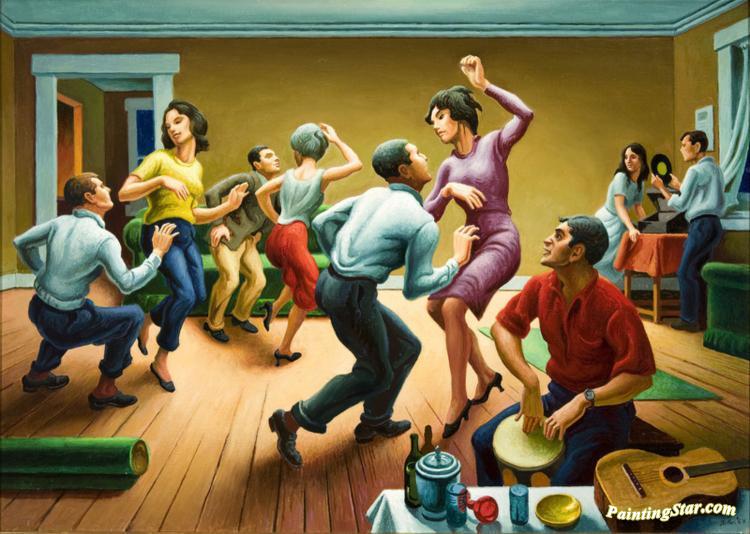
Remembering to dance like nothing else matters

Mural by Thomas Hart Benton

________________________________________________________________

Enough. Stop.

 Let the outrage machine simmer.

Turn off the echo chamber. 

Take a breath. Exhale.

Invest six minutes in some simple joy. 

Maybe a memory or a YouTube video

Search for something like:

“Crazy good dancing”

And see what comes up.

Wantonly happy dancers

All legs and jazz and smiles

Effortless abandon belying the practice, practice, practice.

Lose yourself in the motion

In the ecstasy

In the rhythm and youth and heat and sweat.

Remember all the times you

Could have danced and chose not to.

Too late for regret but ample time

To remember.

And wonder if every step not taken

On some lacquered floor

Now rises up like bile,

Angry fingers dancing across a cold keyboard

Dance, dance in your room.

Dance, dance in your yard.

Dance, dance in the office.

Dance, dance in your cubicle.

Dance, dance in the post-op.

Dance, dance in the checkout line.

Dance, dance on ZOOM with everyone you know and strangers.

For once, we have the space to dance.

Social distancing creates its own stage.

Dance as if the sanity and safety

Of the whole world depends 

On your awkward, gangly, unique

Beautiful, joyous, free steps.

Don’t post, don’t throw more flames on

Facebook fires already consumed.

Step away from the keyboard

And dance, dance, dance.

Recall that long-ago Sunday trip

To storied Rosarito Beach Hotel,

Safely south of Tijuana’s gamey streets.

A womb of illusions and harmless fantasies,

Behind ancient stone walls,

 And thick oak doors. An escape

For those who could not afford a flight,

Could not afford a house in Palm Springs,

Missed the invite to Malibu.

The bar on the bluff

Overlooking the crystalline capped surf

Contained like a landscape in glass windows

And tinkling bar glasses

All glass and lapping cerulean expanses.

Like flying. Above it all.

With a white baby grand on a lemon oak-panel floor.

And kids, Hollywood kids

Refugees from the studio lots and unemployment lines

And waitress jobs, and parking lots

All tumbled down to Rosarito, answering a primal cry 

For something exotic, something foreign

Something away, just far enough away

To rekindle thwarted dreams

Here, in the Rosarito’s bar

We’re all somewhat mysterious celebrities,

Stars on the lam, like Gable, Lombard, Bogie.

Bar the doors to the imaginary paparazzi,

Warm up the piano, 

Let the revue begin! What

Did they say … Let’s put on a show!

Kids with a thick dossier of rejections

And even more talent

Leap to the floor

Singing and dancing with abandon

Sweaty abandon, finely honed and practiced abandon

From high school musicals and college debuts

And second rows on stage

And gaudy rock-star glutted stripper bars.

Icy margaritas fuel scorching  moves, 

torching songs.

Saucy, sultry, racy chops

Designed for the lines of thin summer dresses

And nicely fitted khaki slacks and T’s.

Star-struck dreams are tossed, 

With flaming hot ambitions, 

Into the dance floor bonfire,

Like nothing matters, when

Come Monday,

Everything will.

But not now, god willing, not now.

Now is only the music and the chops

And the hothouse air and tropic sun

And shimmering mirrored ocean below

And Spanish exclamations from smiling bartenders

And the illusion that we are all 

In a Cinemascope Technicolor

Foreign film, the script of which,

Is within our own power

To write.

Every moment is a closeup

Everyone is a star. Everyone is

Hitting it big.

Monday is an opening-night away.

More margaritas, amigos.

More music, more dance, more song

For up North, a thousand more

Just like us

Are having their dreams coddled and crushed

On the mercilessly hot streets of Hollywood.

But not you, not me

Not today.

The war will still be raging when we return.

 But we will rejoin the fray with smiles

A new, fresh look for the face. 

Isn’t that worth it?

Standard
Rants and raves, San Miguel de Allende, Uncategorized, Writings

April 16: The ‘Luminous’ Log … now with 100 percent more annotation!

64575BA4-AB0C-433B-855A-18D7E4E1A9A5On March 27 I began logging my day’s activities into my now-useless appointment calendar. For the time being, there would be no luncheon dates, no concerts, no coffee meetups, no flights to visit grandchildren, no weddings, no visit to Mexico City with friends.

But how was I filling my days? They seemed to be drifting — without recollection of where I’d been, what I’d accomplished, where I was headed — from one gray fog-bound sea to the next.

“Naps,” seemed to be the only achievement that I recalled with any clarity. That, and pointlessly angry and condescending posts on Facebook. I had to be doing more than clicking “Like,” “Angry, “and “Love” buttons, right? Oh, and “HaHa.” Continue reading

Standard
Camino: Porto to Santiago, San Miguel de Allende, Writings

Entering Phase 2 of the coronavirus with the help of the Camino, history, humor, and Garrison Keillor & Randy Rainbow

90783141_645872432654516_853430196651425792_n

Decontamination crews are spraying down the streets of San Miguel de Allende today. The visuals alone ought to drive the doubters indoors. (Photograph by John Bohnel)

So, Mexico entered Phase 2 on Tuesday. While the president still hugs and kisses the babies and young girls, his Health secretary has called for restaurants and casinos to be closed, for public gatherings to disperse — you know, the same stuff we have been doing in San Miguel for a couple of weeks now.

Only, a lot less.

Phase 2 is clinically called the “community transmission phase.”

Phase 2 feels like Mom calling the kids inside to safety — after it starts raining. The kids have been playing outside, conscious of the dark clouds building. Continue reading

Standard
Memoirs -- fact and fiction, San Miguel de Allende, Writings

Exit, stage left, smoking Glock in hand

tunnel-mystery (1)

A two-character, three-page play written to honor a talented theater critic, newspaper colleague, and friend who just announced an early retirement. The characters in this play no way resemble my friend. That would be purely coincidental …

Curtain goes up, in an empty theater.

On an empty stage, two characters face each other. One, Jim, is fully lit. The other is in the shadows. We enter in the middle of a conversation.

Voice: You’re sure? Continue reading

Standard
San Miguel de Allende

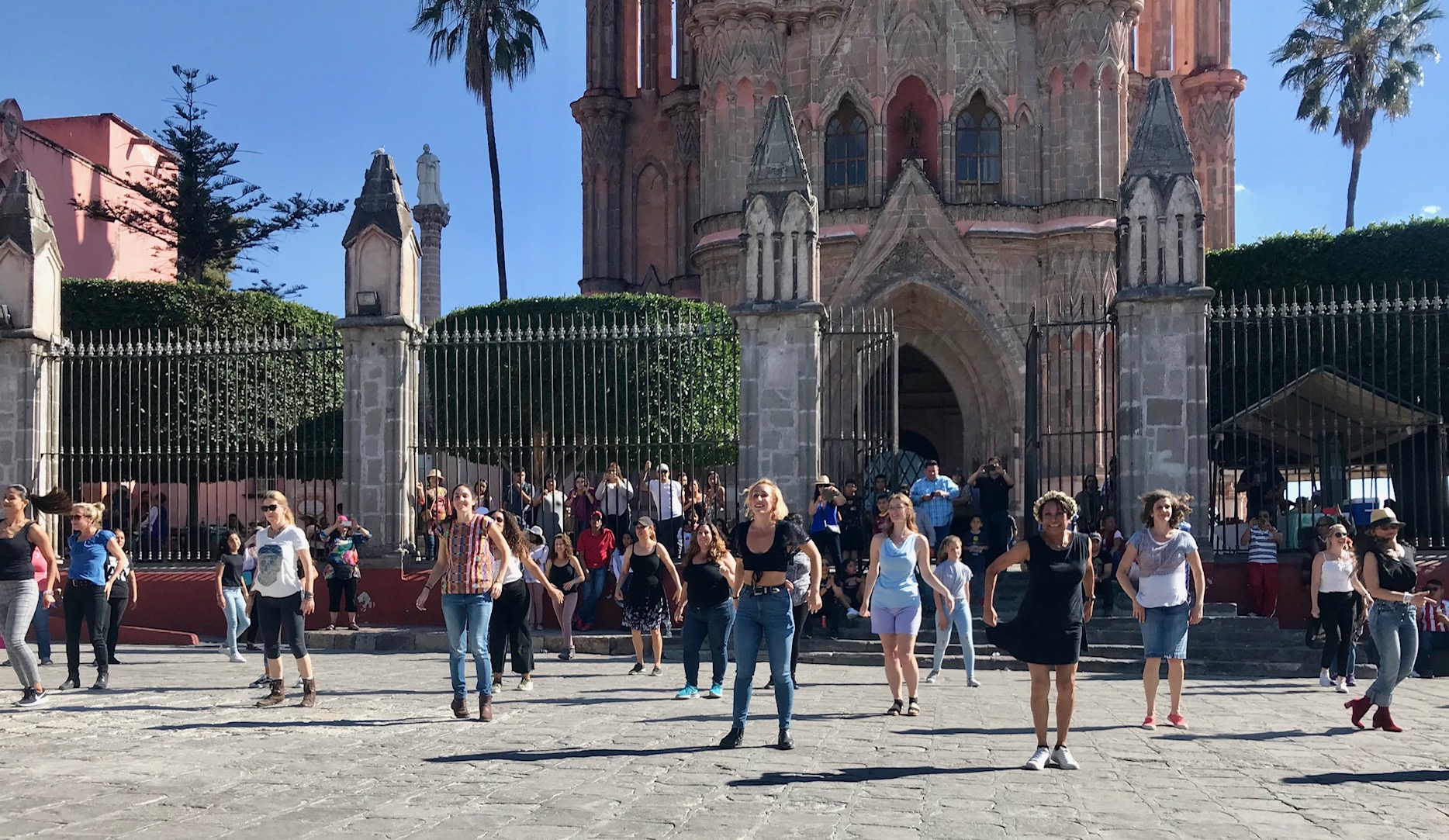
Dancing for the lives of all women

IMG_0705

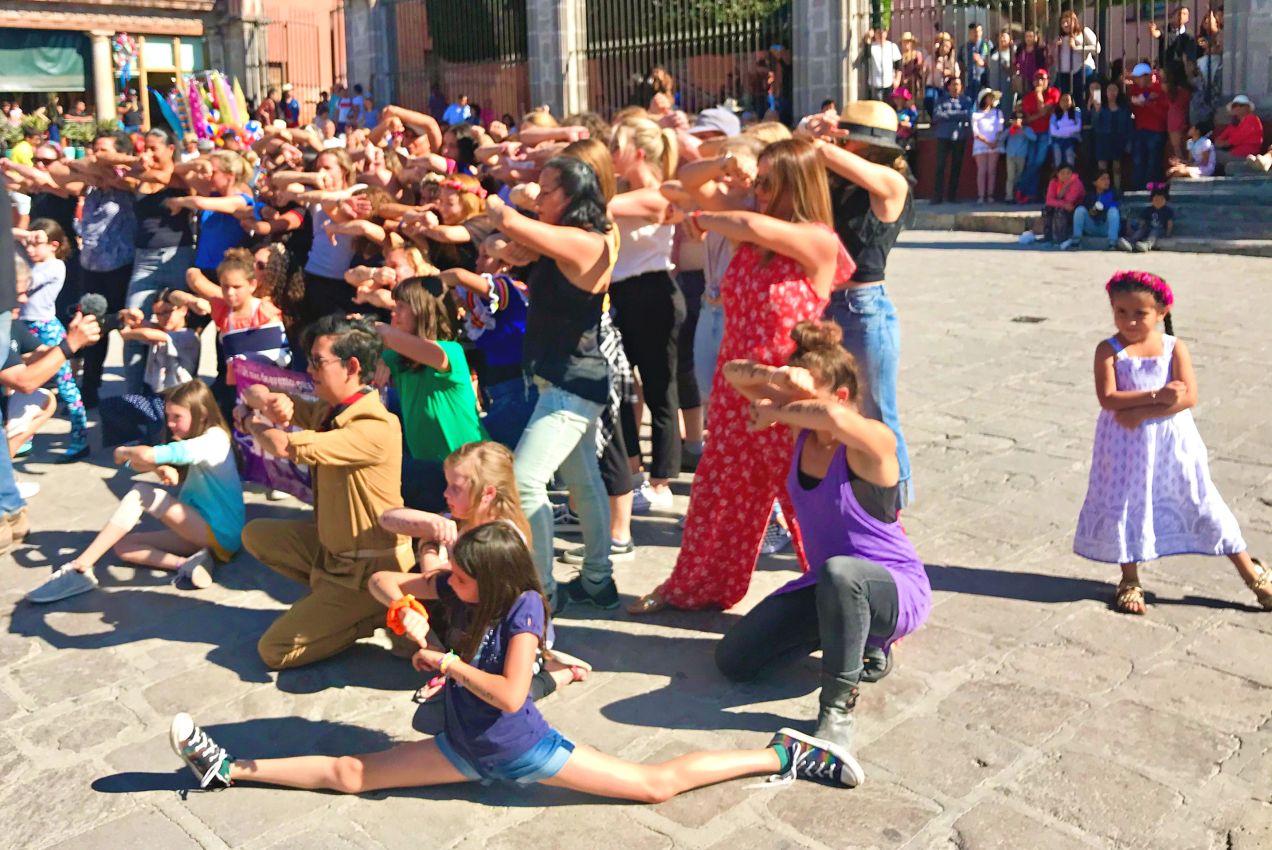
Just before 4 p.m. on a brilliant and blazing Sunday afternoon in San Miguel de Allende the sound of a boombox rose above the usual bustle and cacophony of the Jardin Principal.

As if on cue, the several venders with their bright balloons and bouncing pencils were swept away like neon flotsam and jetsam on the shore.

A lone, tall, leggy blonde in jeans and a black top stepped to center stage and began to dance. She got the attention of the milling crowd. A second woman, all in black, bounded into the open space and the two danced as one. (Full disclosure: Woman No. 2 was my wife, Rose Alcantara.) Continue reading

Standard
#smwc2020, San Miguel de Allende, Writings

In a chaotic world, writers play with the traditional structure of novels

Arbol-Literario-banner-2The recently concluded San Miguel Writers Conference and Literary Festival made one thing pretty clear: Playing with time and structure, in the hands of inventive authors, makes for storytelling that is both challenging and riveting.

The chronological timeline seems so passe, when you add up the considerable success of the featured keynote authors.

Consider: 

Continue reading

Standard
#smwc2020, San Miguel de Allende

Delia Owens explores impact of isolation in ‘Where the Crawdads Sing,’ and discovers millions of friends

IMG_7052 (1)

Hal Wake and author Delia Owens dazzle a sold-out Gran Salon Ballroom at the Hotel Real de Minas during the closing night of the 15th annual San Miguel Writers’ Convention. (Photo by Mary Finley)

Select one of the following:

  1. “Where the Crawdads Sing” is a stunning debut novel about a young girl who grows up alone in a North Carolina swamp with only Nature to nurture her. Her story if folded within a tale of romance and a murder mystery.
  2. “Where the Crawdads Sing” is a science-based allegory about the primal needs of mammals for community and the impact and consequences of growing up outside the socializing influence of the herd.
  3. “Where the Crawdads Sing” is a figment of your imagination because, good lawd dahling, everyone knows crawdads do not sing.
  4. The correct answer is a combination of bits and pieces of A, B, and C.

You said “D”?

Yes, you did. I distinctly heard you say “D” under your breath. Don’t try and wriggle out of it now. You said “D”!

Well, you are correct. Continue reading

Standard
#smwc2020, San Miguel de Allende, Writings

Poet Juan Felipe Herrera: Tell someone today, ‘You have a beautiful voice’

IMG_0213

Poet and author Juan Felipe Herrera reads from one of his 30 published books at the San Miguel Writers’ Conference and Literary Festival #smwc2020 on Saturday, Feb. 15, 2020.

Prologue: Juan Felipe Herrera was Poet Laureate of the United States 2015-17. He is an artist, a teacher, the author of 30 books across all genres, and he plays a mean harmonica.

As a keynote speaker at the 15th annual San Miguel Writers’ Conference and Literary Festival, Herrera put the harmonica to good use. He also introduced plenty of “participatory poetry,” goading on the audience to share the load as he read his poems.

Herrera’s commentary is every bit as poetic as his published works. In fact, it was hard sometimes to see where his beguiling banter ended and a poem began.

Herrera’s life was a rough one from the start. His family traveled up and down California in the migrant labor trucks, from harvest to harvest.  Continue reading

Standard
#smwc2020, San Miguel de Allende

Author Tommy Orange, ever in search of the ‘there,’ plans a sequel

TO-ThereThe title of Tommy Orange’s stunning 2018 debut novel, “There There,” is a fragment of writer Gertrude Stein’s chronically misunderstood quote about her adopted hometown, Oakland.

Stein’s “There is no there there,” was a lament on the changing and disappearing landscape of her childhood community, not a commentary on the cultural desolation of the city.

Orange’s novel explores the disappearing landscape of Native American identity. His 12 characters have deep native heritage but live in the city where reading the highway is more practical than reading the flow of a river. 

The word “pretendian” comes up in the novel. Also, Orange says “urban Indian” is a term used clumsily and far too often in a lot of grant writing.

Orange was a keynote speaker at the 15th annual San Miguel Writer’s Conference & Literary Festival in the somewhat constrained “an interview with” format. Even so, it was a most-dynamic conversation.

While Orange may have felt the need to explore his own heritage within the backdrop of one of the country’s most ethnically diverse cities, the success of his book is rapidly elevating him to the role of spokesman for Native America.

Like it or not, he is being turned to often for his insights and observations.

Even “the Native world has been surprisingly warm to my book,” he acknowledged.  “Wanting novels to do the work of activism is tricky.” Orange knows Oakland and loves his community and is most comfortable writing about it.

But spokesman for Native America? That spotlight is clearly one he enters tentatively.

“Being in front of a lot of people is terrible,” he says with a shy smile. but he would hate it if he “were restricted to talking only about my craft.”

And for sure this night, he wasn’t.

Orange is a registered Cheyenne and Arapaho. His father was from Oklahoma and his caucasian mother was not.

“I love Oakland,” says Orange. Oakland doesn’t get written about much because the New York-based publishing world is narcissistic, “which is why you have 10 million books about New York City.”

“The block I grew up on had seven other kids my age. All were bi-racial, from lower-middle-class families.”

While Orange’s characters struggled with identity, he does not personally share that problem. “My father clearly looks native. It was always clear what we are. I am native and feel that to be true. There was no confusion.”

Clarity, yes, but not without conflict. Orange’s mother came from Evangelical Christian stock, his father of the Native church. “My parents fought constantly,” he says.

Orange started “There There” within weeks of finding out that he was going to be a father. “I started taking everything seriously,” he said. Up to that point, he was doing a lot of personal writing, mostly “experimental and unreadable.”

What’s next for Orange? “I’m following up in the most sell-out way possible, “ he says with a grin. “A sequel”

The rights have already been sold.

The writer Luis Alberto Urrea sometimes worries openly about being perceived as “the border guy” because he writes often and so well about Mexican-U.S. border culture and conflict. I wonder if Tommy Orange will someday be referred to as “the Native American guy.”

For now, he is philosophical. “I was born into a political situation,” says Orange.  “I accept that is a part of my life.”

You can easily sense that  Orange has much to address through his craft, without ever leaving the realm of Native America.

“We have a lot to learn from Native America,” he observes.  There is the Western attitude that land is meant to hold dominion over, versus the Native view of people as caretakers.

Native Americans live in a world of “microaggressions” which Orange can recite in a rapid cascade that leaves him “somewhere between hopeful and feeling doomed.” 

The appropriation of Native imagery for sports mascots is an example. The government oversight of blood-lines and certification of degrees of Indian blood. The bum-tag of alcoholism as a propensity somehow tied to genes or a “stupid enzyme theory.”  

Observes Orange, alcohol is a cheap and readily available commodity to all people facing pain in life, all people under stress and low income.

The painful history runs deep, beyond microaggressions and into raw, horrific violence. The use of rubber bullets, dogs and ice water cannons against natives fighting for their environment at Standing Rock. The Sand Creek Massacre of 1864, in which the U.S. Army murdered as many as 500 Cheyenne and Arapaho, two-thirds being women and children

The frustration, pain, and anger in Orange is palpable. “A lot of people are in a rush to get to the healing state,” he says. “But they still haven’t reached the acknowledging state.” 

“How does that get done?” somebody asks.

“I don’t know,” he says. “It is not up to Native Americans who have been marginalized and oppressed.”

And, “Indian is a word we get to use and anyone who is not, shouldn’t.”

The comments win applause and it makes you wish that Orange had been given an unfettered platform on which to address his own thoughts, rather than constrained by the interview format with nice-guy Canadian Hal Wake at the helm.

Tommy Orange unleashed. Now that is a sequel worth waiting for.

Standard