Where the road begins its descent toward Fanore.A rare house on this part of the pathway.
There are several ways to walk from Doolin to Fanore on the Wild Atlantic Way. I think we picked the longest, toughest, wettest, and most rewarding.
Or maybe it picked us.
Our walk takes us up near the top of Slieve Elva – the highest point in the Burren – with misty views, from the Cliffs of Moher to the ghostly Aran Islands to Galway Bay and the vaguest wisp of Connemara beyond.
That’s Doolin in the distance, the end of the first day hiking the Burren Way.
We’re In the Rock Shop Tea Room, well south of the Cliffs of Moher, an ironic place to begin a five-day hike around the rock-strewn Burren Way. Buying stones to add weight to our backpacks has no appeal but tea and scones do. And, I won’t kid you, it is awfully cold outside.
No need to rush into this thing.
Besides, my stomach needs to settle after riding the 350 Eireann bus along sinuous, snaky, undulating, rolling lanes for two and a half hours – essentially doing in reverse what we will attempt over the next five days.
At our table, we face the Atlantic and Hag’s Head Point as we sip coffee, tea, and scones. Sooner or later, we’ll have to step out the door and step onto the trail.
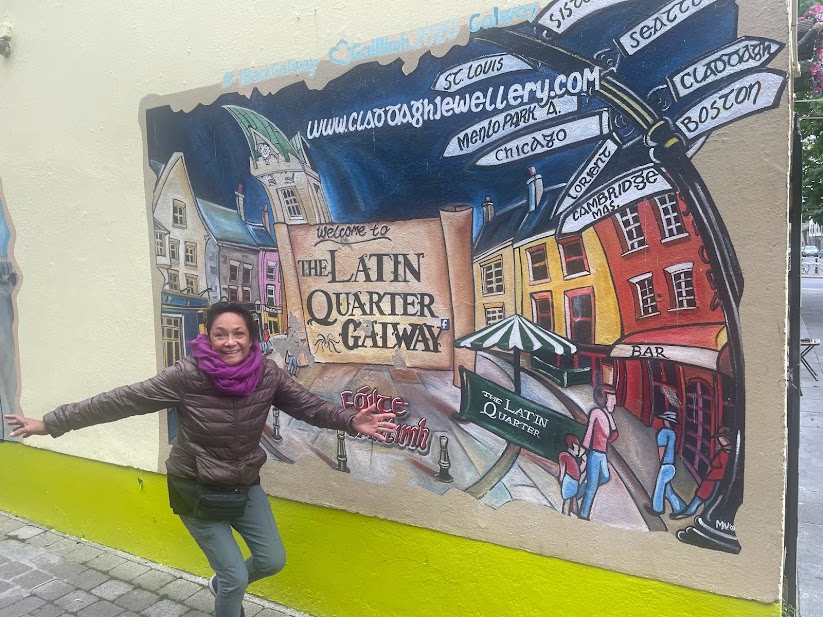
Rose Alcantara finds fresh energy while walking through Galway’s Latin Quarter.
Before you set out to walk The Burren Way in Western Ireland, you are entitled to a bit of self-indulgence. Some good food and drink, some music, some flat terrain to walk, some shopping, perhaps.
Self-indulgence doesn’t get any better than bookending the Burren with Galway and Dublin.
That’s the plan: Live it up in Galway and Dublin, walk it down on The Burren Way.
On the road to Fanore from Doolin on the Wild Atlantic Way, County Clare.
A walking vacation in Ireland was supposed to be a birthday present from Rose Alcantara to me a couple of years ago. We both thought that the idea of a 70-year-old man walking around the Emerald Isle was perfectly sound and a touch romantic.
Albert Sharpe (left) as Darby O’Gill and Jimmy O’Dea at the Leprechaun King — this is the image I was working with as I envisioned walking around Ireland.
You know: a shaggy old gent dressed in tweeds, canvas spats, a carved walking stick, one of those adorable wool caps the sheepherders wear, a small daypack with wine, cheese, and brown bread. Maybe a pipe.
I envisioned gentle green-carpeted trails beside burbling brooks from which I could snag a trout on a fly rod for dinner back at the lodge. There would be castle ruins, steaming beef stew, leprechauns, sheep a plenty, and fey red-headed colleens waving from windows as I walked through quaint and ancient hamlets.
You know what happened. Because it happened to you as much as it happened to us. And it wasn’t banshees, laddie.
I have a subscription to The New Yorker, the print edition. It is the one magazine that I like holding in my hands while reading.
Circling unfamiliar, fanciful, and inventive words is part of my reading habit. Circling whole paragraphs. Underlining brilliant turns of phrase. Highlighting exciting writing. This magazine feeds that habit well. The writing is occasionally above my fighting weight, and I appreciate that.
Every time I read The New Yorker, I come away feeling a little smarter, a little more informed, and definitely motivated to keep writing.
Living in Mexico, the New Yorker can arrive two or three weeks later than it should. More often than not, it is the only thing in my mailbox. Late delivery didn’t matter when the content was less topical. Good writing is good writing and it is timeless. I always valued the New Yorker more for its literary content than for its news.
Even the front-of-the-book calendar on events happening in New York City is entertaining, even when those events occurred several weeks ago. New Yorker writers are like the city — bright, challenging, acerbic, engaging, chatty, witty, savvy and, above all, never dull.
The New Yorker is trying to be more timely and that works against my cross-border mail delivery universe. It is still some of the best writing around but by the time the magazine reaches my hands, the rest of the world has moved on. Now, when I pick up a copy, I find that I’ve read most of the stories online.
I also have a large stack of old New Yorkers that I am reluctant to throw out. It feels like hoarding.
So, I thought, time to switch to an online subscription.
Imagine my surprise, then, when I went online and found that my print subscription expired March 1, 2015.
Is that even possible?
For years, the New Yorker has been arriving faithfully, sometimes two at a time after especially long delivery droughts. And I’ve never once paid my subscription?
For once, I am moved to use two words I despise to describe this moment: existential crisis.
My prized subscription, my only subscription to a printed thing – and I’m what? A glitch in the operation? A bug in the system? A ghost in the machine?
This is a computerized universe. We are a data-driven society. Marketers can tell when your stomach is growling or when you are leaning more Democrat — and swiftly rectify the course of things with ads uniquely chosen for your predicament. To say we are living our authentic lives today means that we are jogging beside a digital stream that knows our every need, predicts our every whim — and responds accordingly.
Usually, an alert arrives well before a subscription expires. Most offer automatic renewal if you choose to take no further action. My online newspaper subscriptions work like that. Convenient, timely, and seamless.
I am not the most conscientious bookkeeper when it comes to my bank accounts. Most times I don’t even think about it. The pension and Social Security come in and the bills get paid. If there is anything left, that is gravy.
I don’t recall an expiration or renewal notice from the New Yorker‘s data grinders. That would have gotten my attention.
Recently, The New Yorker did send me a rejection letter for an essay that I wrote for the magazine’s Shouts & Murmurs section. I sent it in about six months ago and they did warn me that the backlog was horrific. (Ie: “Don’t hold your breath.”)
It was my first New Yorker rejection and didn’t hurt nearly as much as I thought it might. It wasn’t even an, um, existential crisis.
I actually felt at the time that the humor in my essay was more topically in tune with David Egger’s McSweeney’s magazine. I had a momentary dream of submitting to both, having both simultaneously accept the article, setting off a fierce bidding war that resulted in publicity to all the right people and a three-book publishing contract with an embarrassingly frothy advance.
Instead, I thought, let’s give the New Yorker a chance. It was, after all, my first love, in a literary sense.
So, months after submitting, and forgetting like a furtive one-night stand, I found out that I wasn’t ghosted. I was rejected.
In fact, it felt pretty good. How many people can say they got turned down by The New Yorker?
Real answer: Lots. And often.
Getting published follows the same rules as winning the lottery. You have to buy a ticket to win. And most likely, you’ll need to buy lots and lots of tickets before you get a winner.
Many writers are rejected dozens of times before a submission is accepted for publication. The magazine is that good. Cartoonists have it even worse. They can be rejected 30 or 50 times before making it into the magazine, although I believe the cartoon department is set up to more quickly reject a submission than other sections of the magazine.
I don’t really think I’m New Yorker material as a writer but you never know.
The trouble is, I’m in the Grandma Moses phase of my literary life. (Look it up, kids.) I don’t know how much is left in the tank and how much of it is worthy of rejection by prestige publications.
By now you might be thinking, “This is all well and good, Bob, but I think you are avoiding the existential crisis that initiated this essay.”
And you are right.
And I don’t know what to do.
I feel like I should submit this to “The Ethicist” column in the Sunday New York Times.
But wait. I’d better check and see if my NYT subscription is up to date.
Street scene in San Miguel de Allende. The guitarist paused on his way to work to pick up a snack from the street merchant, who clearly has her hands full. This has nothing to do with my story, except that both occurred on the magical streets of San Miguel in the same week.
To the man whom I almost knocked over rounding the corner of Nemesio Diez and De Los Suspiros, thank you for reviving my interest in a novel that I put down many decades ago but never forgot its influence.
Early Tuesday evening, Moppit and I were walking on Nemesio Diez, past the public parking lot at the corner, heading for home at a brisk pace. Brisk for an old man and a dog with very short legs.
As we reached the corner of Suspiros, a man walking at about the same pace nearly collided with us. Or we nearly collided with him.
A good friend invited me to spend a Sunday in Balboa Park with a Buddhist monk named Thich Nhat Hanh. I knew very little of him but Sundays in September in San Diego can be glorious and there are few better places than the park for them.
I think it was promoted as a Day of Mindfulness, another subject about which I knew very little.
The day was pretty much a total immersion. We were blissfully adrift in a gentle sea of brown-robed Buddhist monks and nuns. There were dharma talks and long periods of meditation. Some were led by Thay in his soft, barely audible whisper of a voice. Some were led by his followers.
On a crisp Friday morning, bells peel, pigeons swoop and dive and disappear and return to encircle the spires of the Parroquia de Arc Angel Michael with a feathery halo, in San Miguel de Allende.
Robert J. Hawkins, U.S.M.C. medical corpsman in World War II
The machine-gun fire came out of nowhere, the way it is supposed to in war.
Or so it seemed to the Marines who were caught in an open field next to a presumably abandoned farmhouse. Incorrectly presumed empty, as it turned out.
The carelessness cost the platoon one soldier. He lay on the ground about 10 yards away from the stone wall behind which his comrades took refuge.
He was still alive. They could hear his agonizing cries for help. They could see him, lying there out in the open.
The squad’s 19-year-old medical corpsman had already seen his share of death and savage injuries since their battalion had waded ashore on the island of Saipan. And now, more of the same on the neighboring island of Tinian.
During the initial bloody assault on Saipan, the corpsman was encountering a dead or wounded Marine every 10 yards or so, by his estimate. This made his progress slower than the other Marines. They relentlessly pushed the enemy to the other side of the island and the sea, leaving a trail of dead and wounded for the corpsman to sort out.
He’d already taken grenade fragments in his hand, leg, and shoulder — for which he’d eventually get the Purple Heart.
When I walk the cobblestone streets of San Miguel de Allende, usually early mornings with Moppit the philosopher dog, I find things.
It is not that I am scouring between the cracks and crannies. It is just that cobblestones can be treacherous and if you are not attentive to your footsteps, well, you can fall.
There is a joke about the number of ex-pats who walk around this hilly town with canes — but I forget how it goes.
Cobblestone streets are the tide pools of very old cities. They tend to trap small and delicate things in the spaces between rocks, much the same way that tide pools trap small fish, snails, squid and pirates’s treasure. Especially after it rains.













 Musings, Magic, San Miguel and More