Rabbi Daniel Huebner of Chabad San Miguel de Allende lights the first candle on the community menorah on Sunday evening in Parque Juarez. A lit candle will be added on each of the following seven nights for the Chanukah celebration.
Happy Chanukah, my friends. Or Hanukkah.
Sunday night was the first night of Chanukah — the Festival of Lights — and the lighting of the first candle of the menorah. The Chanukah celebration is observed for eight nights and days, with a new candle being lit each evening.
I know all this because I was walking Moppit in Parque Juarez when I happened upon members of Chabad San Miguel de Allende lighting the community menorah in the park’s gazebo.
I missed most of the dedication, but I happened upon the gathering just as Rabbi Daniel Huebner was explaining the significance of this year’s menorah, created by artist Meila Penn.
Robert J. Hawkins, U.S.M.C. medical corpsman in World War II
The machine-gun fire came out of nowhere, the way it is supposed to in war.
Or so it seemed to the Marines who were caught in an open field next to a presumably abandoned farmhouse. Incorrectly presumed empty, as it turned out.
The carelessness cost the platoon one soldier. He lay on the ground about 10 yards away from the stone wall behind which his comrades took refuge.
He was still alive. They could hear his agonizing cries for help. They could see him, lying there out in the open.
The squad’s 19-year-old medical corpsman had already seen his share of death and savage injuries since their battalion had waded ashore on the island of Saipan. And now, more of the same on the neighboring island of Tinian.
During the initial bloody assault on Saipan, the corpsman was encountering a dead or wounded Marine every 10 yards or so, by his estimate. This made his progress slower than the other Marines. They relentlessly pushed the enemy to the other side of the island and the sea, leaving a trail of dead and wounded for the corpsman to sort out.
He’d already taken grenade fragments in his hand, leg, and shoulder — for which he’d eventually get the Purple Heart.
It’s like something out of a Disney/Pixar movie where a once-beloved and cuddled family Bug grows old as the family grows up and is eventually abandoned in the Shed of Lost Car Souls where it withers, rusts, and decays for decades until the troubled teenage grandson discovers the car and with loving assistance from grandpa restores the Bug, restores his own self-confidence, and restores grandpa’s long-lost memories as he regales his grandson with tales of family road trips and adventures in this very same car — and in the end, grandpa and grandson trundle down the road in their magnificently restored Bug on the Mexican road trip of their lives.
Traffic finally emptied on the Ancha at 8 p.m. Monday and down the broad street, and out from the Rosewood resort, streamed hundreds of Catrinas, Catrinos, ghouls, skeletons, and even an underworld creature or two.
And they came on fast — as if all the pent-up energy from last year’s cancelled parade was unleashed atop this year’s and resulted in a headlong rush to the finish.
The crowd where Nemiseo Diaz meets the Ancha was so thick and eager that costumed paraders had to run a tight gauntlet, elbowing their way to the merger point.
It wasn’t so much a parade as a fast jog of the living dead in glorious technicolour and fabulous costumes. They marched, they merged, they posed for pictures, they trundled up Zacaterous, turned onto Canal and cascaded into the Plaza Principal where the crush of Catrinas and onlookers must have been something else.
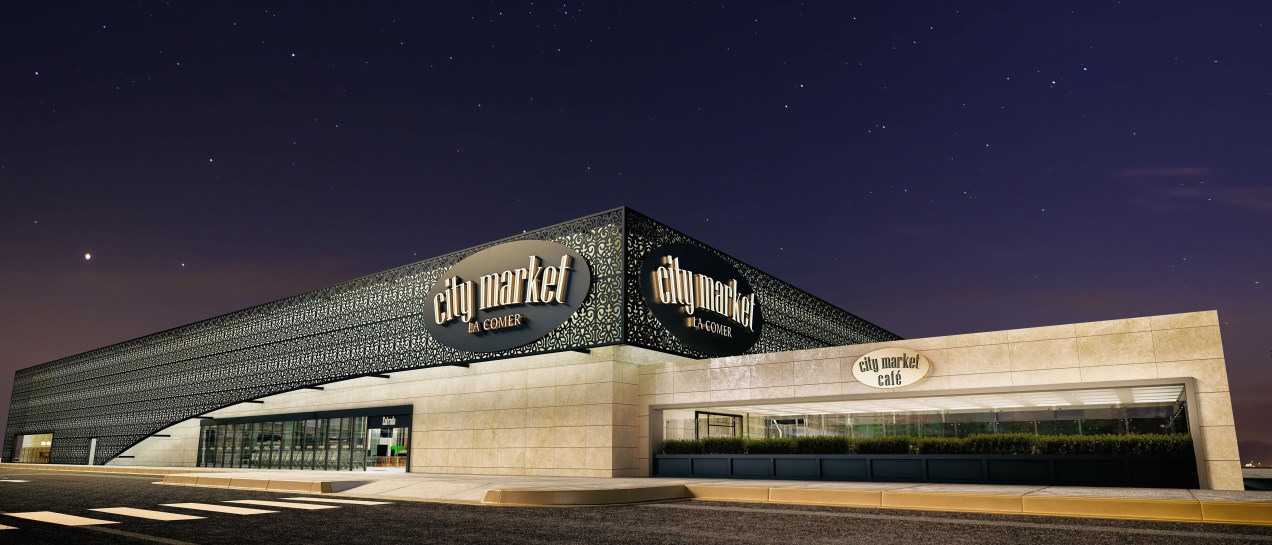
Plus: The 10 Commandments for successfully shooting City Market
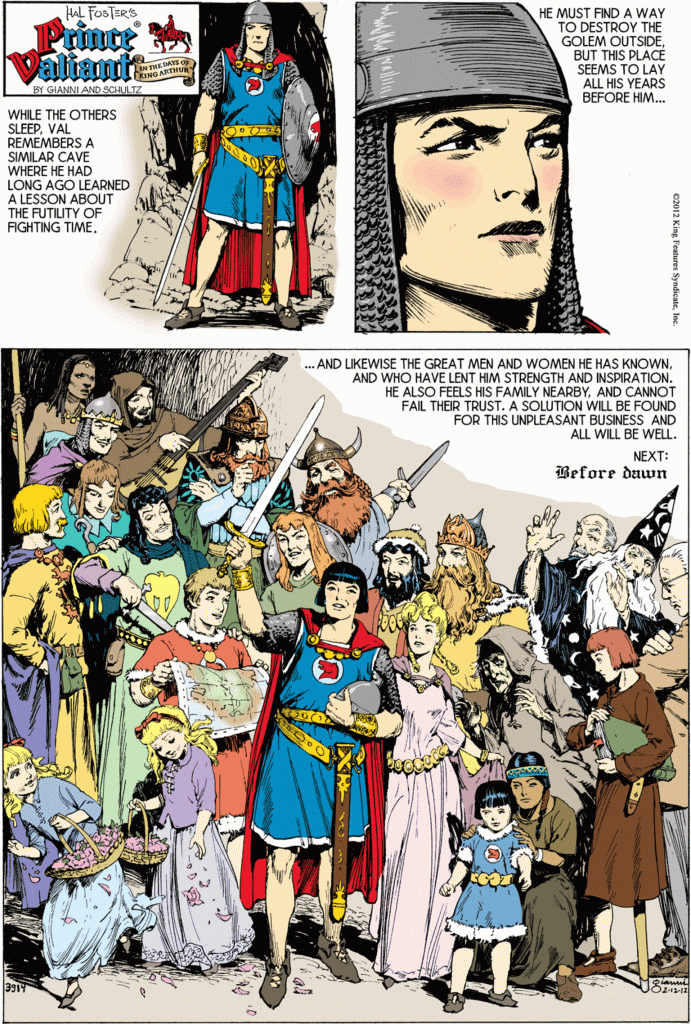
Also, how Prince Valiant’s graphic art layoutcan help tell your story
Congratulations, San Miguel Facebookeers! You are creating a new photography genre — City Market Art. Your orgasmic uploading of scores of images from the newly opened high-end supermarket “experience” has been a visual feast worthy of the artfully displayed departments of bread, fish, wine, vegetables, chocolates, and meats.
This is commercial exhibitionism at its finest.
Because you are all so good — and prolific — I am proud to announce the first-ever open invitational online gallery of the year’s best City Market images. I will create a gallery page for your very best images and keep posting new ones through the end of the year.
By which time we should all feel we’ve fairly well exhausted the subject …
Don’t let your best images languish on a single Facebook post, only to disappear in the relentless and voracious feed cycle. Let me offer you a slice of immortality!
Send images to robertj.hawkins2012@gmail.com — and be sure to include your name (for credit) and a little something about each image. Sorry, this is all for the glory. There is no compensation, honorarium, prizes, or lecture chairs to be gained. The images remain yours and yours alone. I promise to put your name in bold face type.
They will be lovingly posted and curated in the order in which they arrive, on a timely basis.
Be selective. Send your favorites. Volume is not art. And I am only one guy. Send a few at a time, or only the one you really really like!
Be creative. Edit. Photoshop. Play with images. Create compositions. Express yourself through your images. Be irreverent. Be ironic. Be playful. Make a statement. Have some fun. Get serious. Make art. Make commerce.
Maybe there will be artistic or psycho-sociological revelations to be had by the end of the year. Who knows until we try, eh?
City Market Photo Galleria will open when enough images arrive. It will only take a few to launch
Meanwhile …
The 10 Commandments — urgent suggestions, mostly — for getting the best out of your City Market photo shoot.
Pro-tips for the several thousand San Miguelians photographing the new City Market with your cell phones and posting on Facebook:
1. Occasionally incorporate foreground objects for perspective.
2. Compose your picture within the frame before you shoot. Crop before you publish.
3. Create a composition that tells a story: Isolate your subject — say, the wine cellar, or the chocolatier, or the fish monger’s. Then compose three shots — a closeup (detail), a middle-ground, and a panoramic. (Think of the “Prince Valiant” Sunday comics spread. See some examples at the bottom of the page.).
4. Vary the perspective — sometimes you need to get down on one knee or raise the camera above your head, or get your nose into that school of sea bass swimming in a bed of ice. Don’t always shoot straight down into the cold shrimp.
5. Look for interesting patterns, artful combinations, playful images. City Market begs you to be ironic.
6. Volume is information but it is not art.
7. It is not all food porn, but it doesn’t hurt to “think sexy” when you shoot. City Market is commercial exhibitionism at its best. Roll with it.
8. Your cell phone has amazing photo editing capabilities. Yes, yours. Sit down and order a coffee and play with your pictures before posting.
9. Put people into your images. So far, most images have looked like the store is a lovely sexy empty mausoleum.
10. Keep those photos coming!
And here’s some old Prince Valiant Sunday comics that I promise. Harold Foster was famous for using the three visual elements — closeup/detail, middle ground, and panoramic — to tell a whole story in one page. Newspaper photographers have used that same technique for decades.
When I walk the cobblestone streets of San Miguel de Allende, usually early mornings with Moppit the philosopher dog, I find things.
It is not that I am scouring between the cracks and crannies. It is just that cobblestones can be treacherous and if you are not attentive to your footsteps, well, you can fall.
There is a joke about the number of ex-pats who walk around this hilly town with canes — but I forget how it goes.
Cobblestone streets are the tide pools of very old cities. They tend to trap small and delicate things in the spaces between rocks, much the same way that tide pools trap small fish, snails, squid and pirates’s treasure. Especially after it rains.
It is clear to me that the single greatest invention of our civilization has been the wooden toast tongs.
Since the time of Medieval toasters, this device has safely extracted piping hot slabs of bread. Perhaps even earlier, if certain Egyptian hieroglyphics are to be interpreted correctly.
Suspected fact: Leonardo da Vinci may have invented the wooden toast tongs before there were electric toasters, once again anticipating the needs and aspirations of future generations.
Toast tongs made it possible for countless writers and poets through time to sit at their humble desks and create, undistracted by the burning sensation on their fingertips that a tong-less household brings.
In better times, Prose Cafe is a gathering of writers and others (mostly other writers, I think) in the beautiful Belles Artes. Three or four writers would each read something and take questions. I always found the cafe sessions inspirational. I imagined myself — some day, not right away — being just like them, having something of worth to share with other writers.
These days, Prose Cafe and its sister gathering, Poetry Cafe, are ZOOM affairs. They are both the offspring of the San Miguel Literary Sala whose wonderful Writers Conference is currently underway — on ZOOM, of course.
I shared the ZOOM space on Thursday, Dec. 3 with two accomplished authors, Molly Giles and Fredrika Sprengle. Both have published works — award-winning books, short stories. I have nearly four decades of newspaper clippings. A good mix, as it turned out. We all leaven our prose (and pain?) with humor.
What follows is the story that I read. As I told the ZOOM audience, this is a work of fiction, except for the parts that are true. (You figure it out).
It is one of a number of short stories in the file marked “Seminary Life” that may yet grow into a full-sized novel.
Declaring war on … well, everybody
It was the beginning of the end — the end of my days as a Catholic seminarian. It came the moment I picked up that heavy metal bucket full of dirty water and heaved it out the third floor window. Sending a loud and long string of curses cascading after it.
Back in the day — before Uber & Lyft, before Google street maps, before the Internet — there was a thing known as The Thomas Guide. It was a spiral-bound book of maps and street indexes for many of the major West Coast cities in the U.S.
It was a godsend for journalists and taxicab drivers alike.
Toronto had a similar book, as I discovered one night when I arrived to cover the Toronto Film Festival for my California newspaper.
“Where to, eh?
“Sutton Place,please.”
“Good, good. Is that cab in front of us going there, too?”
“No, they’re going to another hotel.”
“Good, good. OK. Sutton Place. That’s not far. Do you know where it is?”
“No. Don’t you?”
“Yeah. Well, no. Well, sort of. I usually work the West End. Don’t get up here that much.”
“Um … Bay Street. I think it is on Bay Street.”
“Bay Street? Good. Good. Bay Street. Bay Street. Right you are.”
“I think it is a main thoroughfare here. North and south.Turn here on University. You’re bound to cross it.”
“OK. Yeah. Right you are. Here, look in this book, page four. Got to be on page four or near it. Look on four.”
“There’s no map on four.”
“What do you mean? No! Index. Look at the index. You read; I’ll drive.”
“I can’t find a map. Look here, there’s Bay Street! If you turn here, we ought to find Sutton Place.”
“I can’t turn. See the sign? It says ‘No left turn.’ You really ought to learn how to read that book. You can get anywhere with in this city with that book, you can. Ah, I’ll turn anyway.”
“Why do I need to read this book? I’ll be leaving Toronto in two days. You live here. You learn it.”
“Sure, but what if you come back? You really ought to learn.”
“You ought to learn. You live here, you drive the cab!”
“Right you are!”
“Look, there’s the Sutton. Just drop me off behind that car.”
“Right! The old Sutton! There you are! I got you here, didn’t I? You really ought to get one of these books. Invaluable! Fare’s $4.25. Told you I’d get you here. Well, have a good evening then.”
Pocket-sized transistor radios were probably one of the first great subversive technologies. And smuggling one into a culturally hermetic community could spark a revolution.
That’s what happened when rock ‘n’ roll invaded the cloistered walls of my seminary.
Thank God.
As an eighth-grader I felt God was calling me to the priesthood. Two years later I realized that he had dialed a wrong number and I had, regrettably, answered.
I went all in: a missionary order whose Latin name translated to Society of the Divine Word (SVD). The order had a very gothic looking building about 20 miles south of Erie, Pa., where they educated their high school recruits.




 Musings, Magic, San Miguel and More