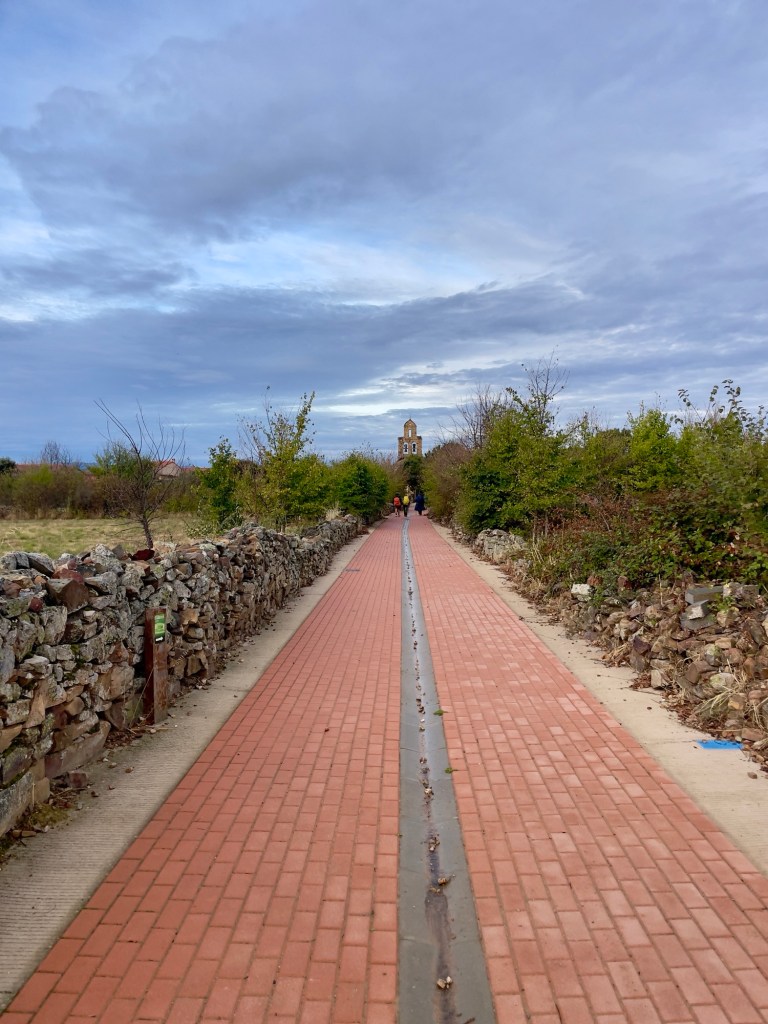
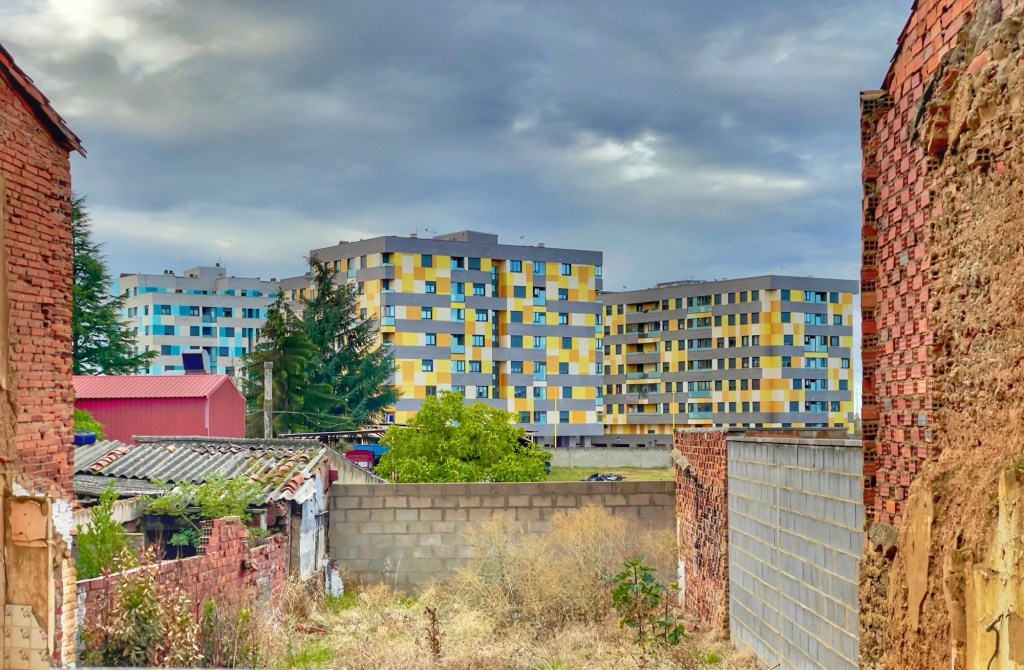
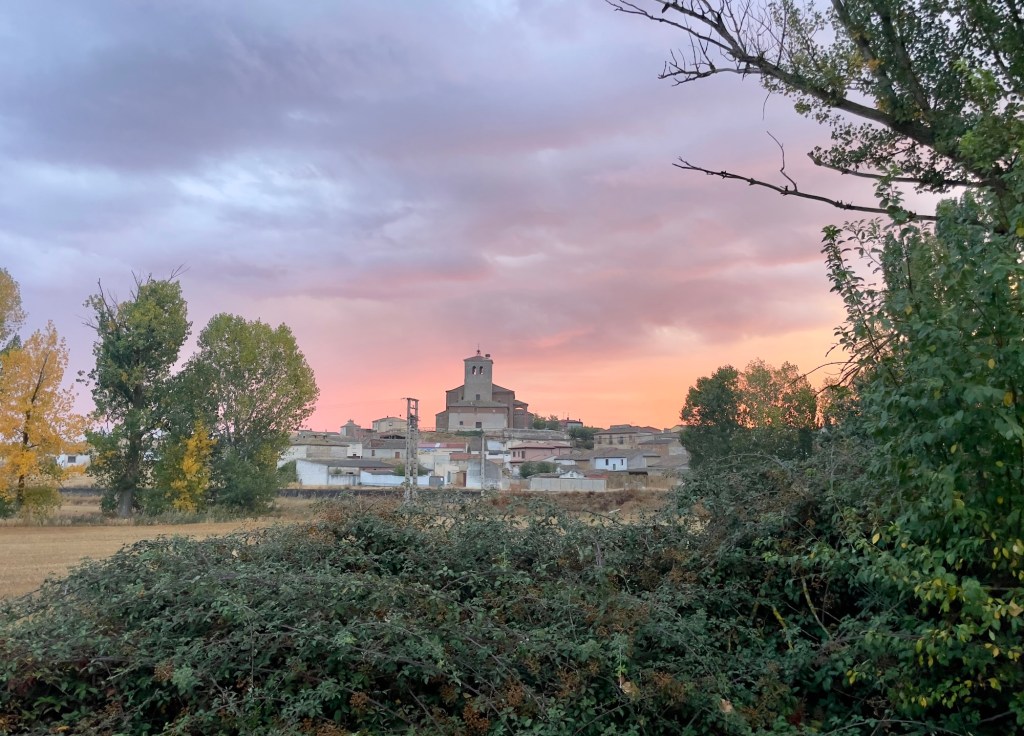
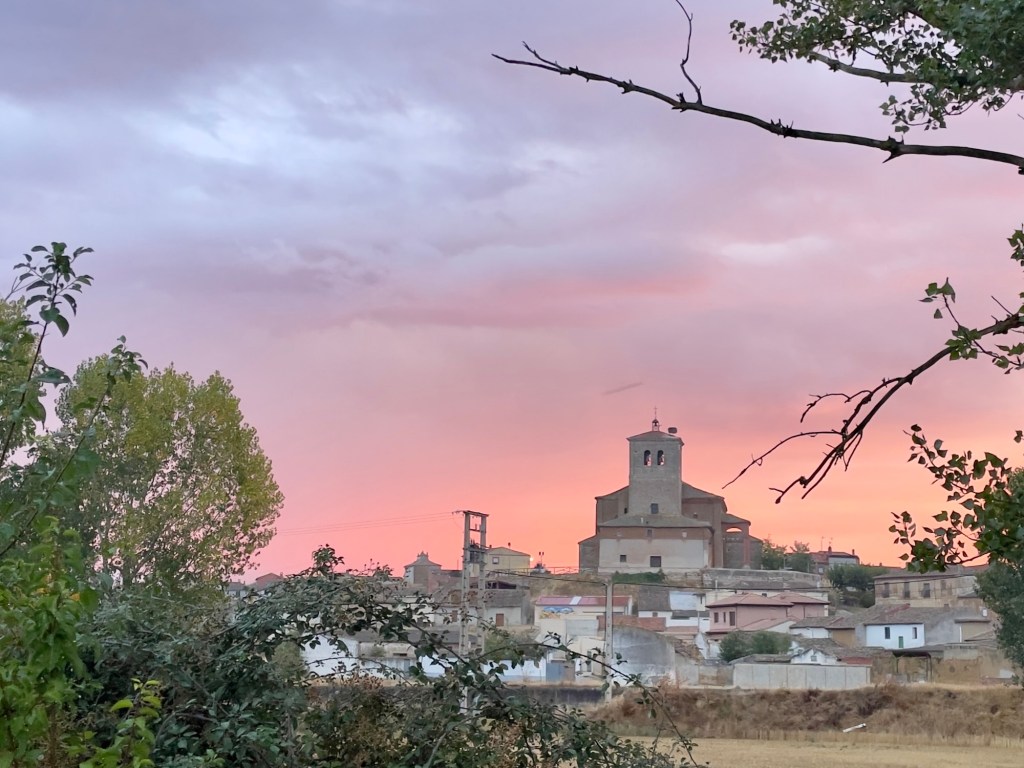
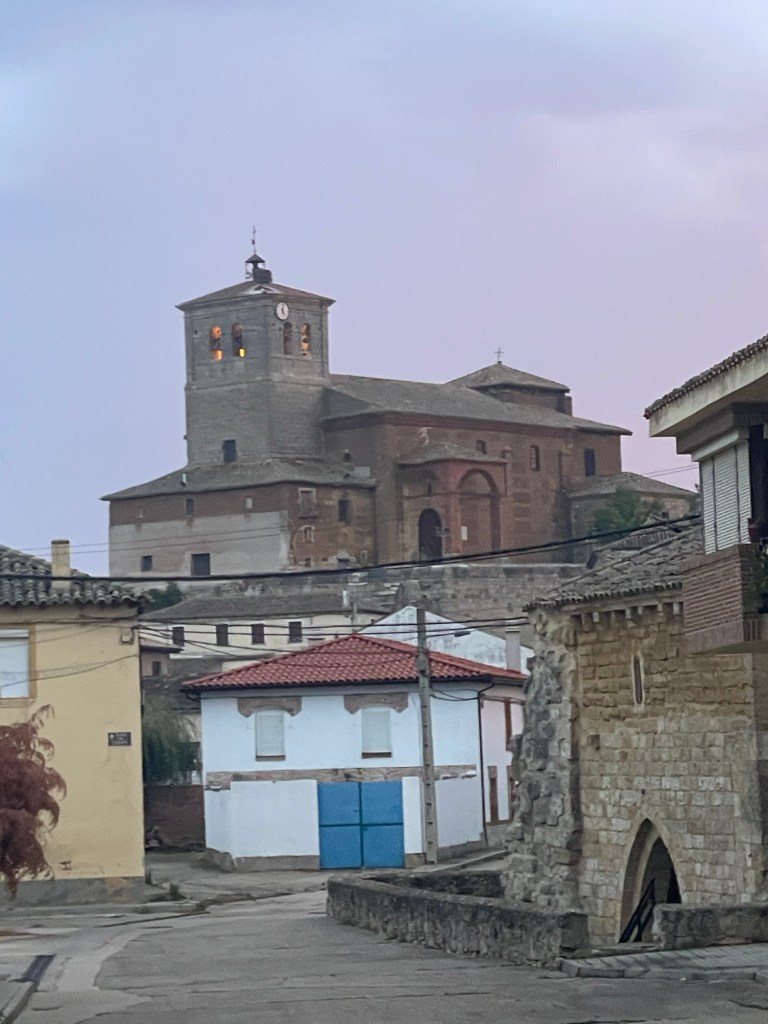
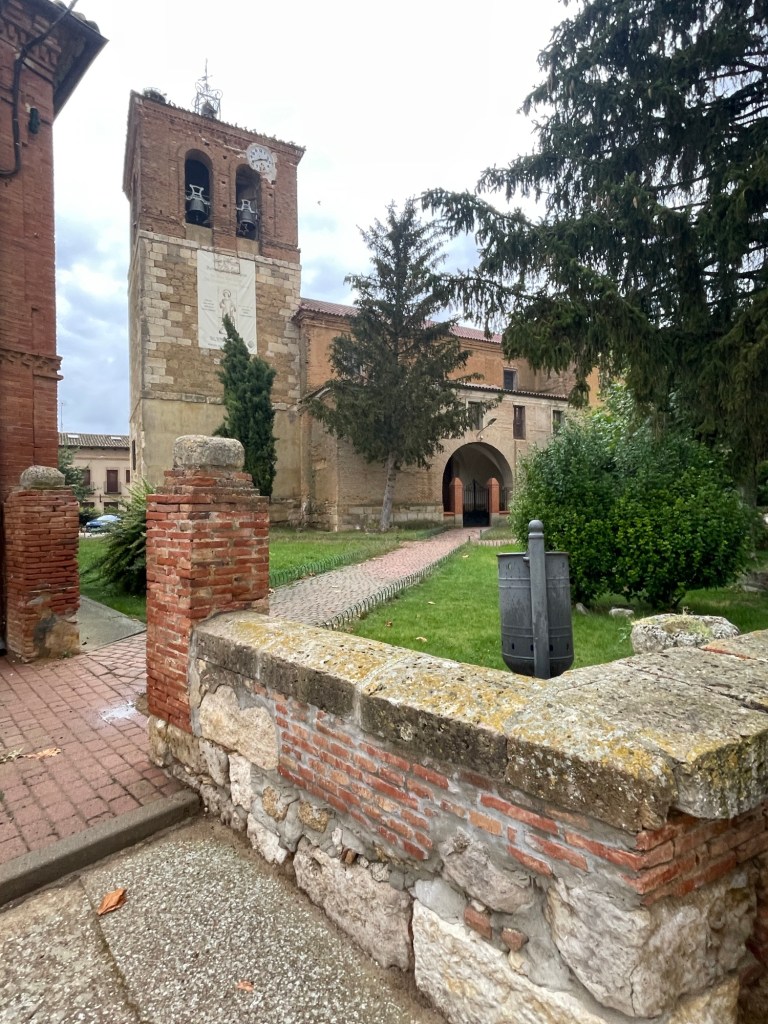
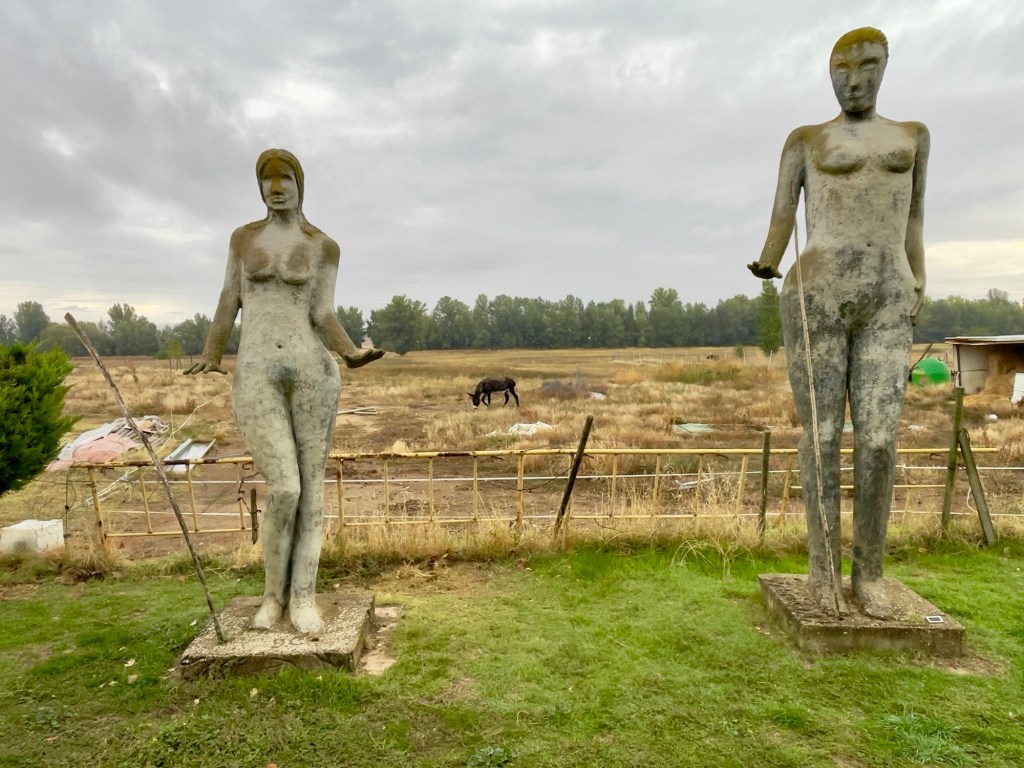
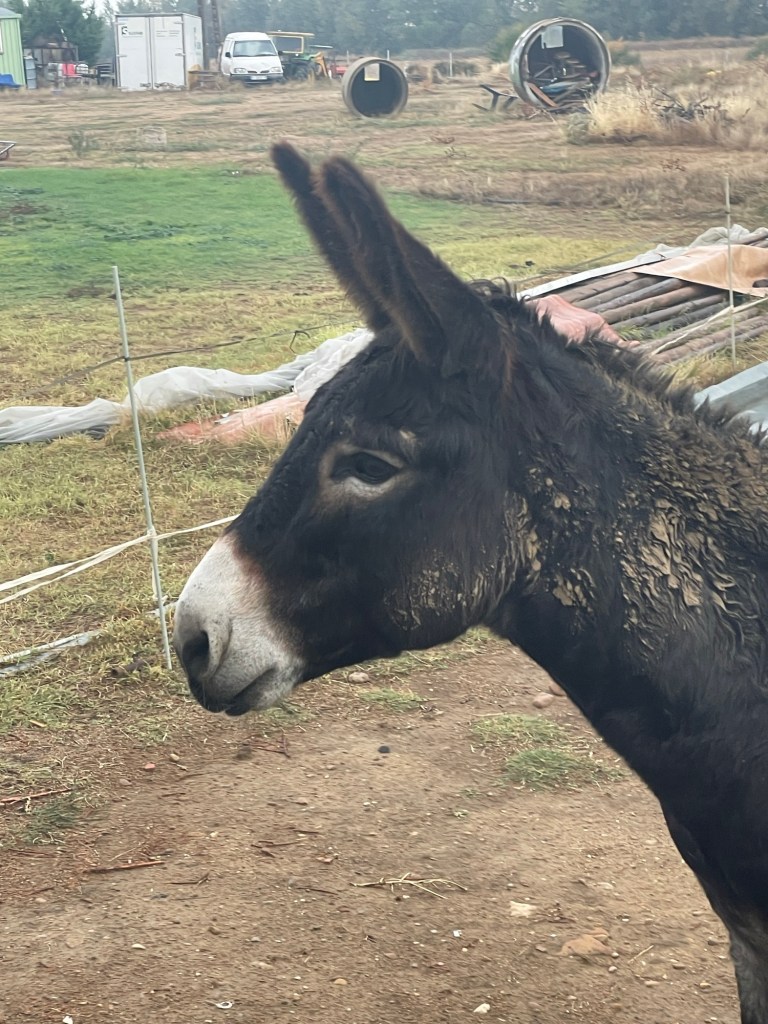
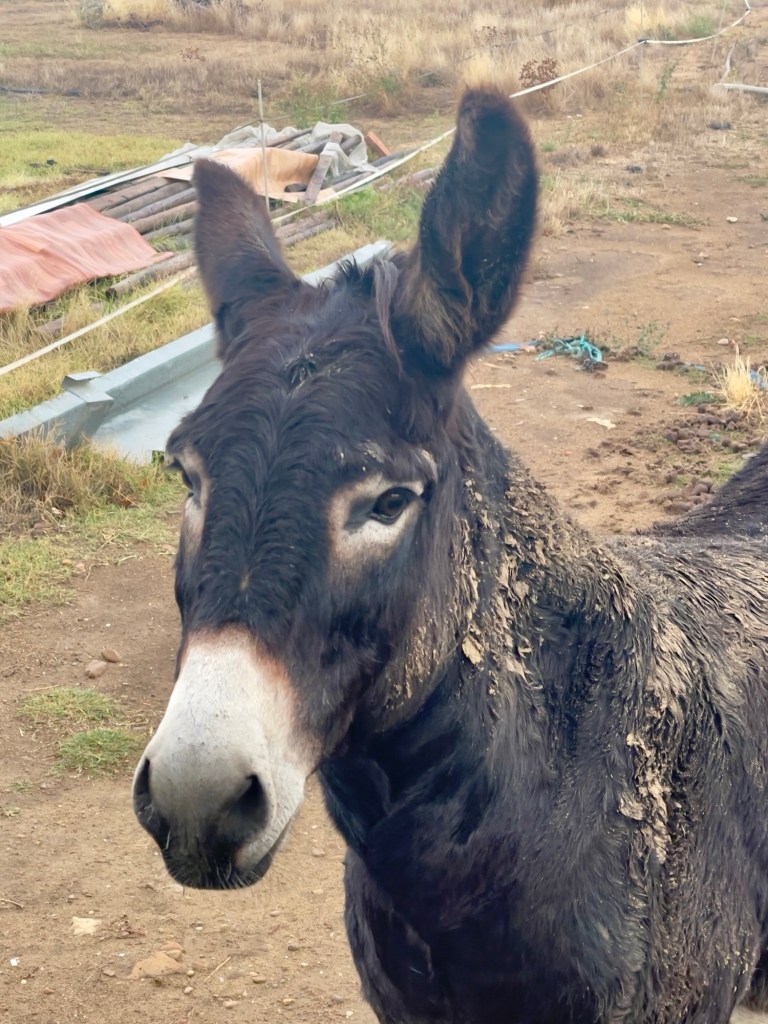
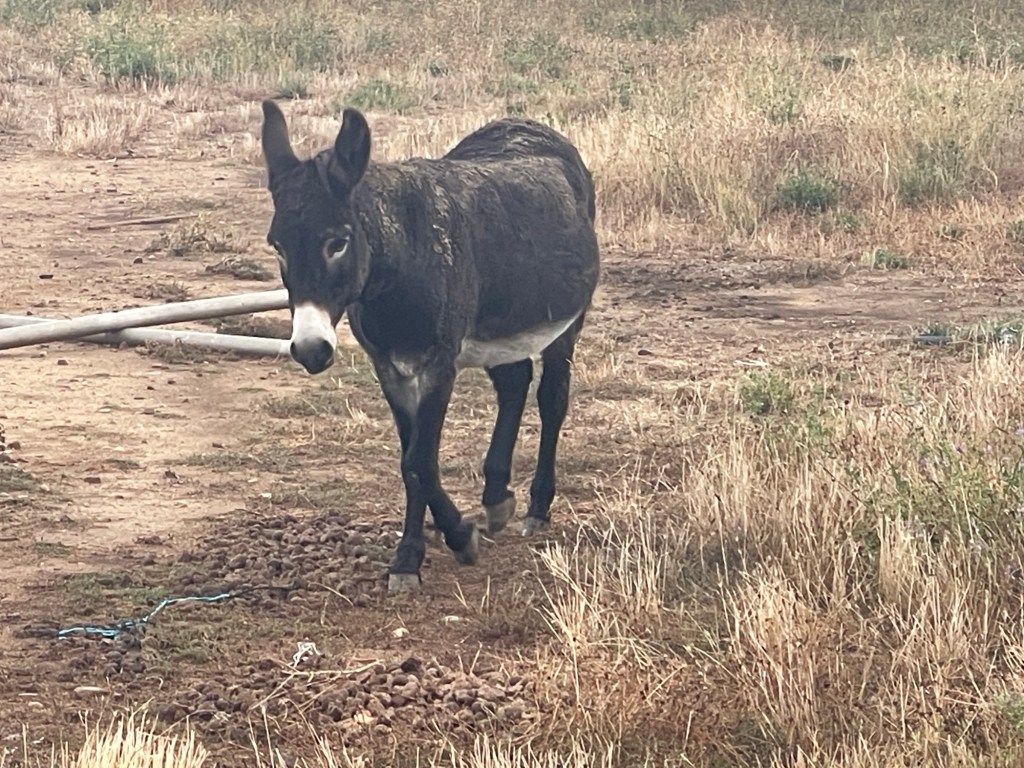
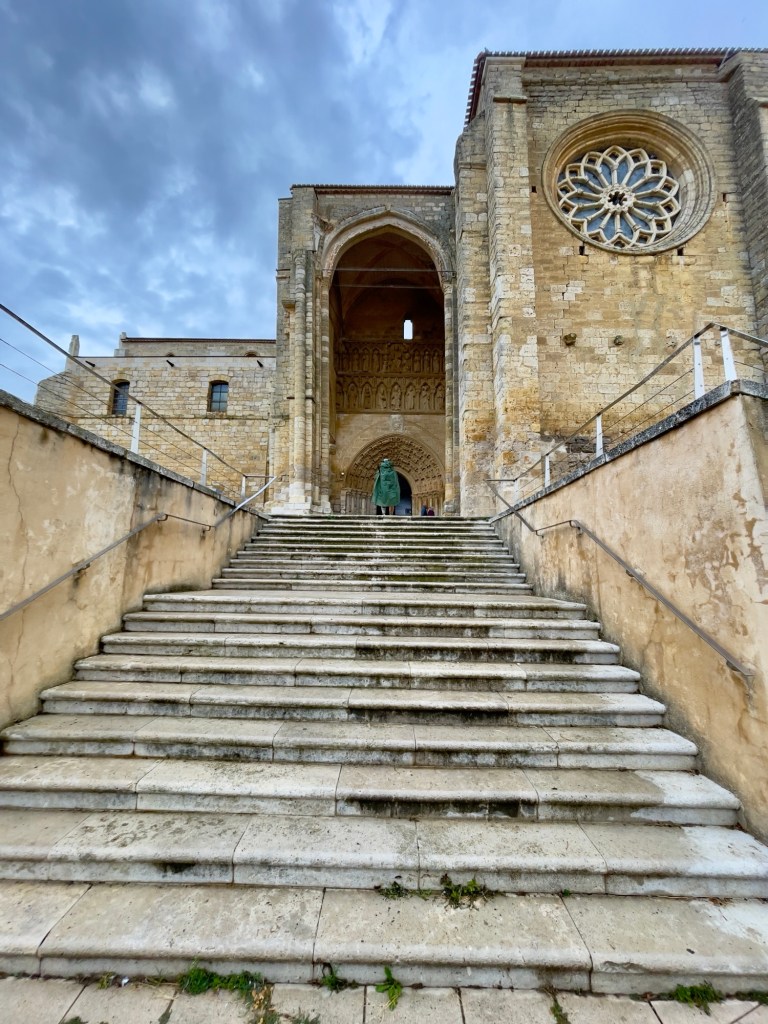
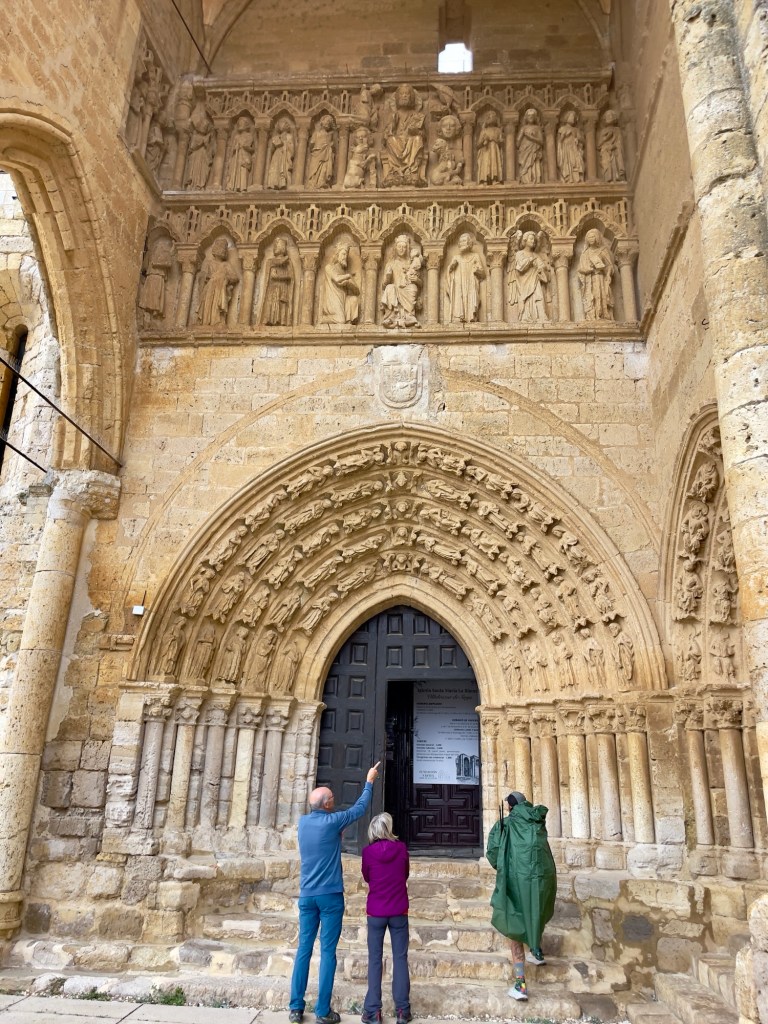
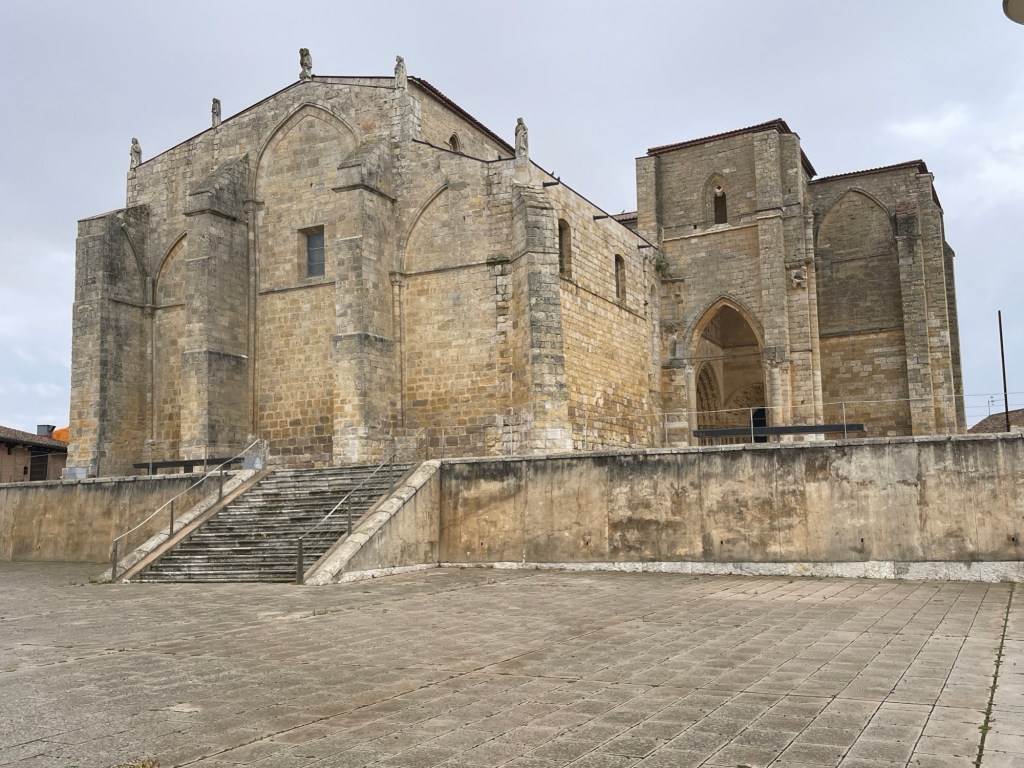
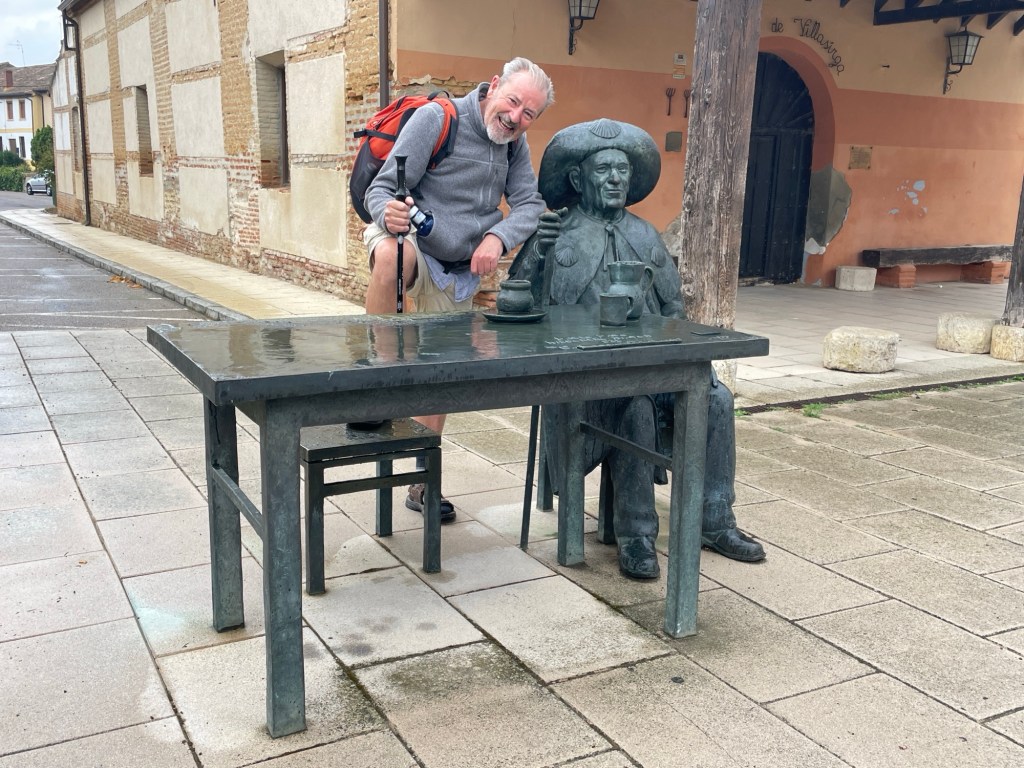
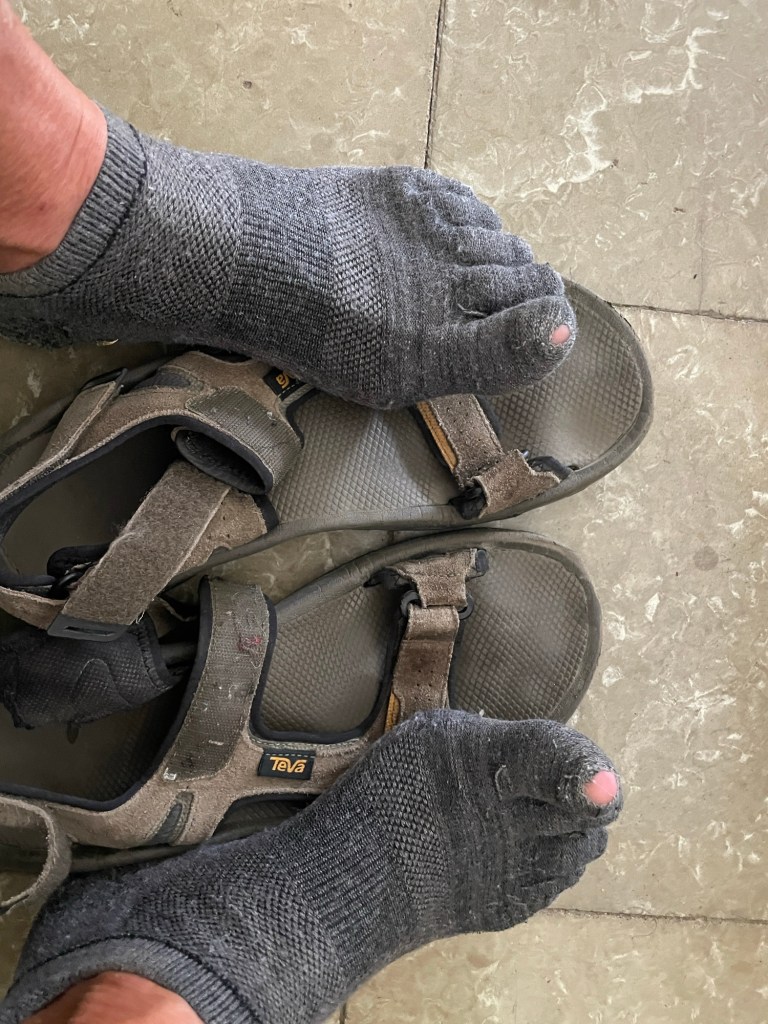
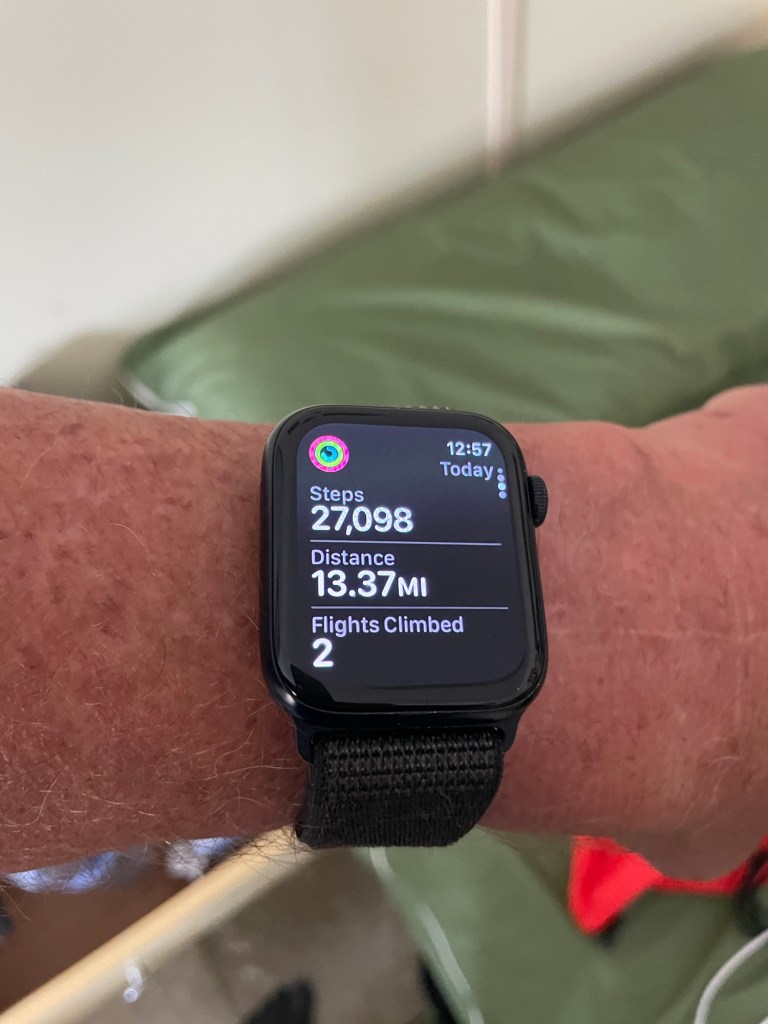
The entrance to the village of Santa Catalina. Hard to bypass this one.
Gone are the wide open fields of harvested wheat, straw, corn and sunflowers. Gone are the gently rolling hills. Gone are the treeless expanses that seemed to stretch into eternity.
Now the hills are aggressively challenging. The groomed pathways have given was to rocky trails. The landscape is densely forested. Serious mountain ranges are on the horizon. Stone fences and houses have changed from rounded rocks to neatly laid and hewn slate.
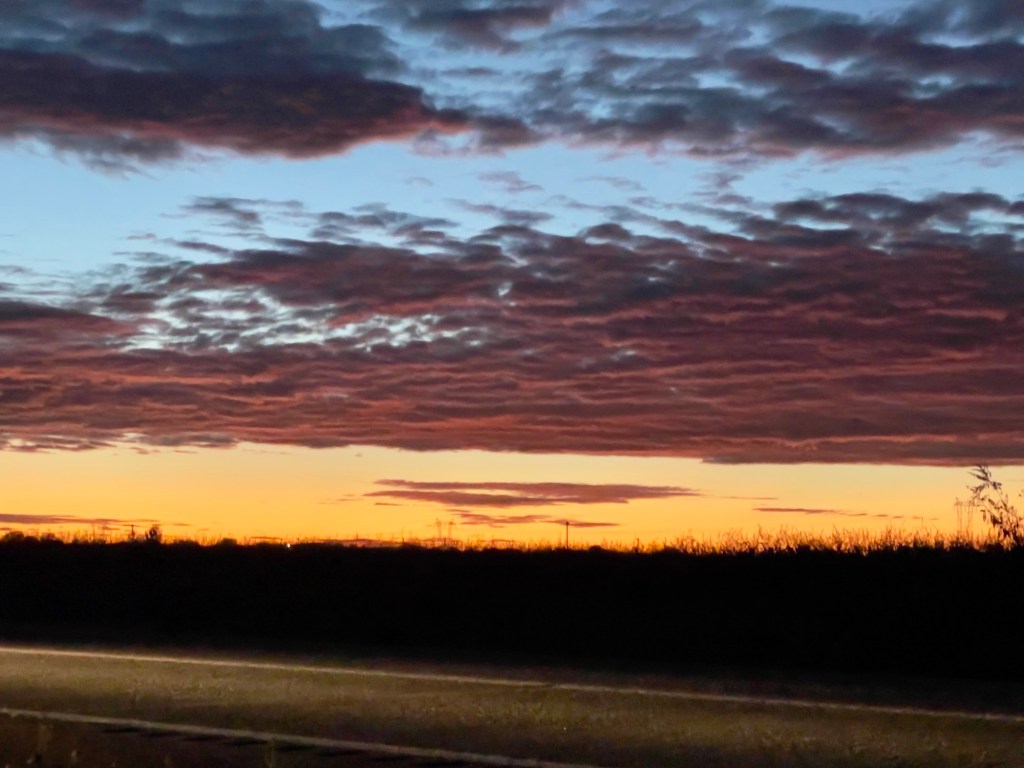
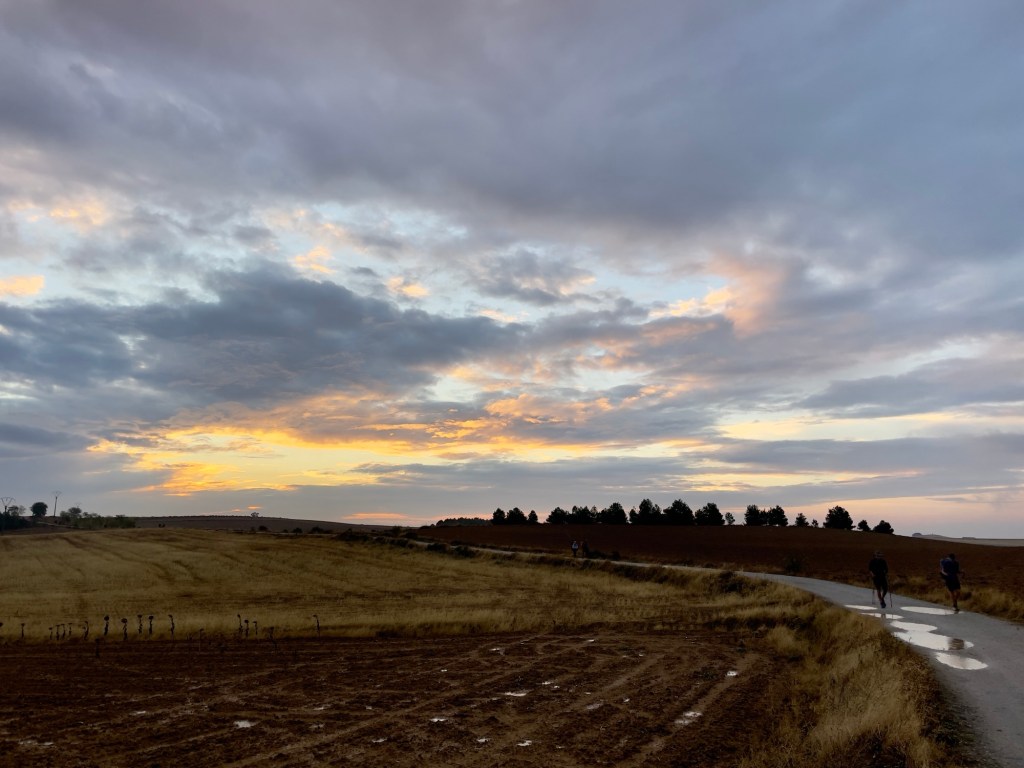
It pays to look back. The sunrise was glorious this morning and the light spread magic through the landscape. (More morning shots below.)
Just after Hospital de Orbrigo, the Camino road offered two paths to Astorga.
Straight ahead promises more of the same as yesterday — highway traffic just feet away, but a relatively flat and shorter route to tonight’s destination. it is the traditional Camino Frances route.
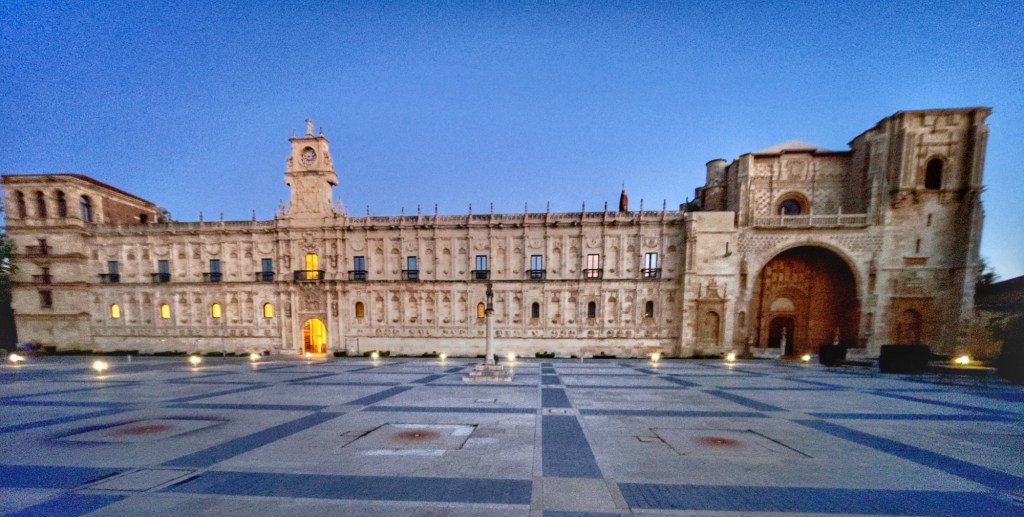
Leaving Leon: This magnificent looking structure is a government-owned hotel. A former monastery, one of a handful rescued from oblivion and converted to hotels. This one was featured in the movie, “The Way,” where Martin Sheen treated his Camino pals to a night of luxury.
No surprise, leaving Leon this morning was painful on many levels.
My boutique hotel room was so comfortable after weeks of bunks, shared shower and bath facilities, 10-30 people in a dorm room, etc.
The privacy alone was worth the price. To have my own washing machine and heater, was beyond my expectations.
It’s not like I needed to be up at 5 am today to start walking. Leon is only 18 kilometers from the auberge where I slept — fitfully among the hackers and wheezers. (Swear to god, thought I was in a TB ward.)
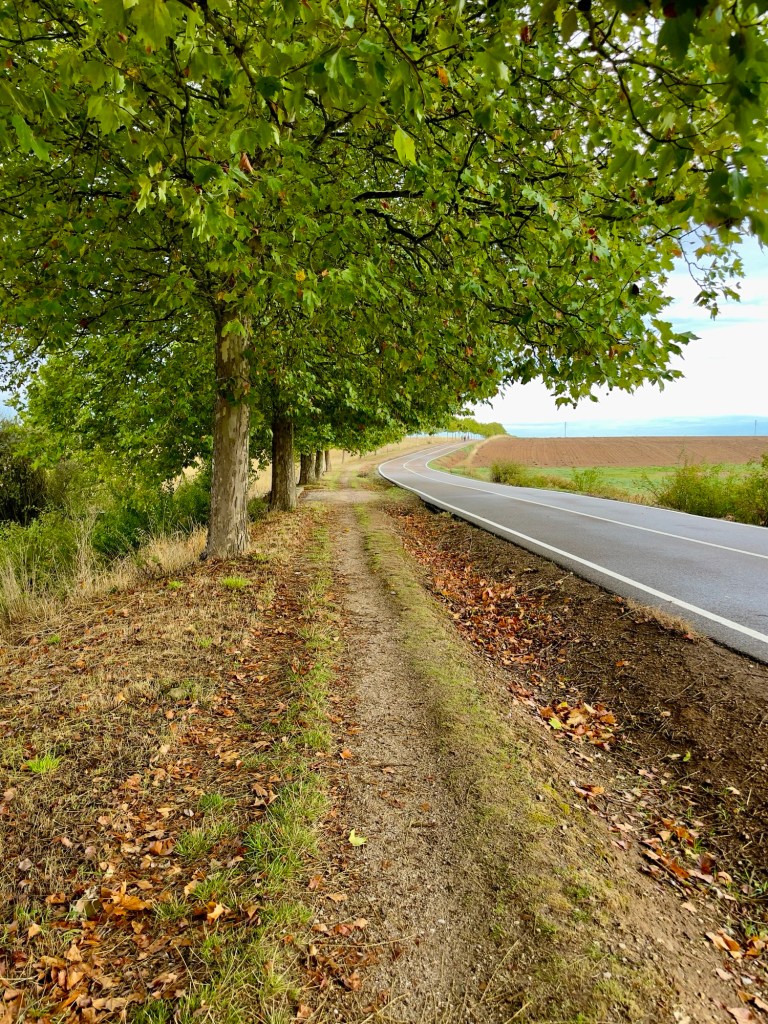
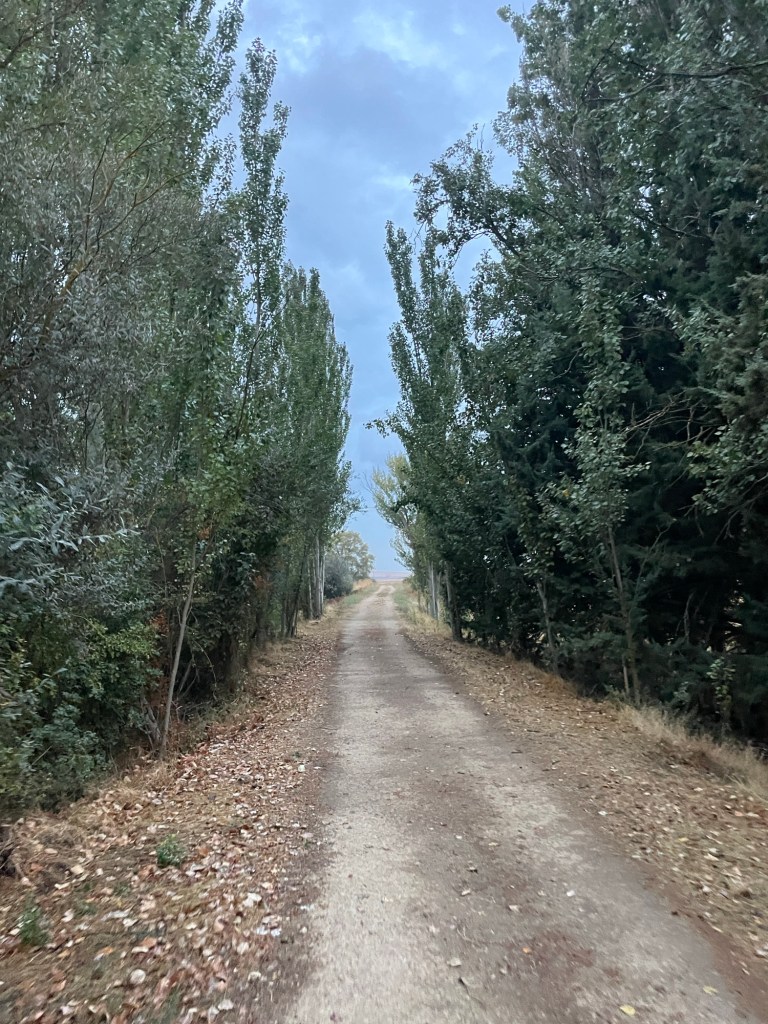
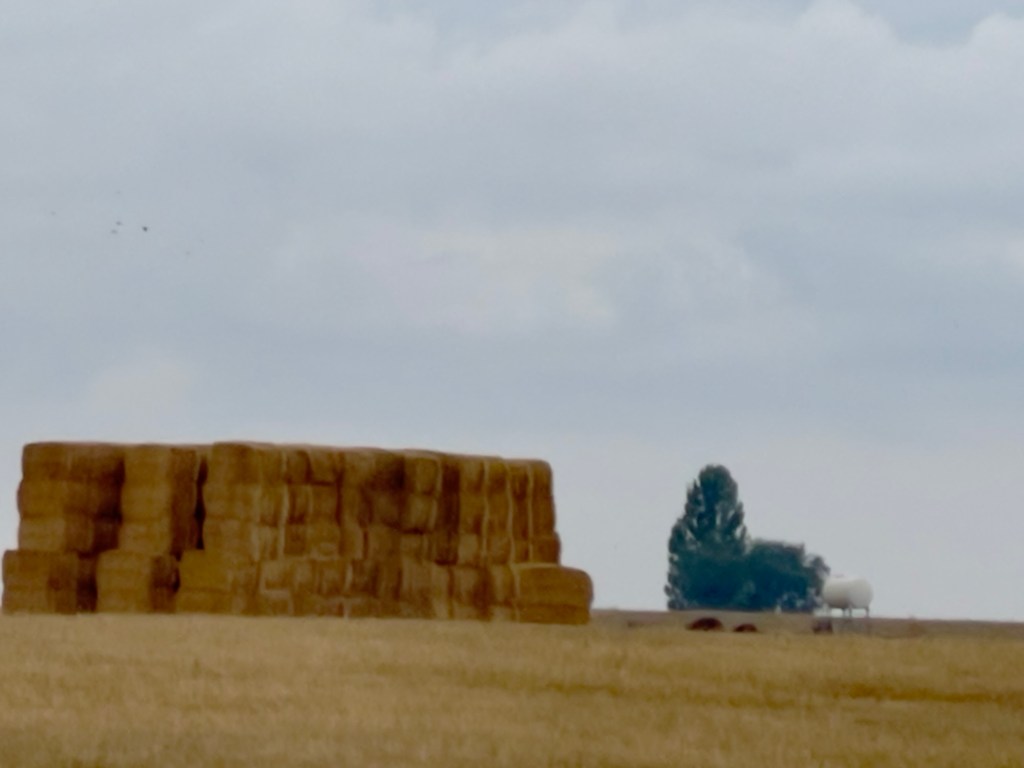
A lot of today’s walk looked like this. Oaks and chestnuts lined the path beside a quiet country road. Unharvested fields of corn and sunflowers filled out the horizons.
Today went by blazingly fast. So fast, it is barely half done and the walk is over.
The walk between Bercianos Del Real Camino and Mansilla de las Mulas was 17 miles and for the first time since I started, I arrived at my auberge before check-in time.
That called for a coffee and pastry at the adjacent cafe.
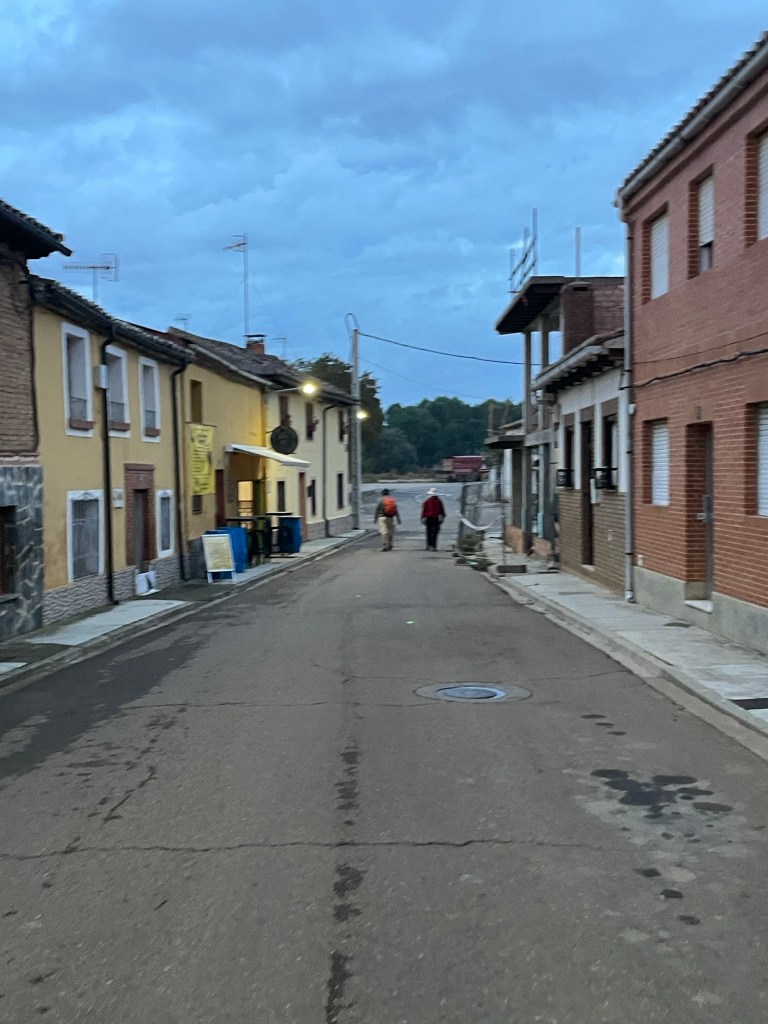
I wouldn’t call it a routine day but all went as smoothly as could be expected. Up and out of Terridillos before 7 am. And into Bercianos Del Camino by 1:30 pm
Up before dawn in Fromista, a town with no there there, from what I could tell. Happy to move on.
Like a Peregrino pro, my bag was ready to lift and run with barely a zipper squeak to awaken my neighbors.
Open the front door and … FLASH! KABOOM! The sky erupted in fireworks and drizzle.
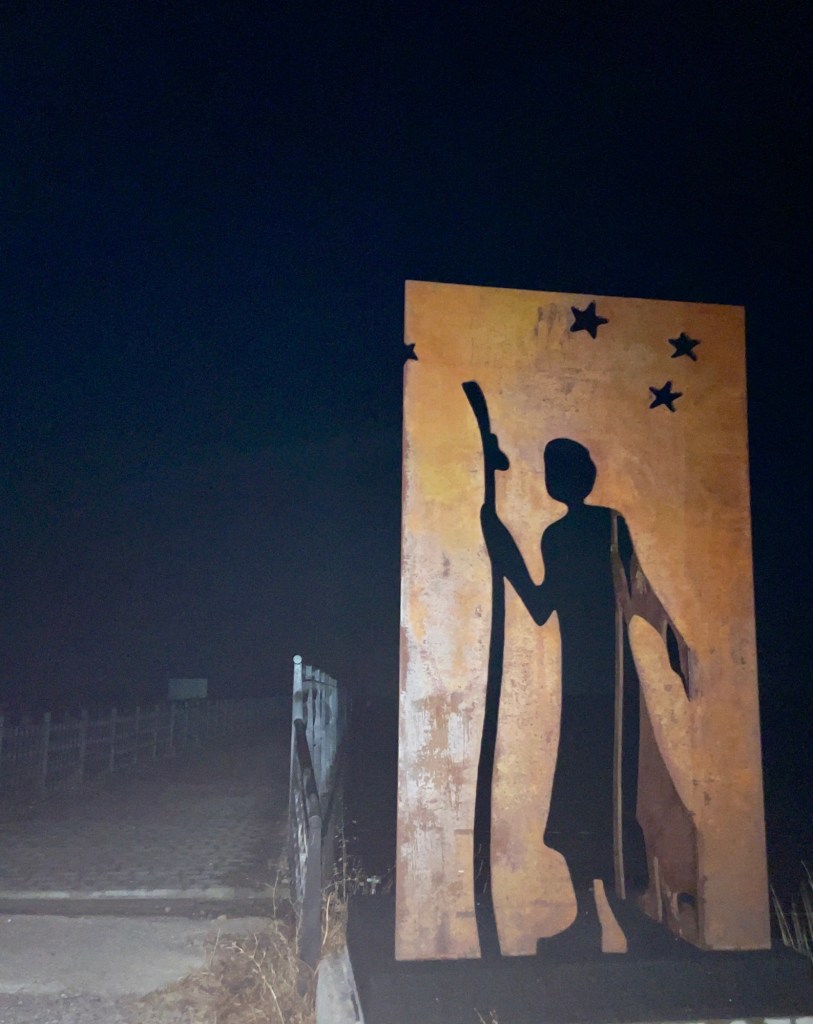
My only shot in the dark, just before crossing a train bridge, just outside Fromista.
Back inside I was able to whip out my backpack condom for the first time. And it fit perfectly.
Of course, there was no more rain. Well hardly any. It began to come down just as I was steps from tonight’s lodging, the 90-bed convent Espíritu Santo in Carrion de Los Condos.
The sisters are marvelous, greeting each damp peregrino as if he or she were the first of the day. Many beds but spacious accommodations. And for your 10 euros, you get a Miraculous Conception medallion to wear around your neck.
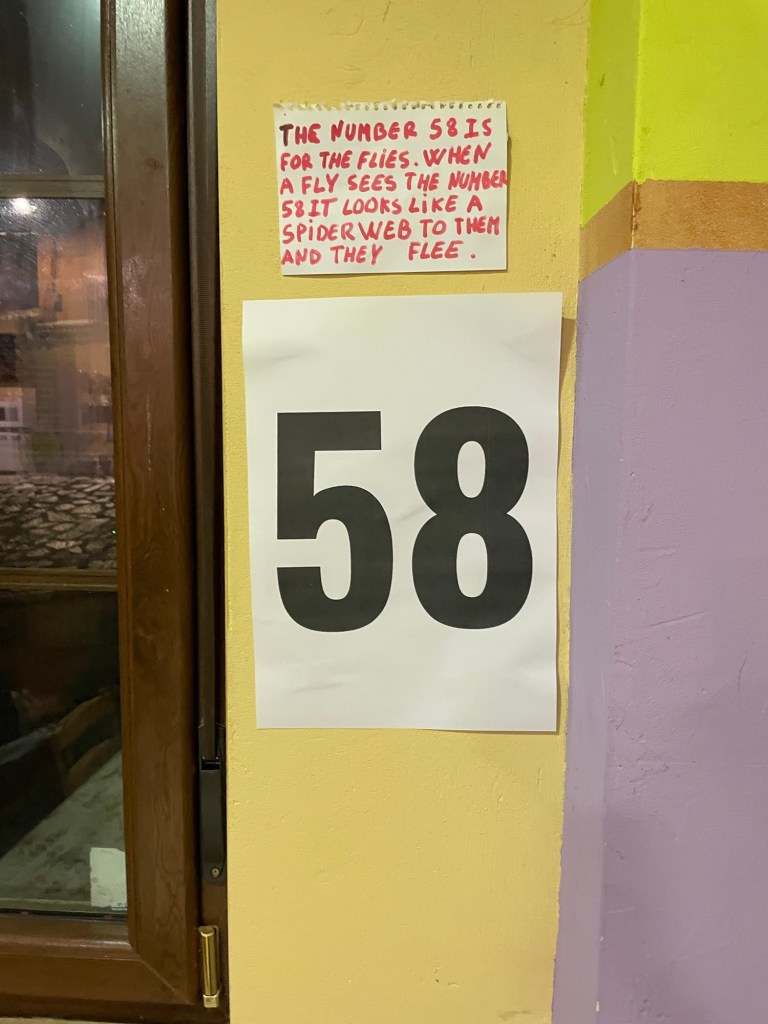
My first coffee break came a half-hour after leaving Fromista. All over the cafe were placards with the number “58” written large.
“The number 58 looks like a spiderweb,” explained the owner. “They scare the flies away.”
Well, I’ll say this, there were no flies.
If you try it, let me know how well it works!
This walk was quick and easy, 13 miles over moderately flat country terrain. Mostly beside a highway, but with several villages and a riverwalk to add variety.
I’m going to fill in the rest as a picture essay because there is a Mass with Gregorian chant in an hour. My favorite music.
Leaving Población, we were given the option of a river trail or a walk beside the highway.
Duh.
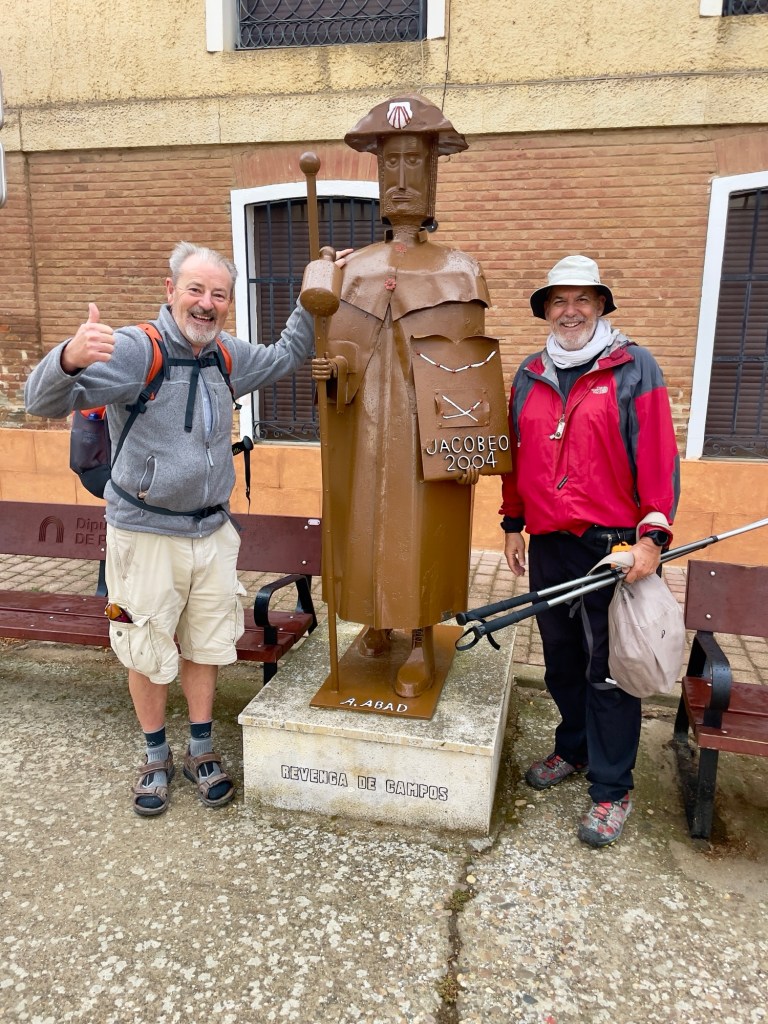
I was with two of my favorite companions — Stephen from Ireland and Eduardo from Chile.
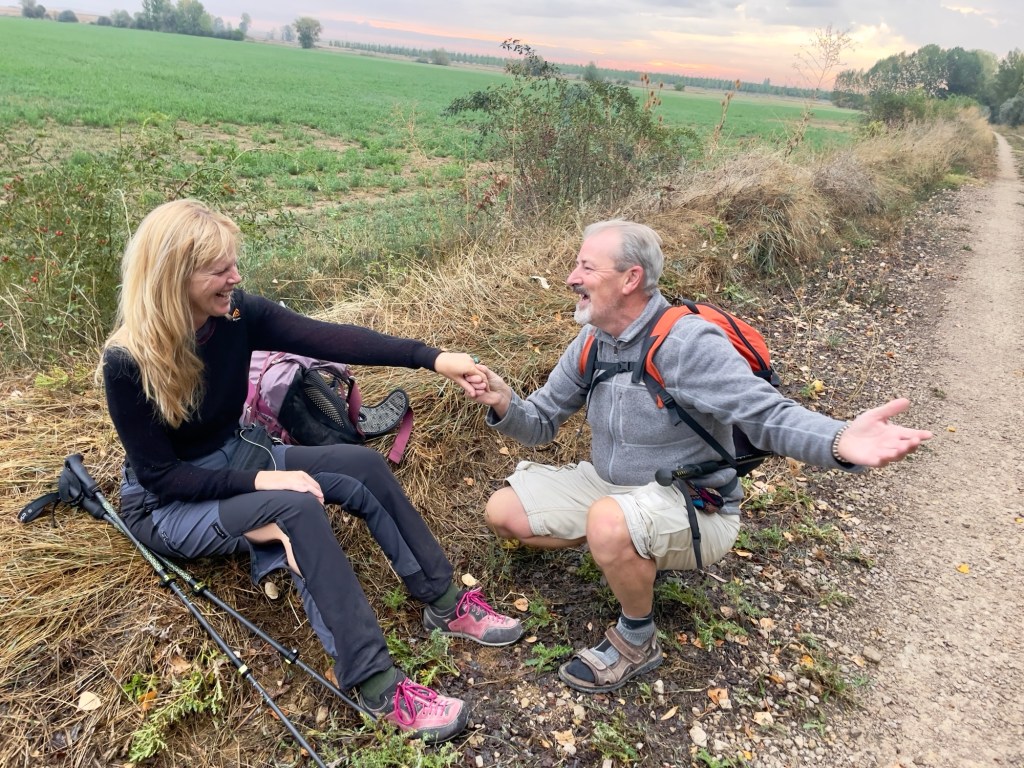
Stephen found a ring with three blue stones several days ago and he has been running around like it was a glass slipper, trying to find the owner.
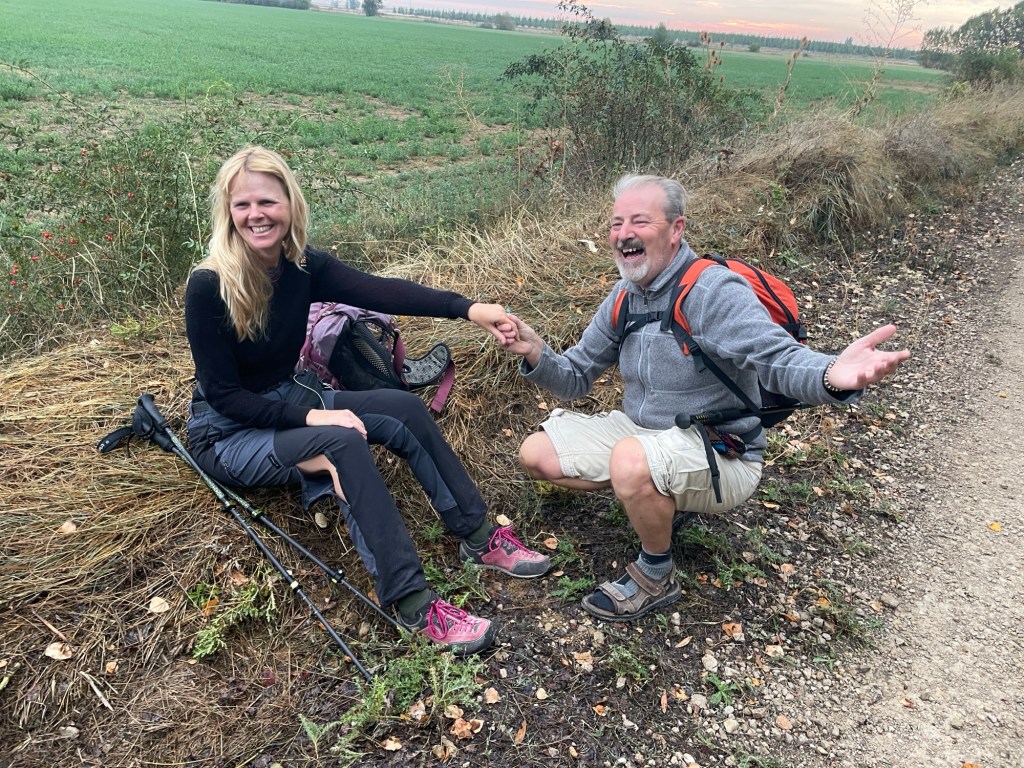
Greta from Slovenia was sitting beside the river trail and …. The ring fit her perfectly!
Later, Greta told me the turquoise color of the stones matches the river Reka Soca, near which she used to live in Slovenia.
“I can’t wait to call my husband and tell him I am not engaged!” She added.
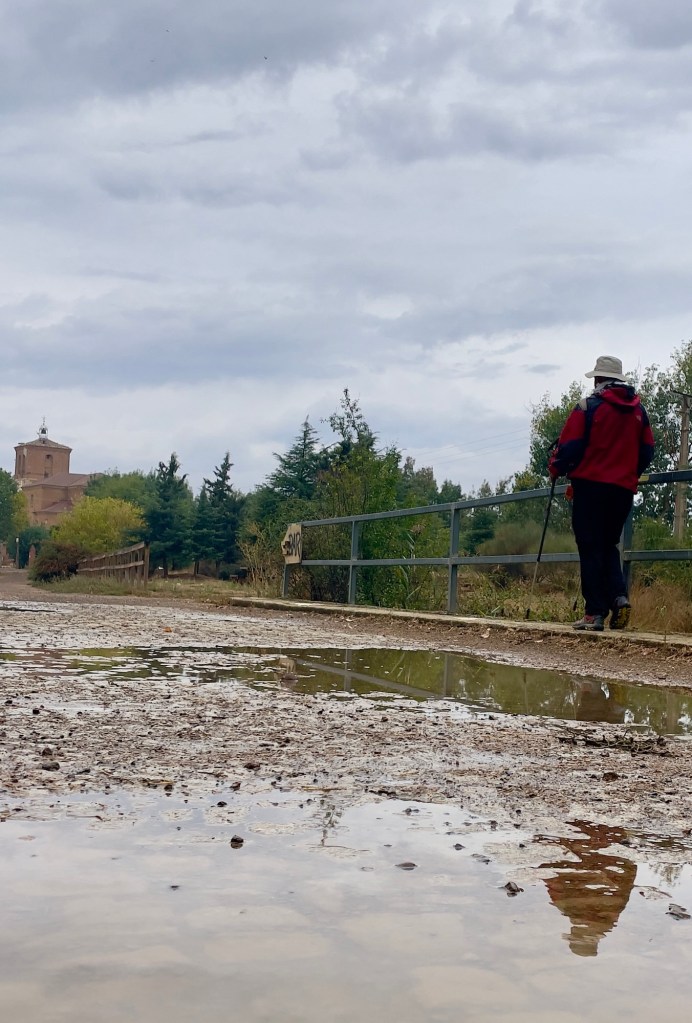
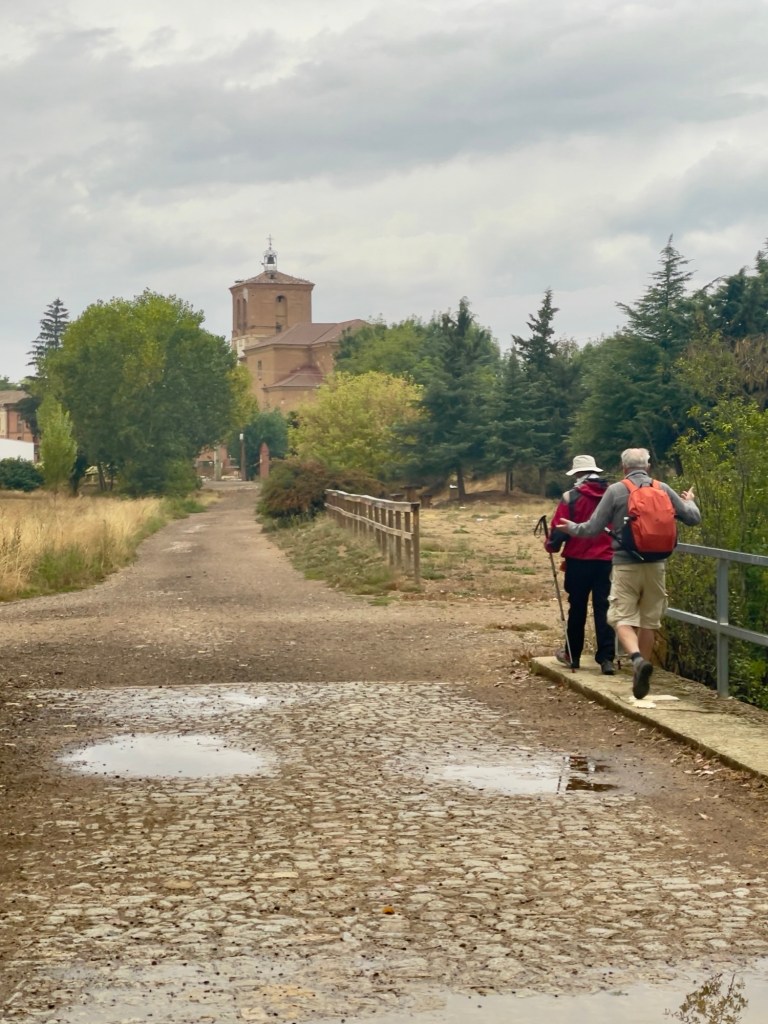
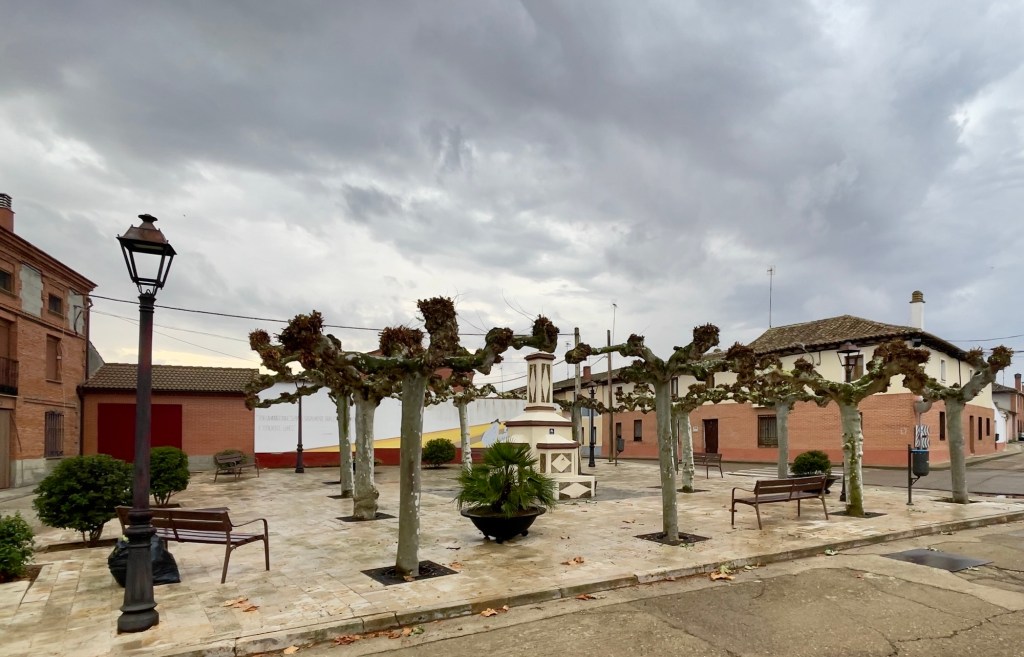
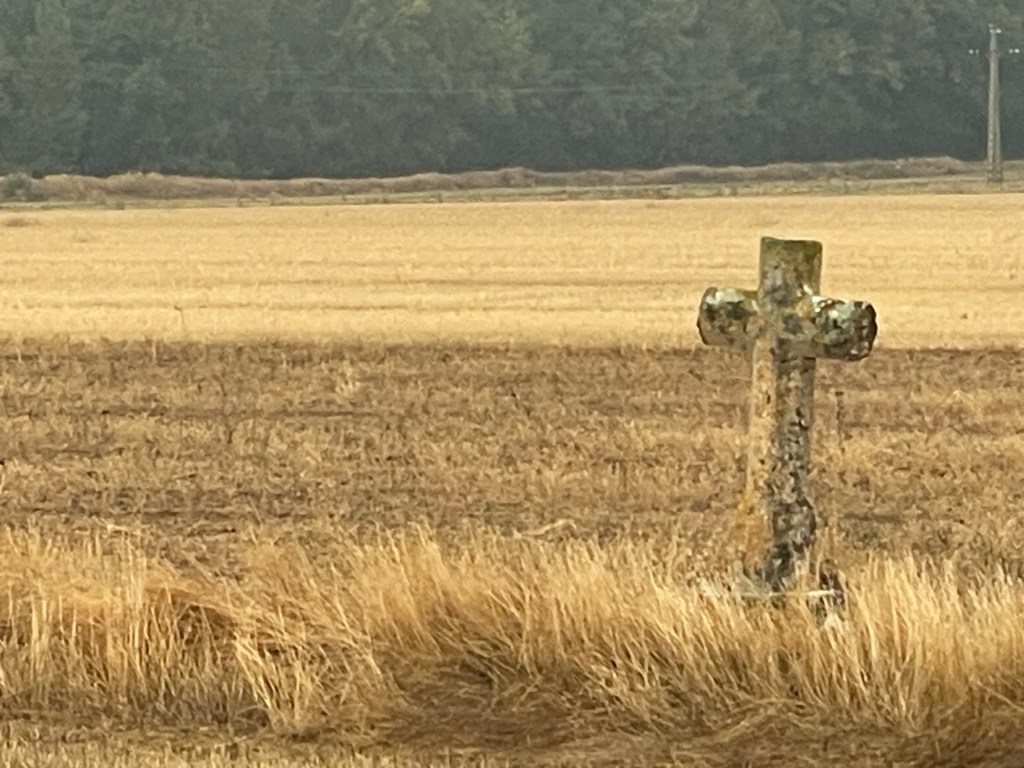
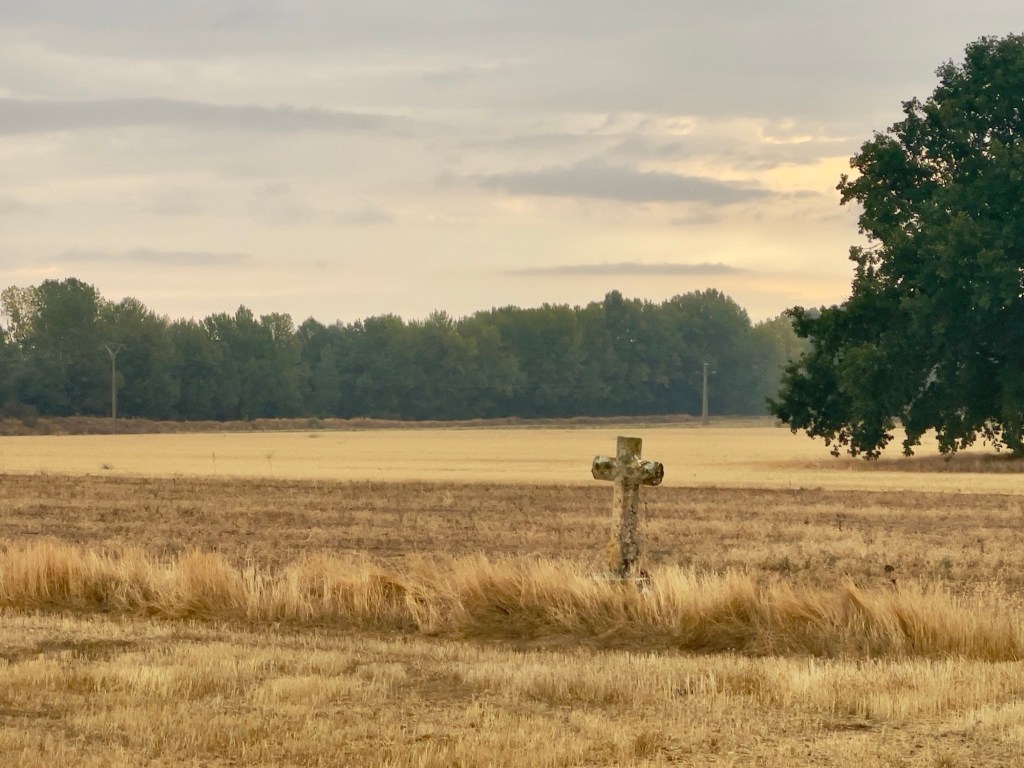
Leaving the river trail, we passed through some quiet and rather damp villages. There was a Celtic cross out in a field not far from the trail.
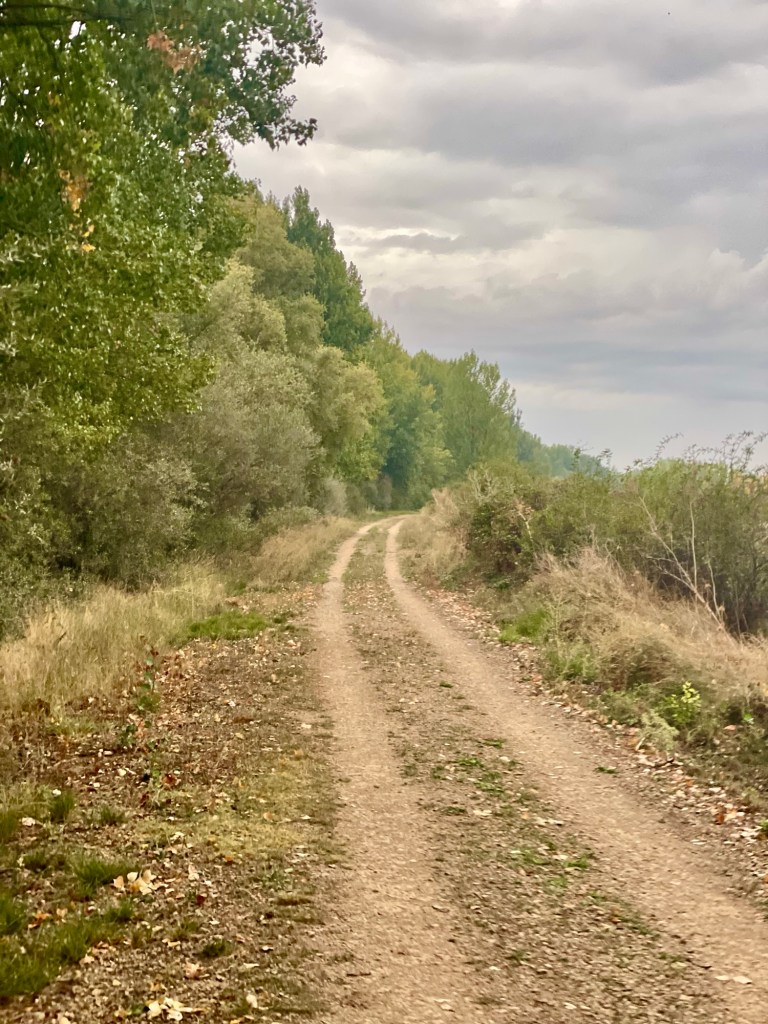
One more shot from the alternate river trail.
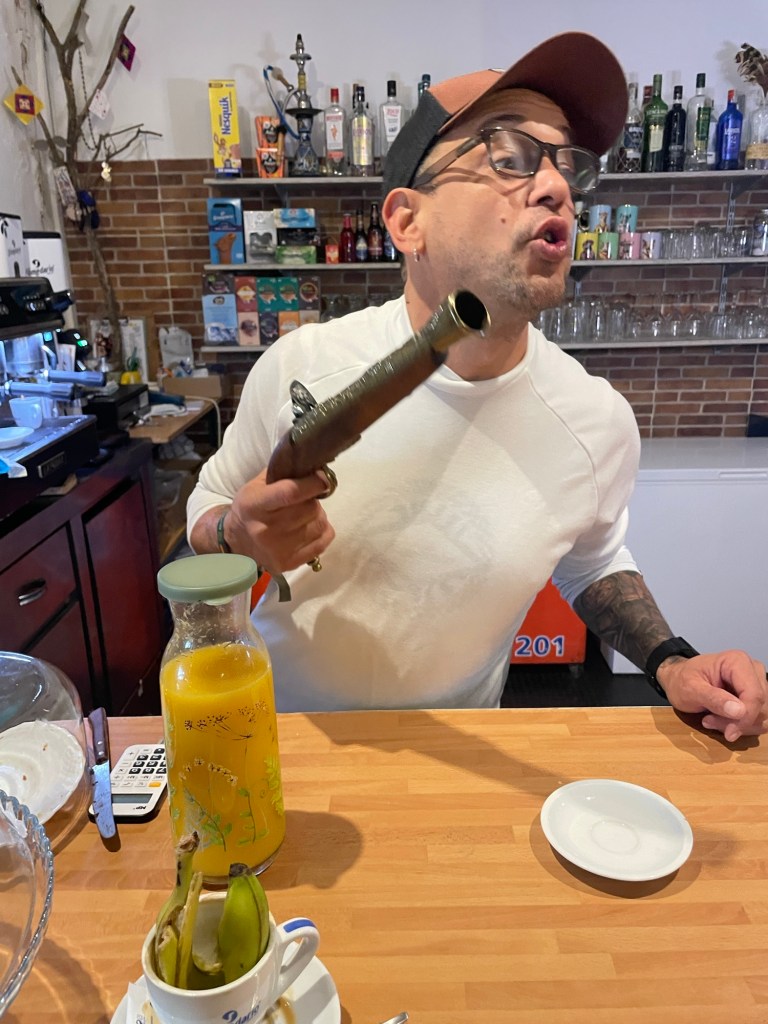
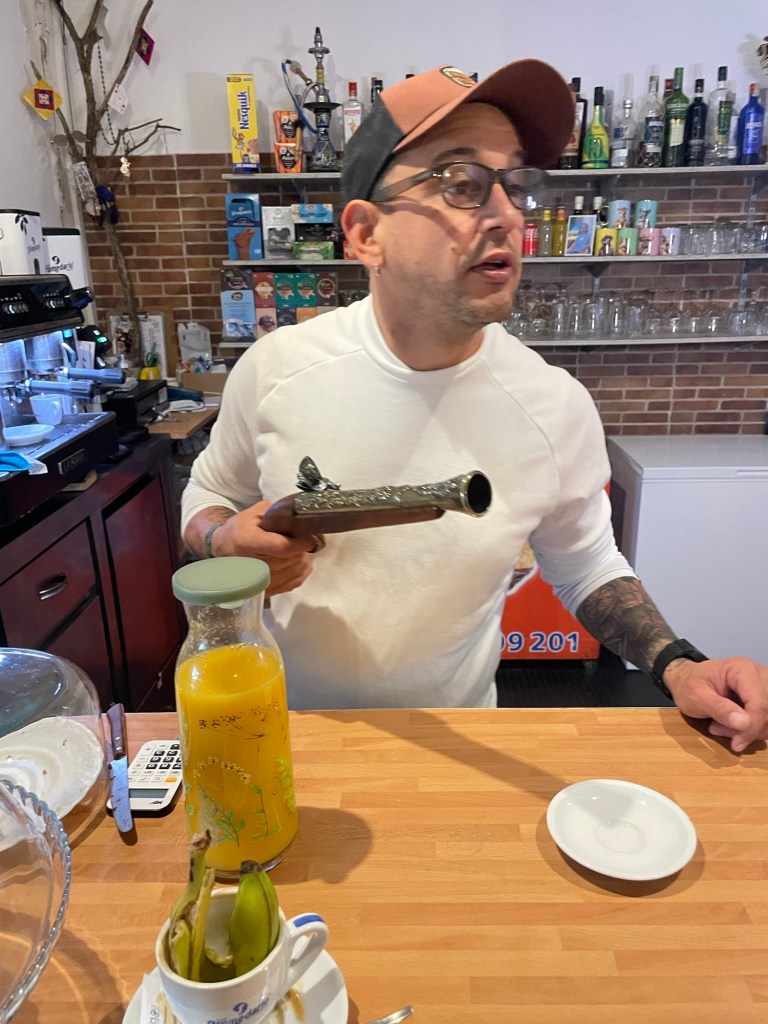
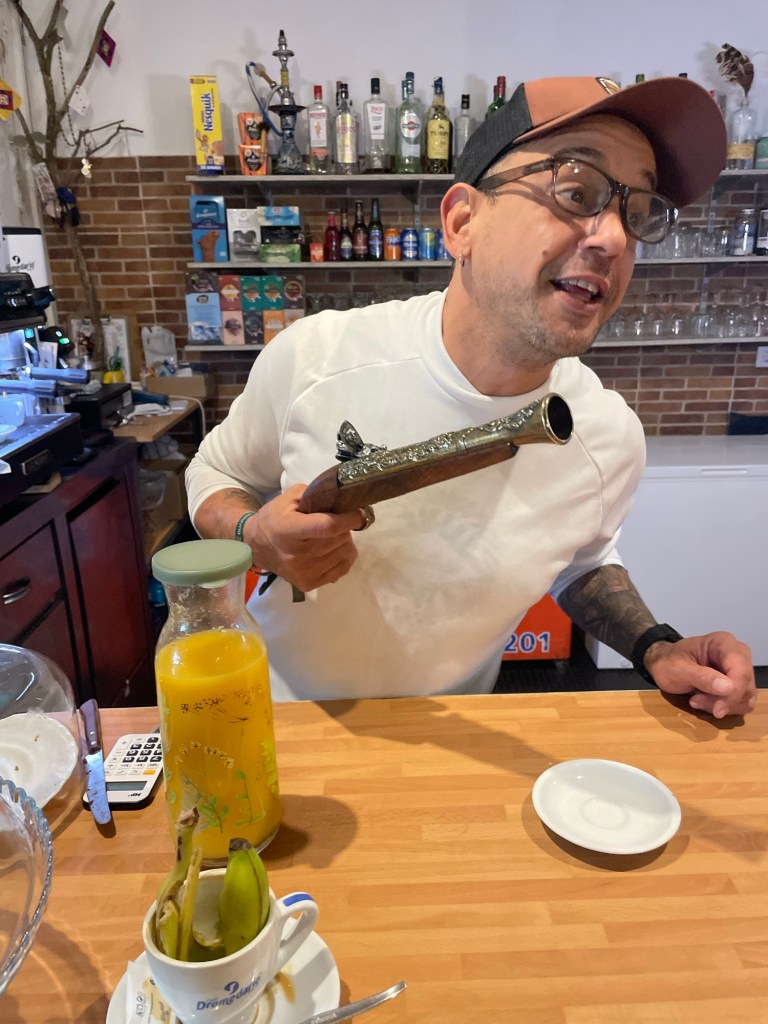
We stopped for a second cup of coffee at a cafe owned by a hilarious Brazilian gentleman. If you declined sugar with your coffee, he pulled out his blunderbuss pistol and said, “Are you sure you don’t want sugar??”
“Brazilians are the happiest people in all of South America,” said Eduardo as we left.
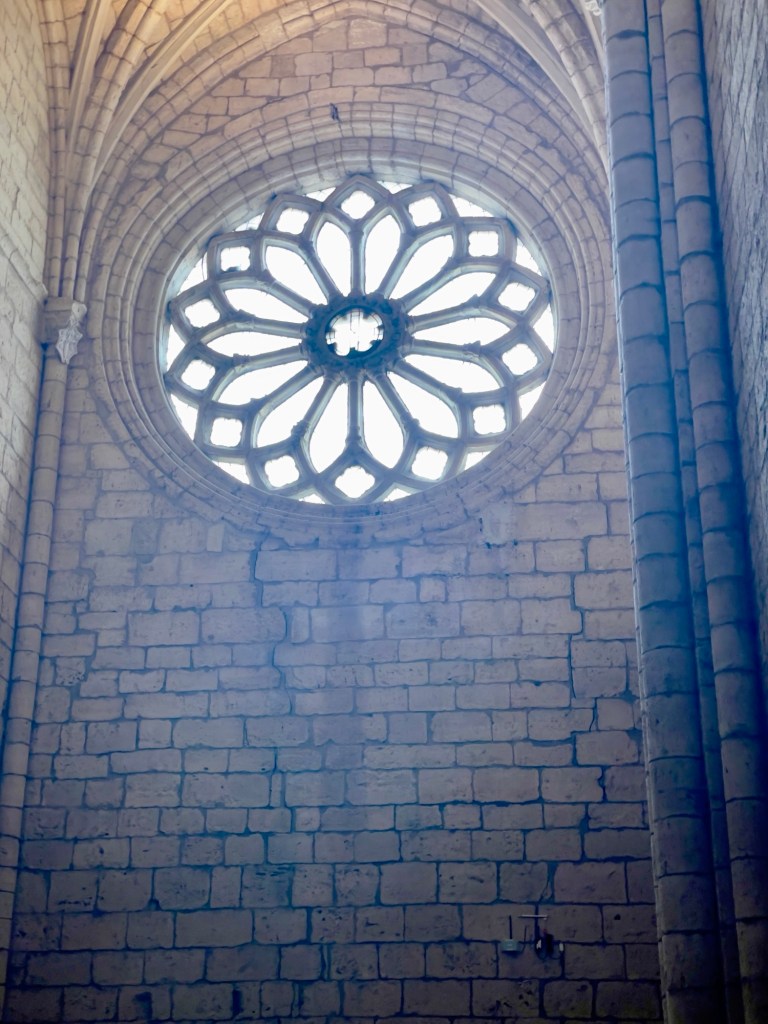
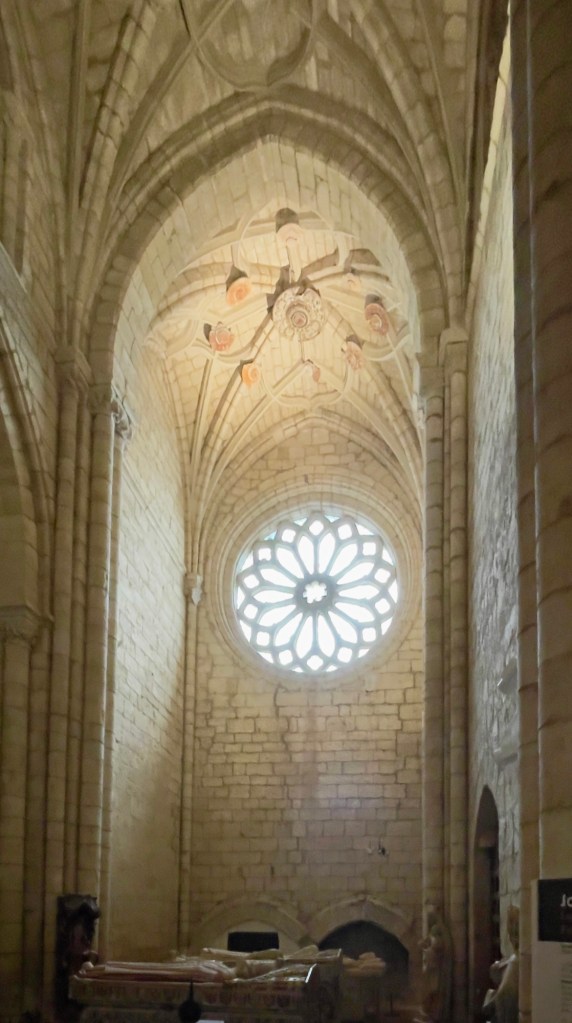
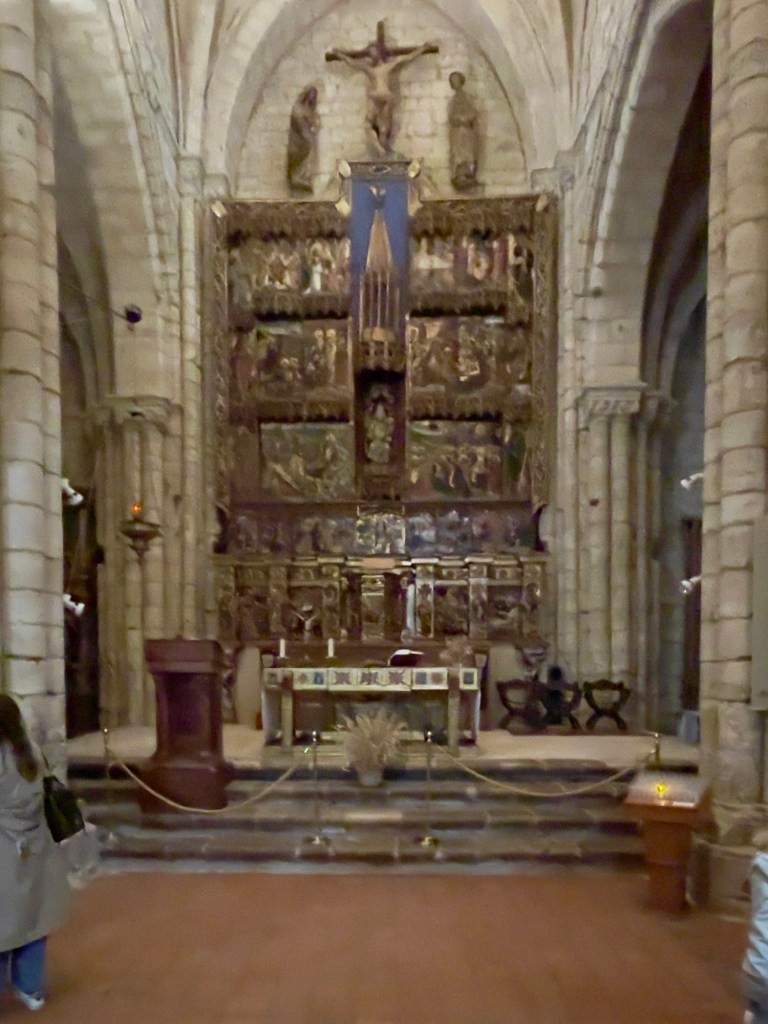
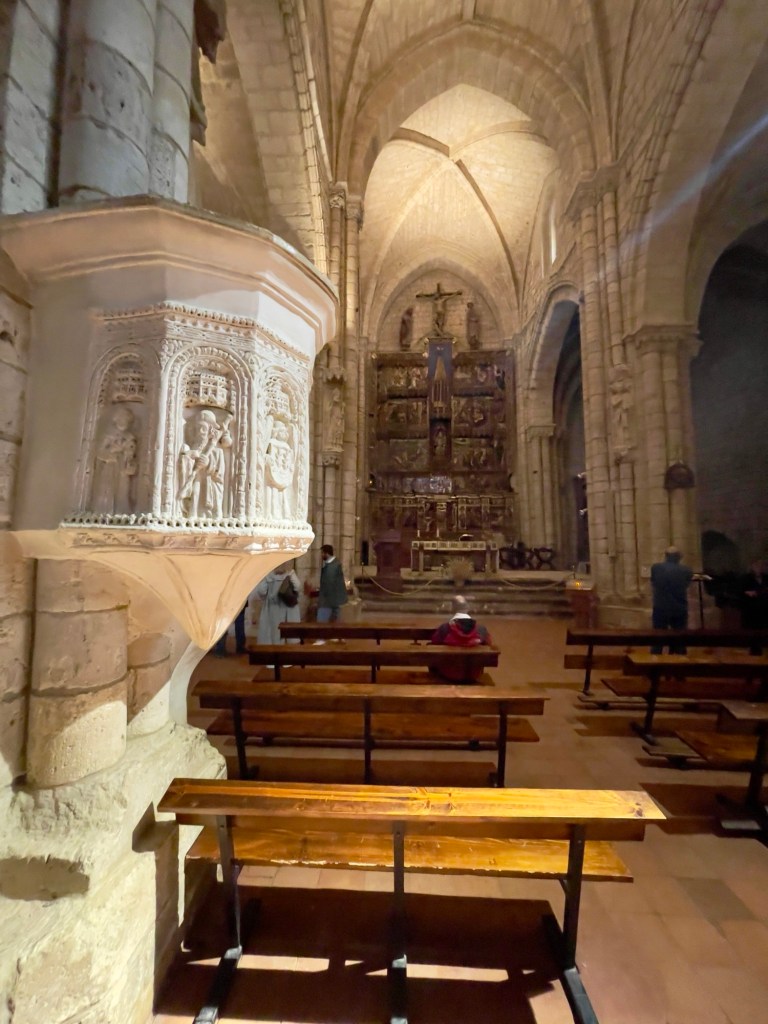
We took a short detour to visit the church of St. James in Villacazar. Foreboding on the outside, warmly inviting and modest inside.