Well, these days, I’ll take any parade — or a procession. You know, the kind we used to bump into on what felt like a daily basis back in the good old pre-Covid days.
Parades say “This is who we are. This is what we believe. This is the best of us, otherwise, why bother having a parade?” And, oh, we’ve had some wonderful parades in San Miguel de Allende.
A good friend invited me to spend a Sunday in Balboa Park with a Buddhist monk named Thich Nhat Hanh. I knew very little of him but Sundays in September in San Diego can be glorious and there are few better places than the park for them.
I think it was promoted as a Day of Mindfulness, another subject about which I knew very little.
The day was pretty much a total immersion. We were blissfully adrift in a gentle sea of brown-robed Buddhist monks and nuns. There were dharma talks and long periods of meditation. Some were led by Thay in his soft, barely audible whisper of a voice. Some were led by his followers.
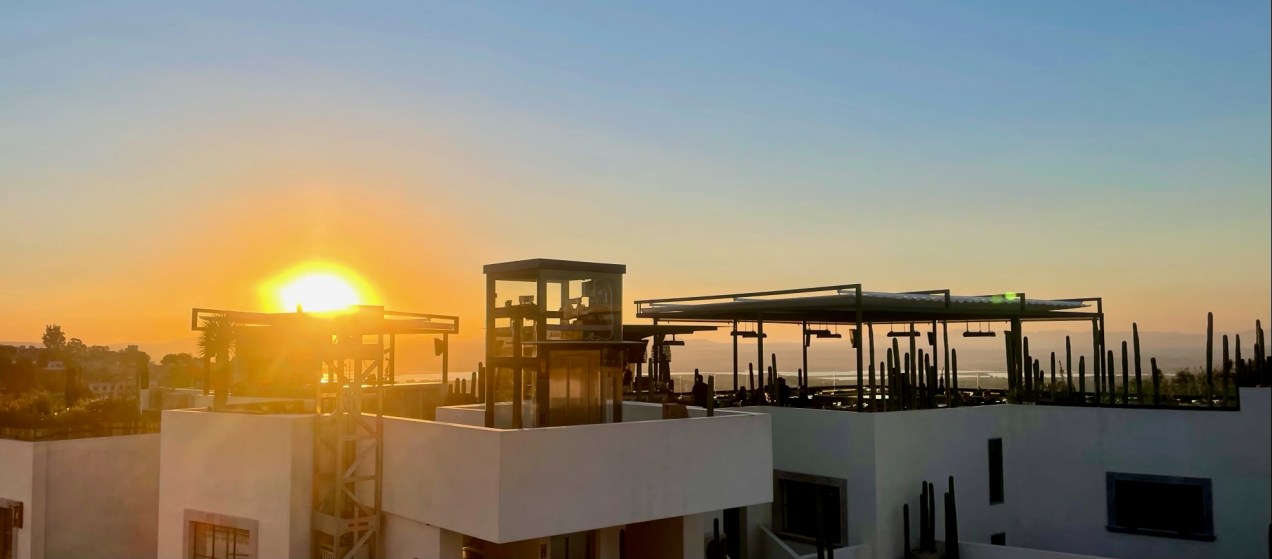
Climbing the stairs to Hachmans restaurant on the roof of the new Amatte hotel in San Miguel de Allende.
If first impressions are all that important, facing the entrance to the brand new Hacmans restaurant in the even-newer Hotel Amatte (Amatte Wellnest Community) – which has yet to open – is a daunting one: 71 gleaming white stairs leading seemingly up to the sky.
Yes, count them: seventy-one.
Of course, there is a glass-box elevator off to the side, but what’s the fun in that?
A quick trip to San Diego last week included a nighttime visit to the San Diego Botanic Garden in Encinitas which has decked out what seems to be all of its 37 acres with twinkling fairy lights, whirling kaleidoscopes of rainbow colors, washing waves of luminescent greens and reds, and light sculptures — all set against a canvas of bamboo groves, desert agave and palm plants, tropical rainforests, California palm trees, sturdy and ancient trees, Mediterranean bushes, and sub-tropical fruit trees.
There was even a snow-making machine if the light show weren’t enough for you. There was also wine by the glass for Mom & Dad. Pro tip: A night like this calls for a nice strong red with a side snack of kettle corn.
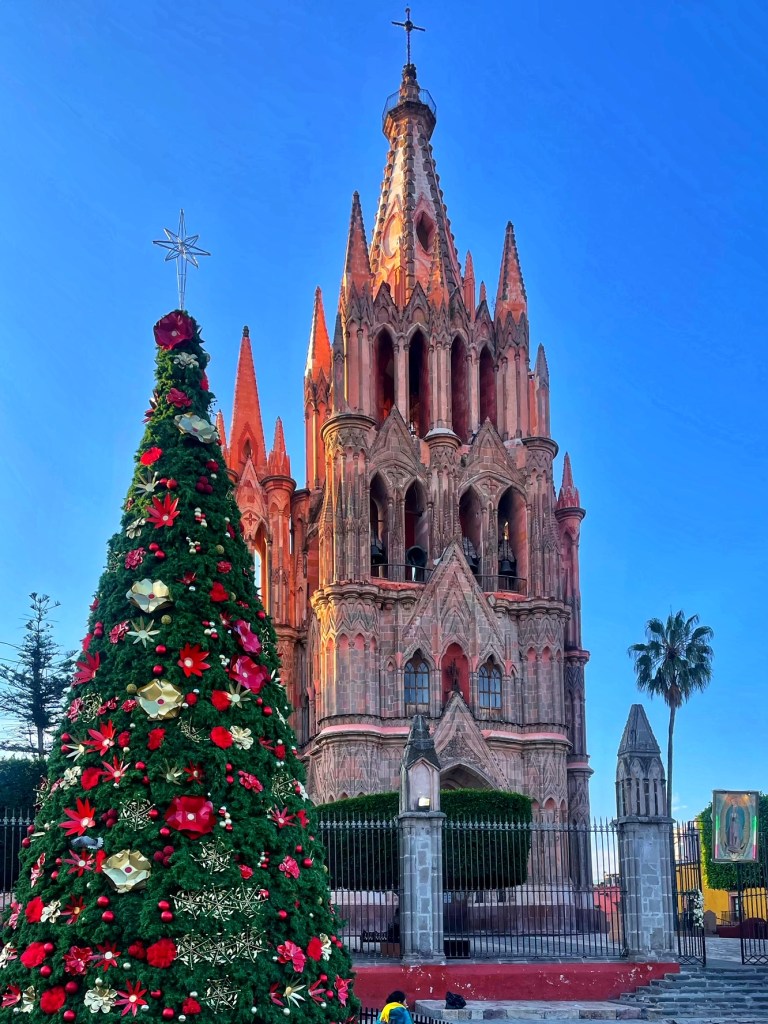
One thing San Miguel de Allende does well is dress up for the holidays.
Not just San Miguel. Every village, town, and city in the country brings out a million white lights, an enormous community tree, a life-size Nativity scene, and an infectious cheeriness that makes you glad to be living in Mexico.
Which I happen to do.
So here is a small collection of what is ahead in December.
The Christmas origin story has taken a real beating on television in recent years.
The film factories don’t follow a script. The have a playbook. There are fixed characters, types. There are predictable situations. There are tried and true bromides. There are fixed plays. And there are utterly predictable endings in which the “true meaning” of Christmas is disgorged just before credits roll.
And the sudden appearance of the much-anticipated snowfall at the end is a complete surprise to everyone but the audience.
Rabbi Daniel Huebner of Chabad San Miguel de Allende lights the first candle on the community menorah on Sunday evening in Parque Juarez. A lit candle will be added on each of the following seven nights for the Chanukah celebration.
Happy Chanukah, my friends. Or Hanukkah.
Sunday night was the first night of Chanukah — the Festival of Lights — and the lighting of the first candle of the menorah. The Chanukah celebration is observed for eight nights and days, with a new candle being lit each evening.
I know all this because I was walking Moppit in Parque Juarez when I happened upon members of Chabad San Miguel de Allende lighting the community menorah in the park’s gazebo.
I missed most of the dedication, but I happened upon the gathering just as Rabbi Daniel Huebner was explaining the significance of this year’s menorah, created by artist Meila Penn.
Robert J. Hawkins, U.S.M.C. medical corpsman in World War II
The machine-gun fire came out of nowhere, the way it is supposed to in war.
Or so it seemed to the Marines who were caught in an open field next to a presumably abandoned farmhouse. Incorrectly presumed empty, as it turned out.
The carelessness cost the platoon one soldier. He lay on the ground about 10 yards away from the stone wall behind which his comrades took refuge.
He was still alive. They could hear his agonizing cries for help. They could see him, lying there out in the open.
The squad’s 19-year-old medical corpsman had already seen his share of death and savage injuries since their battalion had waded ashore on the island of Saipan. And now, more of the same on the neighboring island of Tinian.
During the initial bloody assault on Saipan, the corpsman was encountering a dead or wounded Marine every 10 yards or so, by his estimate. This made his progress slower than the other Marines. They relentlessly pushed the enemy to the other side of the island and the sea, leaving a trail of dead and wounded for the corpsman to sort out.
He’d already taken grenade fragments in his hand, leg, and shoulder — for which he’d eventually get the Purple Heart.
It’s like something out of a Disney/Pixar movie where a once-beloved and cuddled family Bug grows old as the family grows up and is eventually abandoned in the Shed of Lost Car Souls where it withers, rusts, and decays for decades until the troubled teenage grandson discovers the car and with loving assistance from grandpa restores the Bug, restores his own self-confidence, and restores grandpa’s long-lost memories as he regales his grandson with tales of family road trips and adventures in this very same car — and in the end, grandpa and grandson trundle down the road in their magnificently restored Bug on the Mexican road trip of their lives.










 Musings, Magic, San Miguel and More