Editor’s note:In a newsletter for former Union-Tribune newspaper staffers, a colleague in San Diego recently recalled a review I once wrote that outraged the mayor and her staff. Jack Reber, the editor of the newsletter, asked if I would fill everyone in.
Glad to do it. But, as in my online days with SignOnSanDiego.com, I take great pleasure in scooping mainstream media.So, you will read it first, here on my own blog. My newspaper friends may get it at midnight tonight. (Sorry, Jack. I can’t help myself.)
Ah, the Russian Arts Festival of 1989. Gather round kids and I’ll tell you as much as is permitted by the several nondisclosure agreements I signed to gain a generous separation bonus from the San Diego Union-Tribune.
Obviously, I kid. There was no bonus.
My one assignment during the Festival was the Tiblisi State Puppet Theatre, under the direction of the great and late-Rezo Gabriadze (below with some of his creations). Georgean puppets aren’t like the Muppets, Shari Lewis and Lambchop, or Punch ‘n Judy. They tell real and elaborate stories, often tragic, and even violent or sexually mature.
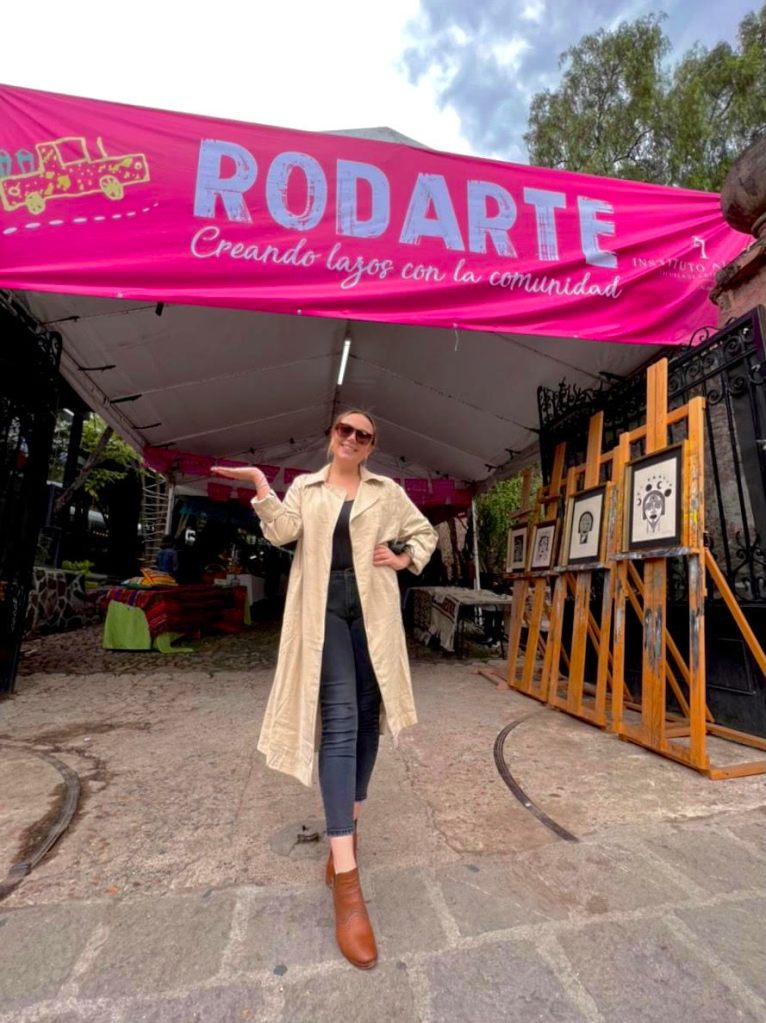
Zara Fernandez, director of the Instituto Allende, stands before the site that will contain the Rodarte artist and artisan bazaar this weekend. Revenues from the bazaar help fund art teachers and art supplies sent out into the community.
“What goes around comes around.”
The expression has always carried a negative connotation. Long before Justin Timberlake grabbed the idiom by the tail and turned it into a hit song of bad love and betrayal with the help of Scarlett Johansson treating each other badly.
After a long night of parading, doing battle with the Devil, blowing off fireworks, celebrating the city’s namesake, and just all-around old-fashioned shoulder-rubbing with neighbors — what do San Miguelenses like to do the next day?
With all the celebrating going on in San Miguel this weekend, it is easy to forget that love is always in the air.
I submit these photographs as evidence.
These were all taken on Sunday morning before I’d even had breakfast. The peacocks sauntered over while I was having breakfast. In fact, they came up to a very large enclosure housing a quartet of finches.
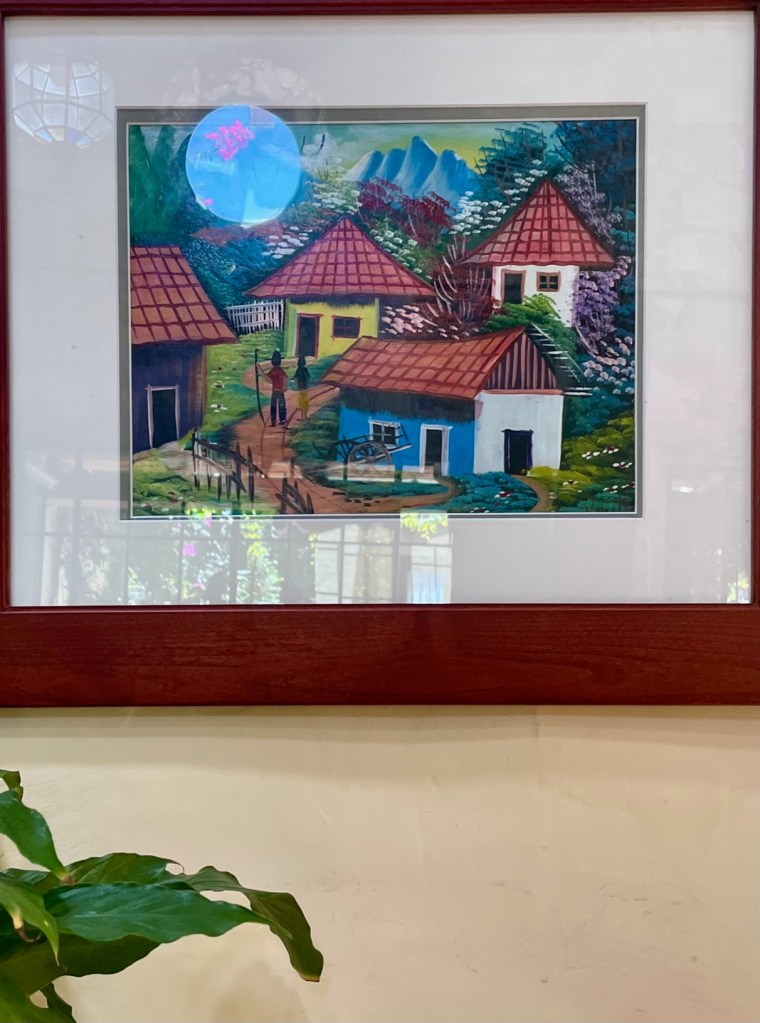
The painting of a tiny Thai jungle village set against snow-tipped blue mountains in our casita has gained a full moon.
The moon wasn’t there yesterday.
And it was not there when Rose Alcantara acquired the painting on the island of Koh Samui, off Thailand, many many years ago. (She doesn’t want to think of how many.)
It is a charming and primitive scene of four red-tiled peaked-roof houses, painted in bright tropical colors. A red-dirt road curves through the settlement. Flowers of many colors encroach on the green grass yards, pushed in by the encroaching jungle. A rickety fence or two and an ancient wooden cart enhance the setting.
It is popular and entirely appropriate in San Miguel de Allende to say “You never know what’s behind a closed door.”
Entrances on San Miguel streets give you no hint at all as to what lies behind them.
The most humble of doors can open onto a garden of Eden, a fairyland, a small village, a rabbit warren of homes, a vast and empty park, a stately hacienda, ancient ruins, a private town square surrounded by stately homes, ageless and towering trees, private roads – well, whatever imagination and money can conjure.
Four doctors walk into a room. For the next 90 minutes, they give a free medical consultation to the scores of people assembled.
No, this is not the start of a joke with a lame punchline.
In fact, if there is a punchline, it would be that the doctors shared valuable information that could save your life. Not funny, just very very helpful.
On Monday afternoon, four of San Miguel de Allende’s most prominent physicians took turns unraveling the mysteries of obtaining good medical care as a gringo in Mexico. The event, titled “Mexico, Medicine and Me: General and Urgent Care,” is to be the first in a series at the Biblioteca on this theme.
The four were Dr. Roberto Luis Maxwell Martinez, the dean of medical practitioners in San Miguel and critical care specialist; Dr. Grace Lim, internal medicine physician and a lifetime resident of San Miguel; Dr. Ricardo Gordillo, founder of The Clinic, general medicine, and stem cell researcher; and Dr. Emilio Ramirez, emergency medicine physician.
Each took turns addressing the key concerns of ex-pat residents, including public vs private hospitals; state, private, and U.S. health insurances; when is a medical emergency actually an emergency; how to find a primary care doctor; how individuals can take control of their medical needs; the importance of a “do not resuscitate” proclamation; and developing a Plan B for medical emergencies (after you have nailed your A game).
The advice was both practical and rich in common sense steps – but also, the kind of stuff so very few people actually practice until they find themselves in the middle of a medical emergency.
So, here’s the goods, as it was delivered.
First, when an ex-pat walks into a hospital, the first thing they are likely to encounter is a language barrier. In the public hospital, of which there is one in San Miguel, almost nobody speaks English. Your odds of finding bi-lingual staff increase massively in private hospitals.
All the same, “be patient,” urges Dr. Maxwell.
If you don’t know Spanish, at the very least, learn some key phrases that will help staff understand your problem. For example (these are mine):
El nombre de mi médico es _________ – My doctor’s name is _______
Estoy teniendo un ataque al corazon. – I’m having a heart attack.
Tengo un dolor muy fuerte aquí. – I have a very bad pain right here.
Por favor, ayudame. Estory muy enfermo. – Please help me. I am very sick.
Aquí está mi historial médico. – Here are my medical records.
Gracias por cuidarme. — Thank you for taking care of me.
¿Quién ganó el partido de fútbol de esta noche? – Who won tonight’s soccer game?
¿Dónde están las máquinas de Coca-Cola y snacks? – Where are the Coke and snacks machines?
Puedes llamarme un taxi? – Can you call me a taxi.
Ok, well enough, but what happens before you get to the hospital … and how do you get there?
Let’s start before you even have a heart attack, a stroke, or a failing kidney.
The first thing you should do, the doctors all say, is find yourself a primary care physician. There are lots of excellent ones here in San Miguel.
You find one by asking your friends and acquaintances who they recommend. Don’t wait until you are sick. Sign up for an introductory consultation.
“Your first consultation has to click,” says Dr. Lim, “if not, find another doctor.”
Once you find a doctor, find out at which hospital he or she practices. In an emergency, that is where you want to end up. Once you know whether it is La Joya or MAC, the two main critical care hospitals, sign up for a tour. Get familiar with their location and layout.
More and more doctors here successfully treat patients up to the second level of care – when the time comes to call in a specialist. This is the doctor who knows you best and can call in the right specialists as needed. Your general practice doctor is the “center of referral.”
Most interestingly, the doctors say your first call in an emergency should be to your own doctor rather than 911 or Cruz Rojas. Dr. Lim sees the primary care physician as your “team leader” in a medical emergency. Your doctor can get an ambulance, alert the hospital, provide medical details, give you quick advice on how to mitigate your problem, and meet you there.
Your primary doctor knows your medical history, what medications you take, what allergies you have, your blood type, and plenty of other medical and personal knowledge that the hospital emergency care staff will find invaluable.
Again, also, when you are flying solo, it is a bit about the language. Your first contact with 911, the ambulance service, and the hospital will likely be in Spanish. Be prepared to answer questions about your health for up to 10 minutes – questions for which your doctor should already have the answer. And while you are fumbling with Google Translate, valuable time is being lost.
As Dr. Ramirez put it “time is life.” Don’t waste it.
“I’d rather have a patient call me at 2 or 3 a.m. than call 911 or Red Cross,” said Dr. Maxwell.
Of course, if you can’t reach your own doctor, call for an ambulance. Give your doctor’s name to the admissions staff as soon as you reach critical care. They will reach him or her.
Ok, so far so good. You’ve got a doctor and a hospital. You’re in good hands. Your work is done, right?
So very wrong.
Long before we reach the emergency stage, there are many things you can do for your own protection.
The most basic thing is, to draw up a list of phone numbers – your doctors, your hospital, 911, Red Cross (the ambulance service in SMA), your family, your key friends, and your patient advocate. Keep it handy and update it as necessary.
Next thing to keep handy is your medical records. You may have noticed that in Mexico, your doctor hands over medical papers to you – including x-rays, blood test results, MRI results, prescriptions, allergies, medical history, insurance card, etc. Unlike in the U.S., medical records are portable. You can take them from doctor to doctor to specialist to hospital.
If you are like me, those records are scattered over several files in a couple of file boxes. If you are like me, you are going to gather and organize all of those medical records and then you are going to put them in what Dr. Gordillio calls a “go-to bag.”
This is something many Mexicans learned the hard way during the earthquakes in Mexico City.
You need all of your necessities in one bag, ready to go in an instant. Not just your medical records. You need insurance information, contact information, a cache of cash, or other means to pay your medical bills.
That’s right, cash. Hospitals want an upfront fee (cash or credit card) or deposit. It is just how things work here. Even if you have insurance, you can get reimbursed later.
Also in that bag should be – if you want it – a “do not resuscitate” letter. This is a directive to medical staff to not go to extraordinary means to keep you alive in the event of a debilitating stroke or injury. It is called an advance directive. It should be signed, witnessed by two people, and notarized.
If your spouse/partner or doctor is aware of your wishes, they can accomplish the same directive but best to have the paperwork in order. The good news, you can change your mind at any moment before the plug is pulled.
It goes without saying, your chances improve if you have a spouse, partner, or friend in there battling for you. The reality is many in San Miguel are single and live alone. The doctors urge people to form circles of support – key friends or neighbors who can step in, know where all your medical information is located, and fight for your care, act on your behalf, as you will do for them.
There are also several patient advocate companies in San Miguel which provide support for a fee.
San Miguel’s medical community is robust for a city of its size, the doctors say, but chances are patients will need to travel to Queretaro, Guanajuato, Leon, or Celya for special needs – like neural surgery, strokes, and heart operations. Many San Miguel doctors also have practices and connections in these cities.
Dr. Maxwell recalls the time when specialized care meant patients took “life flights” back to the United States. That rarely occurs anymore. Regionally, we are as well equipped and qualified as any spot in the U.S.
Even better, says Dr. Lim, in that there is no barrier between doctors here and their patients. No staff to filter out your needs. Doctors here will give you their e-mail, texts, phone number, WhatsAp,p and other means of direct contact.
But don’t abuse it. Don’t ask for medical analysis and treatment over the phone. Don’t call your doctor at 2 a.m. because of an ache you’ve had for four days. Don’t call for things that should be handled in person. Don’t expect your doctor to answer your call when he or she is with another patient or making hospital rounds.
One last tip: People who get up in the middle of the night to go to the bathroom should take their cell phones with them. Slipping and falling on a bathroom floor at night is distressingly common – as is finding yourself immobile on the floor. All the numbers on your speed dial will do you no good if the phone is in another room.
Keep it handy at all times.
This was the first of many Biblioteca forums to come on a wide variety of topics, including possibly one on independent living and managed care facilities in San Miguel.
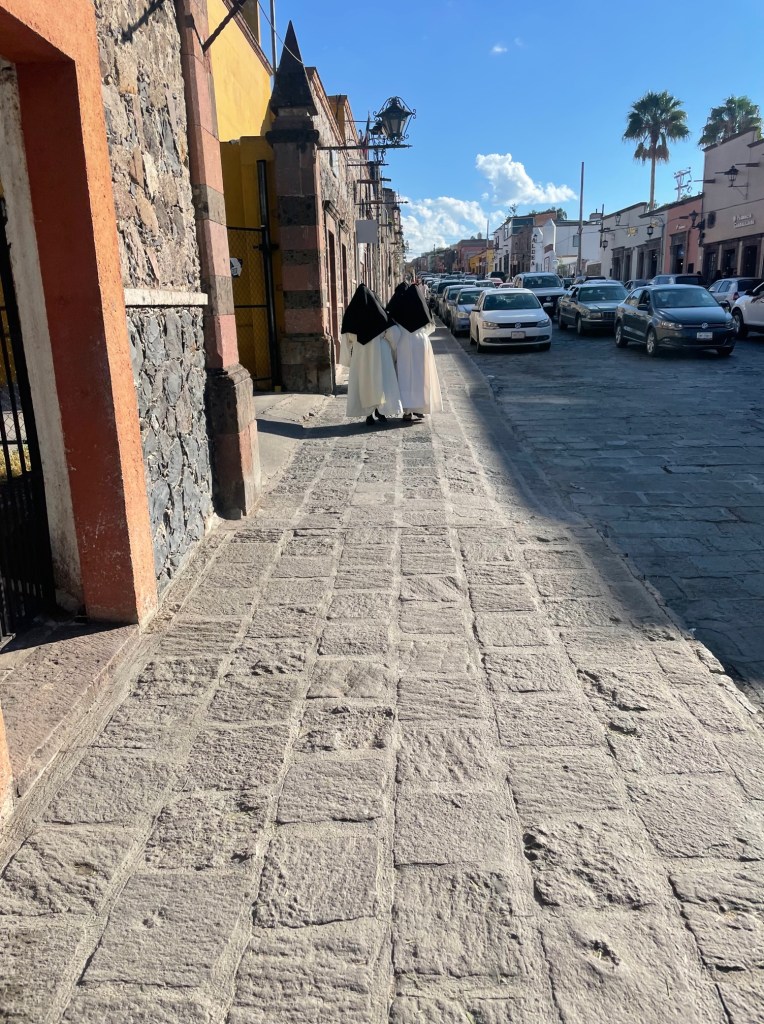
The four good sisters were walking in tight black-and-white formation up Calle Ancha de San Antonio on Friday, Sept. 23, 2022, around 9 a.m.
That’s it. Nothing more to it. They just made me feel like smiling. Who wouldn’t smile at seeing a happy scrum of nuns?
I thought they were headed into a scrum with the tourist cluster headed down the sidewalk, but they stayed their formation and the visiting team blinked.
I’m sure pleasantries were exchanged by all. That’s just the way it is in Magical San Miguel.
Seen on Calle Cuna de Allende
Flower power along the busy Calle Cuna de Allende, next to the Parroquia de San Miguel de Arcangel in Centro.
In the doorway of El Alcazar restaurant and hotel, a couple painstakingly added real roses to the living floral doorframe.
Who wouldn’t want to walk through such a door on their way to dinner? Be it ever so fleeting an experience.
The gorgeous frame was created on Friday and gone by Monday.
Several doors down, this floral frame at Uri Zatarin Art Gallery was built to last, out of silk flowers. It was still there on Monday evening, as beautiful as ever.








 Musings, Magic, San Miguel and More