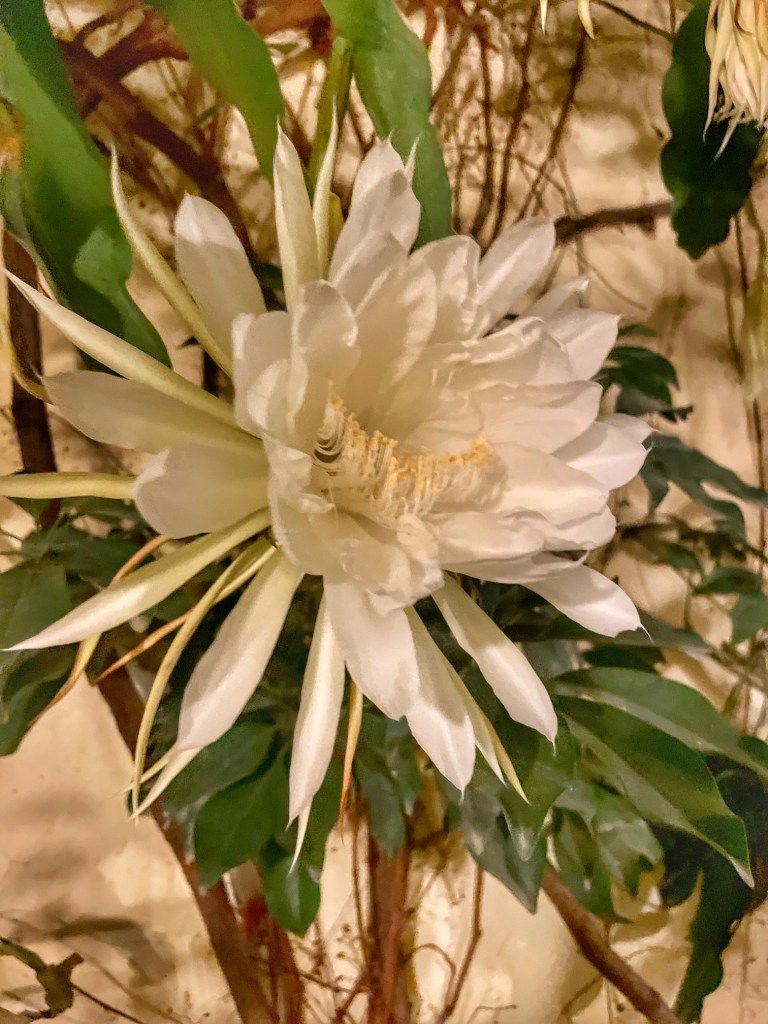
And the Creator said, “epiphyllum oxypetalum, you shall be a cactus, though you do not look like one. Once a year and only at night, you shall bear forth beautiful flowers while the world sleeps. Before dawn your flowers shall wither away, but only before being ravaged by bats.”
The epiphyllum oxypetalum did not understand this curious fate but it knew better than to argue with the Creator.
Perhaps the Creator felt a little guilty because later, the epiphyllum oxypetalum was given a lovely and pronounceable name: Queen of the Night.
Well, this explains so many things: Anthony de Padua is the patron saint of the insane.
Now the Dia de Locos — or Convite de Locos — isn’t so crazy after all.
Well, yes, it is. Crazy, I mean. Very very crazy. In so many delightful ways.
What better way to honor the patron saint of people who have lost their minds than to assemble thousands of people in costumes that suggest they, too, have indeed lost their minds?
“Everything is made out of magic, leaves and trees, flowers and birds, badgers and foxes and squirrels and people. So it must be all around us. In this garden — in all the places.” — The Secret Garden, by Frances Hodgson Burnett.
It is easy to get lost in a garden,
No matter how small it might be.
There you are, sitting in full possession of your mind
Ready to conjure great things that will soon become
I met a woman, in my dreams last night. Her senses are scrambled. She touches through her eyes. She sees through her nose. She tastes and smells through her skin. She listens through her mouth. She speaks through her ears.
Speaking isn’t a sense. I know. But this was her dream. I only happened to walk into it.
“What a fine mess you are in,” I say. “Or is this a path to enlightenment? “Or a punishment? Some sad karma?” Mainly, she remains mute, confused. As would I, in such a confounding scramble.
I ask her if I could walk a mile in her shoes. “My shoes?” she cries. “Do you mean to say that I still have feet?” Just what she didn’t need, someone else in her shoes. “Are they still at the bottom of my legs?” she asks.
Under the circumstances, it was an unkind thing to say.
Swapping sensual responsibilities has its strengths. Imagine listening through your mouth, Drawing in another’s words with your breath. Savoring them, absorbing them, digesting them. You would actually have to listen. Rather than think of some clever retort.
Suppose you speak through your ears. That requires special talent well beyond small talk. I don’t even know how it can be done. My dream offered nothing on this. Maybe, intently listening is a form of speaking. Silence does speak volumes as others chatter on.
Putting your senses to work in areas For which they were not trained Sounds like a grueling, but potentially rewarding, exercise. Sort of like the blind man whose other senses Compensate by growing intensely acute.
Perhaps all senses ought to be rotated once in a while, Like the tires on your car. We grow lazy, only hearing through our ears, Seeing through our eyes, speaking/tasting through our mouths, feeling through our skin, smelling through our noses.
Shake them up, I say! And when, again, we grow too comfortable, Rotate them once more! Keep the fine treads of our senses staying sharp.
Perhaps if we employ all our senses to share the load — Let the eyes do the speaking, let the ears do the seeing, Let the skin replace taste and smell …
Soon, all our sensations grow muscle and power. Newer sensations arise, previously unknown sensations. Next thing you know, the heart and brain Want to engage in this circus of sensations, too. And, then, won’t things get interesting?
We are fully present in processing our environment We are fully engaged in evaluating, understanding, inhabiting.
Deep immersion, full immersion, absorption and immersion.
Life gets more interesting because we will be, well … living. No longer just data-processing and consumption machines. We are higher beings. At one, for once, with the various universes.
The woman in my dream knows none of this just yet. She is still trying to … Touch through her eyes. See through her nose. Taste and smell through her skin. Listen through her mouth. Speak through her ears. Find her footing.
I try to tell the woman in my dream that it will get better. But her face is blank. She betrays no thoughts. The woman in my dream moves on, back to the shadows. She seems neither excited nor saddened.
I gather it will take some time. Perhaps she will come back on another night And show me what she has learned.
Images were generated by artificial intelligence based on the first stanza.
The locos danced through the afternoon under a hot and humid sun, made more challenging by the layers of costuming and bulky headpieces. After hours of parading and trance-like dance, catharsis must come, a cleansing, a purifying, exhaustion.
I don’t know how they do it.
Still, as the sun began to dip behind the San Antonio church, the locos gave way to the folkloricos.
What’s a Sunday morning without a few crazies parading through the neighborhood?
Empty indeed.
We got our share today. The first of three parades around San Miguel de Allende began at the Parroquia an Antonio de Padua around 10 a.m. and danced down Callejohn San Antonio before hanging a left on the Ancha and heading for Centro.
“The artist is a receptacle for emotions that come from all over the place: from the sky, from the earth, from a scrap of paper, from a passing shape, from a spider’s web.” — Pablo Picasso
Spider webs are beautiful things. Unless you walk face-first into one in the dark of night.
Then, not so beautiful. Or interesting.
My friend Sonny once sat for hours on the floor of our Cape Cod house staring at a spider as it wove a stringy orb behind a door. Sonny insisted he learned a lot from observing the construction of the web.











 Musings, Magic, San Miguel and More