San Miguel de Allende, Uncategorized

When you have to wait …

IMG_4471

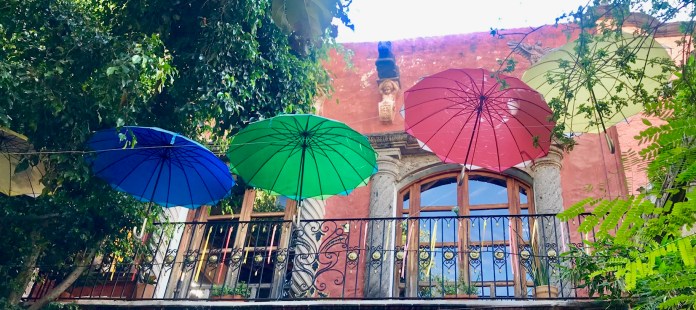
The Umbrellas of Cherbourg hover above the courtyard at Paprika Restaurante.

So often we zip into Paprika Restaurante, catch a concert in the back or check for mail upfront. Then zip out again. Rarely do we slow down to appreciate the many layers of beauty which make up the interior space.

Tuesday, we were fortunate to attend a concert by violinist/composer David Mendoza and pianist Lorelei Capell in the Paprika courtyard. We found ourselves there a little early, which in itself, was a gift.

Stepping off the busy Ancha de San Antonio and into the courtyard is like stepping back in time, to something like 17th century Spain. Or, maybe a movie set.

Every corner, every niche, invites inspection. The eye flits over statues, cornices, carvings, flora, several layers of living space soaring into the sky above, and umbrellas.

Yes, a row of colorful umbrellas. They like artifacts from the French musical “The Umbrellas of Cherbourg” and convey a whimsical air to the setting from above.

As for the concert, there is none better to enhance the setting. David Mendoza has returned to San Miguel de Allende after an absence that was felt by many. He doesn’t just play the violin, he inhabits every note and imbues the music with an intoxicating joyfulness. You should see how people smile when he puts bow to strings. You can’t help it.

Lorelei Capell is the perfect complement to David’s flights of passion. Together they performed a set of deeply moving songs, mostly from classic movies. The set contained a fair number of compositions from Ennio Morricone, including from “Cinema Paradiso,” and one from Yann Tiersen’s soundtrack for “Amelie.”

“It is going to be a very romantic evening,”  Lorelei had said the day before. How right she was!

David went solo for the second half with his own compositions using drum tracks, sound loops, and reverb to augment his meditative and dreamlike music. He gently painted on layer upon layer of sound until a near orchestral density pulled at the heart.

With an uncanny sense of timing, the concert ended minutes before the skies opened and evening showers arrived.

___   ___   ___   ___   ___

David Mendoza performs in concert next on 25th September at Miguel Malo hall,  in the Bellas Artes. You can sometimes catch him around town, sitting in with other fine musicians, like Media Luna which performs Sundays at Paprika.


Standard
San Miguel de Allende, Uncategorized

Then there were clouds

IMG_4443

Clouds are best after the nightly rain.

The rain arrived promptly at 6:45 p.m., courtesy of just one gray-black chunk of water-engorged atmosphere.

It was beautiful. Even if Moppit and I were caught out in the open.

It poured for all of 10 minutes, quickly turning the cobblestone roads into rivers and turning Moppit and me into a couple of drowned rats. (She is very hairy at the moment and looks much more like a drowned rat than me.)

Did I mention that repairs were started today on the roof to stop up a few leaks? Did I mention there are now way more than a few?

Getting drenched. Mopping up the floors. No problem.

Do you know why?

Clouds.

You can’t stay down when the clouds are this beautiful.

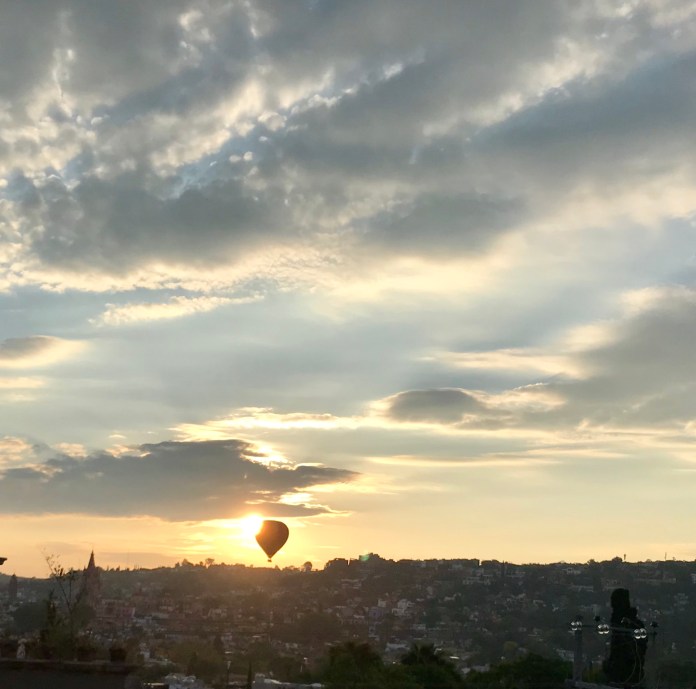
It is my favorite time, after the evening rain, because the sun hasn’t yet set and Old Sol, being the artist that he is, uses the clouds as the perfect canvases for the light and shadow show.

Appearing nightly on a mountainside near you, beautiful clouds of all sorts and dimensions. And making a special guest appearance for a few nights only — the moon.

I love San Miguel de Allende.

(Click on individual images to see full size.)

Standard
San Miguel de Allende, Uncategorized

Festival de Musica de Camara Master Class: Like boot camp for Beethoven


IMG_4393

The four members of the Dover Quartet listen intently as the Chroma Quartet performs a passage from Beethoven’s String Quartet No. 14, Opus 131 on stage in the Angel Peralta Theater on Saturday, Aug. 10, 2019.

I attended a master class this morning. And, no, it was not Malcolm Gladwell or Neil Gaiman writing, or Helen Mirren on acting, or Gordon Ramsey on cooking, or Steve Martin on comedy, or Spike Lee on moviemaking.


Surely your Facebook has been swamped with famous people wanting to teach you the secrets of their craft, through MasterClass.com. (I’m waiting for a “master class” on how to make the perfect pitch for a master class. Because they’re all good …)

Here’s the thing about master classes: By numerous definitions, they are taught by acknowledged experts in specific fields to highly knowledgeable or talented people in the same field. In other words, the best of the best passing along hard-won knowledge to the very people who are nipping at their heels, so to speak.

MasterClass.com has the first part right. Their teachers are awesome, with instant recognition in their fields. Who can sign up for their courses?

 Me. For one example. Maybe even you.

How does that make it a Master Class?  I am a master of none but slightly knowledgeable in many fields. For example, I can breeze through the Monday and Tuesday New York Times crossword puzzles. Maybe Wednesday, if I have the time. The rest of the week? Forget it.


IMG_4386

The four members of the Dover Quartet listen intently as the Chroma Quartet performs a passage from Beethoven’s String Quartet No. 14, Opus 131 on stage in the Angel Peralta Theater on Saturday, Aug. 10, 2019.

So, technically, a master class lifts the already elevated to the next level.


That is no mean trick, making the best and the brightest, even better and brighter.

But I saw a bit of that today. From the audience.

It really starts Friday night when the Dover Quartet gave a mercurial concert at the Angela Peralta Theater, here in San Miguel de Allende. The performance was part of the 41st season of the Festival de Musica de Camara.

The quartet dazzled the audience with an unexpectedly romantic and lyrical composition from Anton Webber, Beethoven’s career-defining String Quartet No. 2 (the one that blew Hayden off the Top 10 charts), and Dvorak’s stirring post-New World Quartet No. 14. All transitional, game-changing, pieces for the composers.

The Dover quad oozes charm, expressiveness, warmth, and fluidity. And not only their music. If you could see their faces as they perform you would melt from sheer unfiltered happiness. They are so expressive in their unspoken communications — nods, eyelid flutters, eyebrow lifts, head tilts — I started mentally writing cartoon captions for them:


IMG_4398

The Chroma Quartet performs a piece from Beethoven.

Camden Shaw, cello: “Steady as she goes, darlings!


Joel Link, violin: “Sweet transition, Milena “(Pajaro-van de Stadt, viola)

Bryan Lee, violin, to no one in particular: “Ah, bliss.

And such forth and so on. 

They like each other.

Saturday morning the four Dover musicians returned to that stage to conduct a public two-hour master class with the rising young stars of Chroma Quartet from Universidad Veracruzana. 

And one hour after the master class, the Chroma Quartet was on the steps of the Casa de la Cultura, near Parque Juarez, delivering a free concert of stunning verve and passion as part of the Music Under the Trees program, produced by the Festival.

Jeeze, what a great couple of days.

The Chroma four certainly qualify as “highly knowledgeable or talented people in the same field.” 

They have performed together since 2015 and recently finished a masters residency at the University of Victoria in Canada. Its members – Ilya Ivanov (violin / viola), Carlos Quijano (violin), Félix Alanis (violin / viola) and Manuel Cruz (violoncello) have taught their own share of master classes as well.

Now, where do they fit in the professional quartet hierarchy with the Dover Quartet?  Now, I am not qualified to say but using the broadest definition of “nipping at their heels,” I’d say catch them if you can because that would give you lots of bragging rights at some future festival. “Yes, I heard Chroma when the ink on their master’s degrees was still wet.”

So this masters class was on stage at the Angela Peralta and the front door was open. (No need to be crass. Yes, it was free to come and see.) The Festival pairs up its weekly headliners with up-and-coming talent on Saturday mornings for the edification of all.

And believe me, it is edifying.

From what I could see, here is how the master class works: the students begin to perform a pre-selected piece — in this instance, Beethoven’s String Quartet No. 14, Opus 131 — and … well … they don’t get very far.

Behind each performer stands their counterpart from the Dover Quartet and each has authority to halt production, point out some discrepancy and share an insight or two before the piece resumes. 

And, boy, did they have a lot to share.

I couldn’t even keep up in my little notebook, and keeping up with talkers is what I did for nearly 40 years.  “Use the dimension if you choose … there’s an innuendo happening here that like in the previous section … the audience expects a release here but Beethoven isn’t giving it to them … you need to fight against a natural tendency to speed up … you’re forcing the sound to get it a little louder …think about the length of it … one more time … when you have a long crescendo, think about what you want to do … each figure has its own shape … different types of crescendi within the same figure … dynamic surprises are easy to find … maybe you rushed it …volume and texture are really nice here …you’re so close, don’t over-tink it.

The torrent of observations is so rapid that sometimes the musicians eschew language for sing-song mimicry of a key passage.  “It is like this, da-de-de-deeee-de dah!”

Heads nod in assent. They get it. They’ve all been there.

As a member of the audience to this spectacle, my admiration grows immeasurably for the complexities that inhibit and inhabit of four musicians rolling that single jagged rock up the hill in unison.

The myriad details each musician must hold in his or her head while performing in some sort of unison with three other people is staggering. And Beethoven. He was the guy who famously responded “Not my problem” when musicians complained about the technical complexity of performing some of his compositions.

Then again, there is no way that the members of the Chroma Quartet could possibly absorb and internalize all of the data flowing in their direction at the speed of the superior knowledge of the Dover team. 

We sat and watch the Chroma performance being deconstructed even as they tried to play through it. 

And yet, it all comes around again as a whole and the elusive “fifth voice” begins to emerge, and rise, and hover just above the performers with a light all its own that spreads throughout the auditorium. It is the seemingly magical joining of four disparate instruments in such a bonded performance that it has a unique color, shape, phrasing, articulation, depth, resonance, and personality of its own.

It is the elusive essence that makes a quartet unique among the many many other quartets playing the same compositions. 

I don’t know what the Chroma Quartet got from this session. It was two hours out of a lifetime.

Most likely what they got can’t be adequately articulated. But it is there. Inside them. I’m willing to bet that the next time they sit to play Beethoven, that fifth voice will begin to emerge.
 

IMG_4408

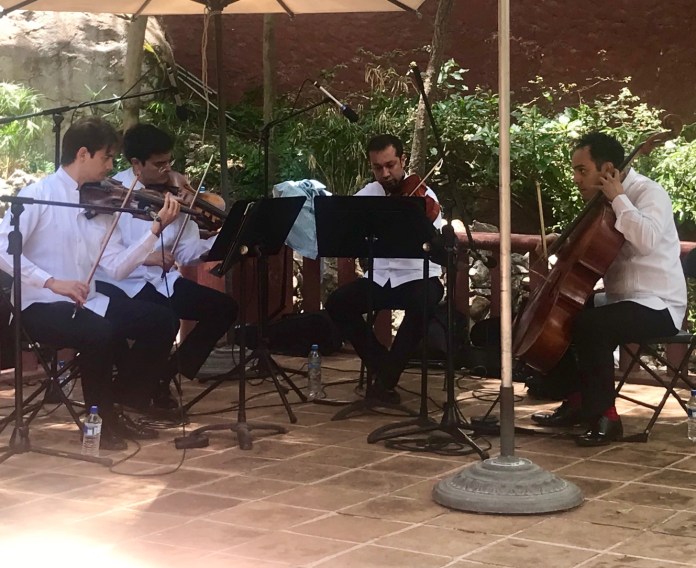
Double-duty for the Chroma Quartet: Following the master class, they rushed over to the Planchas del Chorro,  below the House of Culture, to perform as stars of the Music Under the Trees series.

The Chroma Quartet had a chance to apply all that an hour later in the open-air concert on the Planchas del Chorro,  below the House of Culture. Unleashed from the “classroom” they plunged into a program that roared through time with pieces from Bach to Mozart, to Schubert to Paganini to modern times with Blas Galindo, Arturo Marquez, Eduardo Gamboa, and even a rearrangement of George Shearing’s jazz nugget “G & G.”


A perfect tour de force for an outside venue.

___   ___   ___   ___   ___   ___   ___

Next Saturday, Aug. 17, at 10 a.m., the Gryphon Trio will present a master class with Trio Naab from Mexico City. It is free. Stop in, buckle up, and get ready for the ride of your musical life.

Also, Chroma Quartet will no doubt return to San Miguel in the future. Possibly after the release in September of their first CD, “Chromaswing,” in collaboration with renowned jazz pianist Edgar Dorantes. I wouldn’t miss that performance for the world.


IMG_4415

Music Under the Trees is a free series put on every second Saturday at the Planchas del Chorro,  below the House of Culture, by the Festival de Musica de Camera.

Coda:


The young Buddhist postulant sat cross-legged on the cold stone floor of the temple, the very model of repose. His hands were clasped in his lap. His eyes were cast downward, while his posture was erect.

In front of him sat the old bikkhus, a Buddhist monk of many years, who came to this monastery as a child.  He was nose-to-nose with the postulant. His breath was smelly but he said not a word. Instead, he lit small firecrackers on the end of a string tied to a pole.

The postulant occasionally flinched but mostly he stayed deep in his meditation.

The old monk’s purpose was not to distract the young man from his daily meditation but to drive him deeper into it.

One day, when the young man was no longer young and no longer a postulant, he gained notoriety for sitting as still as a statue while a fierce battle for control of the monastery raged around him. Arrows flew in all directions, many with flames or gunpowder attached. 

The monk was untouched and unaware of the events surrounding him. 

I thought of this story this morning as I sat in the Angela Peralta Theater in San Miguel de Allende and watched members of the wonderful Dover Quartet conduct the two-hour master class with the rising young stars of Chroma Quartet from Universidad Veracruzana.

That is very much what the teachers were doing: Driving their pupils deeper and deeper into the Beethoven ethos until they are the masters of the realm.

Standard
San Miguel de Allende, Uncategorized

Going micro at El Charco del Ingenio

IMG_4368

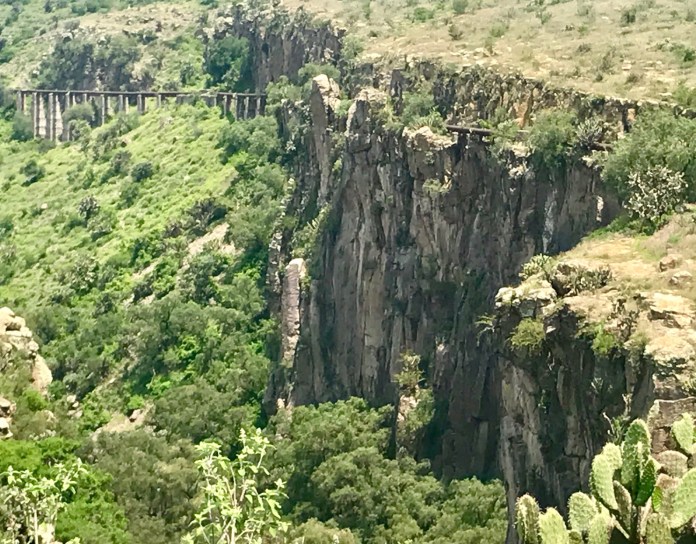
A view of the opposite wall of the canyon from El Charco. One of the few “scenic” photos I allowed myself today.

A wise old friend once said, “If you really want to observe life in the desert, get down on your hands and knees.”

His point was, everything that goes on in the fissures and tiny patches of shade on the dessert floor is every bit as complex and magical as the sweeping vistas and craggy mountain ledges and canyons and arroyos.

And he was right, you know. Thanks, Bud Murphy, where ever you may be.

I was thinking about old Bud this morning as we hiked up to El Charco del Ingenio, the jardin botanico in San Miguel de Allende. Two weeks ago when we hiked up here, I was mesmerized by the big picture: beautiful trails, the Presa las Colonias, the ancient canyon below the reservoir dam, the vast diversity of central Mexico flora on display.

Today, it was different. In the intervening two weeks, the rains have returned. Everything is green and healthy. The reservoir is spilling over just enough water to activate some of the canyon waterfalls.

But my focus was on the extraordinary patterns and textures of many of the plants in the garden, especially the cacti.

So, here is some of what you find when you get down on your hands and knees and look deep into the biosphere. Click on each image for an expanded view:


Standard
Memoirs -- fact and fiction, Uncategorized

Hanging out on Leo’s private island

leosisland

Walking around Blackadore Caye on my birthday in April, 2016, enjoying the splendor of a deserted island — with 20 of my best friends!

Did I ever tell you about the time that my wife threw me a surprise birthday party on Leonardo Di Caprio’s private island off the coast of Belize?


I know what you are thinking so let’s clear that up right away: No, Leo did not attend the party. Was he invited? I don’t know. Should have been. It was his island, after all.

But 20 of my closest friends on Ambergris Cay, where we lived, did show and that was party enough for me.

In fact, it was on a Sunday.  I sat on the porch reading the New York Times online when a boat filled with laughing and shouting people pulled up to our dock. They started singing “Happy Birthday.”

That’s when I learned we were going to spend the day on Blackadore Caye.

c-monkey

Wow! Imagine the shock of looking up on a Sunday and see the C-Monkey loaded up with friends ready to help celebrate my birthday on a deserted island! They had party horns, food and drinks aboard, too.

For a newspaper writer who is a trained professional observer, it is pretty easy to pull off a surprise anything on me. My wife, Rose, did it again this year on my birthday here in San Miguel de Allende,  just as she did the first year we were together, at Lake Tahoe.


(Which reminds me, her birthday is coming up in early September. Any suggestions will be greatly appreciated! But keep it between you and me ….)

We all boarded one of our favorite island transports, the C-Monkey and an hour and a couple of cold rum punches later, we were on the island.

Blackadore Caye is three miles long and barely a few hundred yards wide. If you were to make a movie about being stranded on an impossibly beautiful and deserted tropical island, this would be the place.

You can see pictures here and read a bit about the party.

leosisland1

The landscape on Blackadore Caye hasn’t changed since this visit in 2016.

I am writing this is because my old friend and Belize blogger Rebecca “Scoop” Coutant just posted yet another blog about Blackadore. I say “yet another” because over the years she and I were constantly posting stuff about Leo’s plans for turning the island into a high-end, environmentally-responsible, resort and residential paradise.

Rebecca recently re-visited the island and reports that it is virtually unchanged. You can read her latest account here.

Frankly, it may never get developed. The more Di Caprio’s partners tried to be responsive to local concerns and be responsible guardians of the environment– well, the deeper into the muck sank their plans.

The whole dream development has been shelved.

Meanwhile, as Rebecca points out, some incredibly shitty and sleazy developments are moving forward at the speed of many a greased palm. That’s just life in a corrupt Caribbean nation, I suppose.

I feel bad about Blackadore. It could have been one of those showpiece developments that define a whole country and could have set the bar high for all future projects. Of course, it would have become a place that I couldn’t even dream of visiting.

As it is, thanks to Rose and a bunch of great friends, we’ll always have Blackadore — as it is now.

Thanks for the memories, Leo.


Standard
Uncategorized

‘To see ourselves as riders on the earth together…’

earthrise

Apollo 8 astronaut William A. Anders took this celebrated shot of the Earth “rising” on Christmas Eve in 1968. NASA photo

Fifty years ago, when man landed on the moon, The New York Times turned to a poet, Archibald MacLeish, to place the event into some sort of context on its front page.

Seven months earlier, when the astronauts of Apollo 8 had become, on Christmas Eve, the first humans to enter the moon’s orbit, Archibald MacLeish also interpreted the meaning of it all for the Times, but in prose.

He referred to humankind as “brothers,” as was common then. If you overlook that, his concluding paragraph is profound:

“To see the earth as it truly is, small and blue and beautiful in that eternal silence where it floats, is to see ourselves as riders on the earth together, brothers on that bright loveliness in the eternal cold — brothers who know now they are truly brothers.”

I pray that when we next visit the moon, it will be for the benefit of all humankind and not the personal glorification of one.

Standard
San Miguel de Allende, Uncategorized

Woke up this morning …

IMG_4281

At sunrise this morning, August 4, 2019, in San Miguel de Allende.

IMG_4280

Same view of sunrise, Aug. 4, 2019, from a distance. Kind of a Mary Poppins feel to the morning …

Standard
San Miguel de Allende, Uncategorized

When family ties are stronger than country, love finds a way home

IMG_3934

Omar Rogel and Alena Orwin and their family, shortly after being reunited in San Miguel de Allende. Omar grew up in the United States but was deported in late 2018. He was three years old when he first arrived in the U.S.

Sometimes stories need to be told over and over again, stories in which bad things happen to good people but they persevere, they stay strong, and they keep the faith — and in the end, they win.

If you can call being driven from the country you love “winning.

Make no mistake, Omar Rogel and Alena Orwin love the United States. Or did. I’m not sure how they feel now.

Alena was born in the U.S. Omar was not. But it is really the only country he has ever known.

You knew this was coming. Omar was brought to the U.S. when he was three years old.

Three.

He grew up there. He was educated there. He earned an honest living there. He made friends. He married Alena there and they were raising three beautiful children.

Behind all this, Omar tried hard to become an actual citizen, not just a de facto one.

Last September, Omar was called in by ICE for a “meeting.” He and Alena were excited. At last, they thought, citizenship. Immigration put Omar in cuffs and deported him to Mexico. He barely got to say goodbye to his wife and children, or friends or family.

According to Atlanta’s TV station 11Alive an ICE spokesperson said, “Mr. Rogel-Brito was ordered removed from the U.S. by a federal immigration judge in 2016, and the courts subsequently denied two appeals in January 2017 and December 2017.”

ICE also pointed out that Omar also has misdemeanor convictions for trespass, disorderly conduct, and obstruction of an officer.

Misdemeanors.

As if some misdemeanors justified ripping a good family apart. In the U.S. we elect felony perverts to high office and give them daytime privileges while they do vacation time in resort prisons.

Misdemeanors.

Omar had, I think, the good fortune to end up in San Miguel de Allende. I say “good fortune” because when you grow up in the U.S., San Miguel is about the friendliest halfway house to assimilation back into the Mexican culture that you can hope to find.

Omar found a home in San Miguel and employment as a teacher of English to young students.

Alena, meanwhile, kept the family together in Atlanta. She tried to get her husband’s deportation overruled. They shared birthdays and special events over Skype and Facetime and other social media.

Eventually, a hard choice was made — family is more important than country. Alena and the kids decided to move to Mexico to be with the husband and father they all love.

Alena had never been to Mexico and her children can not speak Spanish.

How terrifying that must be.

They arrived Wednesday in Queretaro. The airport was filled with hugs and tears and screams of joy, according to my friend John Bohnel, who was there.

Somewhere, John had heard about Omar and his story and decided, as John often does, that he would make a positive difference in this family’s life. John’s a guy from Jersey with a big heart and a well-defined sense of indignation when he sees injustice.

John immediately saw the inherent cruelty in Omar’s and Alena’s story. He felt shame for his own country, as does everyone who has heard this story.

Wednesday was also John’s birthday but he’d postponed the celebration for a day. On Thursday, John threw a “surprise party” at the house of his friends Scott Simmons and Cathy Taylor and he insisted that Omar and Alena and the kids be there to make new friends. He wanted to turn his birthday celebration into a Welcome to SMA Party.

Which is exactly what happened. Omar and Alena damn near got hugged to death by John’s friends, Rose and myself included. They are easy to like and everybody is anxious for them to have a beautiful future in San Miguel. The kids got to play with Cathy’s pet turtle and her big fat old cuddly rabbit.

The artist Efrain Gonzalez showed up and he brought the musician Yaya Fuentes who performed on a Swiss steel drum called a Hang and sang a mesmerizing tune in Sanskrit. Efrain also brought a large painting of an angelic little girl that he just completed, inspired by a photograph taken recently by John Bohnel.

Efrain’s idea was to put the picture online and auction it off to raise money for San Miguel’s newest immigrant family. Something to help them get started.

A group at the party pooled the contents of their wallets and enough money was raised to outbid any possible contenders in an online auction. In the joy and confusion, I gathered that the painting would go to Omar and Alena, maybe go to the Biblioteca public library, or maybe even be auctioned off again.

Anyhow, generosity and love and giant slices of birthday cake were fueling an incredible high the other afternoon.

For Omar and Alena and their children, there is hard work ahead. San Miguel is pretty amazing but it is not Atlanta. There is a lot of new culture to be assimilated. And Spanish, the kids will be learning Spanish and that is a little daunting to them right now.

There are the less tangible things too — the loss of home and friends and family in Atlanta, the abuse at the hands of authority, the trauma of separation, the feeling of imbalance and displacement. All this will be dealt with in time.

As Alena has said through it all, “One step, one day at a time.”

This story was written in July 2019.

Three variations on a teaser for video documentary about Omar and Alena:

  1. “One day you are living the American Dream — a great job, a beautiful family, a stake in the community. Suddenly you are being uncuffed by ICE agents at the Mexican border and told to keep walking. South. Omar Rogel and his family are lucky. They turned this tragedy into a beautiful new life, but one that will likely never again include the country that was the only home they ever knew.”
  2. “Children are being ripped from the arms of their parents when they cross into the United States.  But did you know that whole families in the U.S. are being ripped apart, too? Here’s what happened to one family of five when the father, a U.S. resident since he was 3 years old, was deported to Mexico. Not all stories end as well as this one.”
  3. “Omar came to the U.S. with his family when he was three years old. For 33 years he lived the American dream — athlete, honors student, father, employee, pillar of his community. That didn’t stop ICE from arresting him like a criminal and deporting him to Mexico. “
Standard
Memoirs -- fact and fiction, Uncategorized

A 2020 election? Time for Love 22 to run for president, again

love22Back in 1975 while trying to write a short story in the noisy University of Rhode Island student union, a peculiar string bean with long, long black hair under an Uncle Sam hat leaped atop a table and began to preach.

He was an “abecedarian,” a practitioner of the magical art of distilling everything in the world to the number 22. He proceeded to assign numerical values to the letters of the alphabet: A=1, B=2, C=3. Pretty simple stuff. But then he would take a word or sentence and slice and dice it by the numbers and with enough leaps of logic and poetic manipulations all that was left, in the end, was the number 22.

My short story was about a rogue CIA operative who lost a daughter named Julia to drugs at a rock concert and avenged her death by killing Jim Morrison, Jimi Hendrix, Brian Jones, Janis Joplin … all with first or last names starting with a “J.”

Anyhow, I put the story aside and focused on the deranged individual who by now had the rapt and largely stoned attention of the whole student body.

His name was Love 22. Yes, legally.

He made his fortune by inventing a little thing he called two-for-one coupons. Remember those? You’d buy a book filled with “twofers” for restaurants, movies, ice cream, tons of great date-night things. It was a massive hit.

And he eventually crashed and burned and when the Phoenix arose from the ashes, he was Love 22.

He was running for governor because the RI gov’s office is No. 222 in the capital building and because the capital in Providence is the No. 22 point of interest on the official Rhode Island tourism map. These things were true. I checked them out.

In fact, a lot of things that add up to 22, well, added up.

love22billsOne bogus but cherished item was the 22 dollar bills he handed out with his face on them. Those were keepers.
Once you start looking at life this way, it is very hard to turn away. Even to this day, I find myself pausing to look around when a clock hits 2:22 p.m., just to see if there is magic, whimsey or practical nonsense about.

I wrote about Love 22 for the local weekly paper, where I was working part-time.

A year and a few months later, I would find myself graduated from URI and the editor of that newspaper, The Narragansett Times.

Love 22 would drop by occasionally to announce wonderfully preposterous stunts like, he was going to set the world record for tossing a frisbee out to sea and catching it upon its return.

My favorite Love 22 stunt came around every Easter. In our neck of the woods, there were two fishing villages, Jerusalem and Galilee, divided by a wide channel. On Easter Sunday, Love 22 said, he was going to walk on top of the water from Jerusalem to Galilee.

I loved that but lacked the maturity and wit to appreciate the humor and write it up for our stodgy New England newspaper.

Did he do it? I don’t know. I had kids and Easter Sunday meant finding eggs, and refereeing chocolate-driven sibling spats, and reading the Sunday New York Times.

Not everything you love lasts forever. I moved on to a daily newspaper and Love 22 moved on to, well, god knows.

So what a shock to see that he is still alive and now running for president in 2020. Mark Patinkin, a PJB columnist I admired back in those days, recently wrote a column on Love 22.

He’s 82 and residing in a third-floor flat in an assisted living center. But he is still Love 22. And he’s gearing up a run for president in 2020 because … it is 2020. If zeros = nothing, then 2020 = 2 nothing 2 nothing = 22. It will be the Year of Love 22. Don’t you see? 

As for that short story, I never finished it. Or maybe it was supposed to be a novel. Either way, Love 22 was a better story. Still is, apparently.

Standard