That’s Doolin in the distance, the end of the first day hiking the Burren Way.
We’re In the Rock Shop Tea Room, well south of the Cliffs of Moher, an ironic place to begin a five-day hike around the rock-strewn Burren Way. Buying stones to add weight to our backpacks has no appeal but tea and scones do. And, I won’t kid you, it is awfully cold outside.
No need to rush into this thing.
Besides, my stomach needs to settle after riding the 350 Eireann bus along sinuous, snaky, undulating, rolling lanes for two and a half hours – essentially doing in reverse what we will attempt over the next five days.
At our table, we face the Atlantic and Hag’s Head Point as we sip coffee, tea, and scones. Sooner or later, we’ll have to step out the door and step onto the trail.
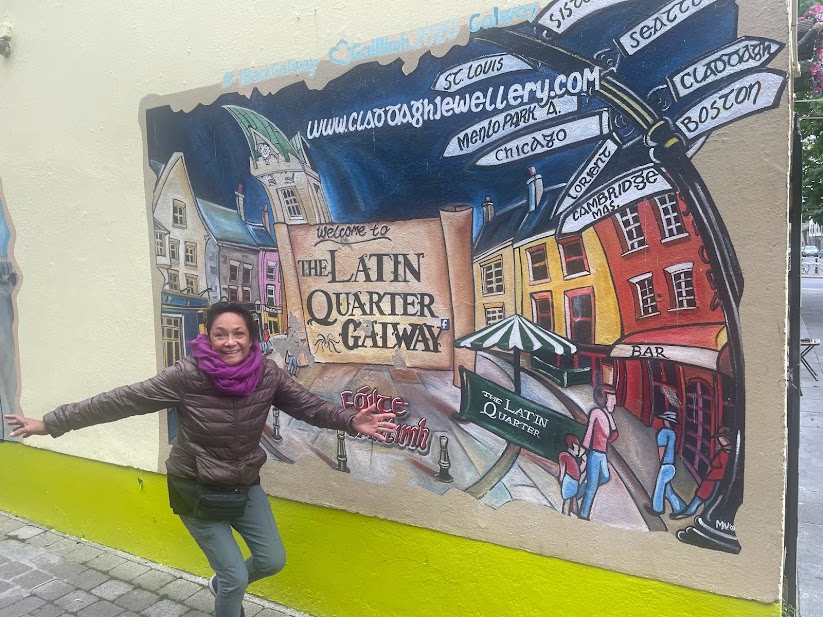
Rose Alcantara finds fresh energy while walking through Galway’s Latin Quarter.
Before you set out to walk The Burren Way in Western Ireland, you are entitled to a bit of self-indulgence. Some good food and drink, some music, some flat terrain to walk, some shopping, perhaps.
Self-indulgence doesn’t get any better than bookending the Burren with Galway and Dublin.
That’s the plan: Live it up in Galway and Dublin, walk it down on The Burren Way.
On the road to Fanore from Doolin on the Wild Atlantic Way, County Clare.
A walking vacation in Ireland was supposed to be a birthday present from Rose Alcantara to me a couple of years ago. We both thought that the idea of a 70-year-old man walking around the Emerald Isle was perfectly sound and a touch romantic.
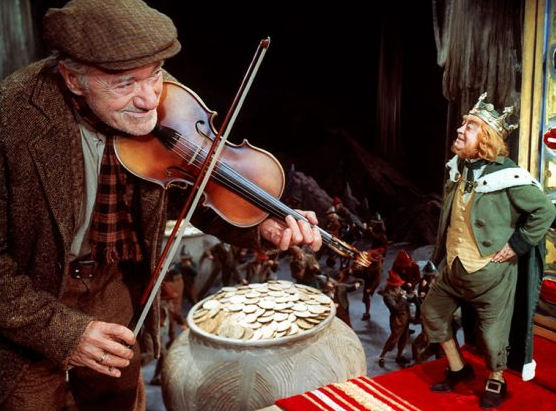
Albert Sharpe (left) as Darby O’Gill and Jimmy O’Dea at the Leprechaun King — this is the image I was working with as I envisioned walking around Ireland.
You know: a shaggy old gent dressed in tweeds, canvas spats, a carved walking stick, one of those adorable wool caps the sheepherders wear, a small daypack with wine, cheese, and brown bread. Maybe a pipe.
I envisioned gentle green-carpeted trails beside burbling brooks from which I could snag a trout on a fly rod for dinner back at the lodge. There would be castle ruins, steaming beef stew, leprechauns, sheep a plenty, and fey red-headed colleens waving from windows as I walked through quaint and ancient hamlets.
You know what happened. Because it happened to you as much as it happened to us. And it wasn’t banshees, laddie.
I have a subscription to The New Yorker, the print edition. It is the one magazine that I like holding in my hands while reading.
Circling unfamiliar, fanciful, and inventive words is part of my reading habit. Circling whole paragraphs. Underlining brilliant turns of phrase. Highlighting exciting writing. This magazine feeds that habit well. The writing is occasionally above my fighting weight, and I appreciate that.
Every time I read The New Yorker, I come away feeling a little smarter, a little more informed, and definitely motivated to keep writing.
Living in Mexico, the New Yorker can arrive two or three weeks later than it should. More often than not, it is the only thing in my mailbox. Late delivery didn’t matter when the content was less topical. Good writing is good writing and it is timeless. I always valued the New Yorker more for its literary content than for its news.
Even the front-of-the-book calendar on events happening in New York City is entertaining, even when those events occurred several weeks ago. New Yorker writers are like the city — bright, challenging, acerbic, engaging, chatty, witty, savvy and, above all, never dull.
The New Yorker is trying to be more timely and that works against my cross-border mail delivery universe. It is still some of the best writing around but by the time the magazine reaches my hands, the rest of the world has moved on. Now, when I pick up a copy, I find that I’ve read most of the stories online.
I also have a large stack of old New Yorkers that I am reluctant to throw out. It feels like hoarding.
So, I thought, time to switch to an online subscription.
Imagine my surprise, then, when I went online and found that my print subscription expired March 1, 2015.
Is that even possible?
For years, the New Yorker has been arriving faithfully, sometimes two at a time after especially long delivery droughts. And I’ve never once paid my subscription?
For once, I am moved to use two words I despise to describe this moment: existential crisis.
My prized subscription, my only subscription to a printed thing – and I’m what? A glitch in the operation? A bug in the system? A ghost in the machine?
This is a computerized universe. We are a data-driven society. Marketers can tell when your stomach is growling or when you are leaning more Democrat — and swiftly rectify the course of things with ads uniquely chosen for your predicament. To say we are living our authentic lives today means that we are jogging beside a digital stream that knows our every need, predicts our every whim — and responds accordingly.
Usually, an alert arrives well before a subscription expires. Most offer automatic renewal if you choose to take no further action. My online newspaper subscriptions work like that. Convenient, timely, and seamless.
I am not the most conscientious bookkeeper when it comes to my bank accounts. Most times I don’t even think about it. The pension and Social Security come in and the bills get paid. If there is anything left, that is gravy.
I don’t recall an expiration or renewal notice from the New Yorker‘s data grinders. That would have gotten my attention.
Recently, The New Yorker did send me a rejection letter for an essay that I wrote for the magazine’s Shouts & Murmurs section. I sent it in about six months ago and they did warn me that the backlog was horrific. (Ie: “Don’t hold your breath.”)
It was my first New Yorker rejection and didn’t hurt nearly as much as I thought it might. It wasn’t even an, um, existential crisis.
I actually felt at the time that the humor in my essay was more topically in tune with David Egger’s McSweeney’s magazine. I had a momentary dream of submitting to both, having both simultaneously accept the article, setting off a fierce bidding war that resulted in publicity to all the right people and a three-book publishing contract with an embarrassingly frothy advance.
Instead, I thought, let’s give the New Yorker a chance. It was, after all, my first love, in a literary sense.
So, months after submitting, and forgetting like a furtive one-night stand, I found out that I wasn’t ghosted. I was rejected.
In fact, it felt pretty good. How many people can say they got turned down by The New Yorker?
Real answer: Lots. And often.
Getting published follows the same rules as winning the lottery. You have to buy a ticket to win. And most likely, you’ll need to buy lots and lots of tickets before you get a winner.
Many writers are rejected dozens of times before a submission is accepted for publication. The magazine is that good. Cartoonists have it even worse. They can be rejected 30 or 50 times before making it into the magazine, although I believe the cartoon department is set up to more quickly reject a submission than other sections of the magazine.
I don’t really think I’m New Yorker material as a writer but you never know.
The trouble is, I’m in the Grandma Moses phase of my literary life. (Look it up, kids.) I don’t know how much is left in the tank and how much of it is worthy of rejection by prestige publications.
By now you might be thinking, “This is all well and good, Bob, but I think you are avoiding the existential crisis that initiated this essay.”
And you are right.
And I don’t know what to do.
I feel like I should submit this to “The Ethicist” column in the Sunday New York Times.
But wait. I’d better check and see if my NYT subscription is up to date.
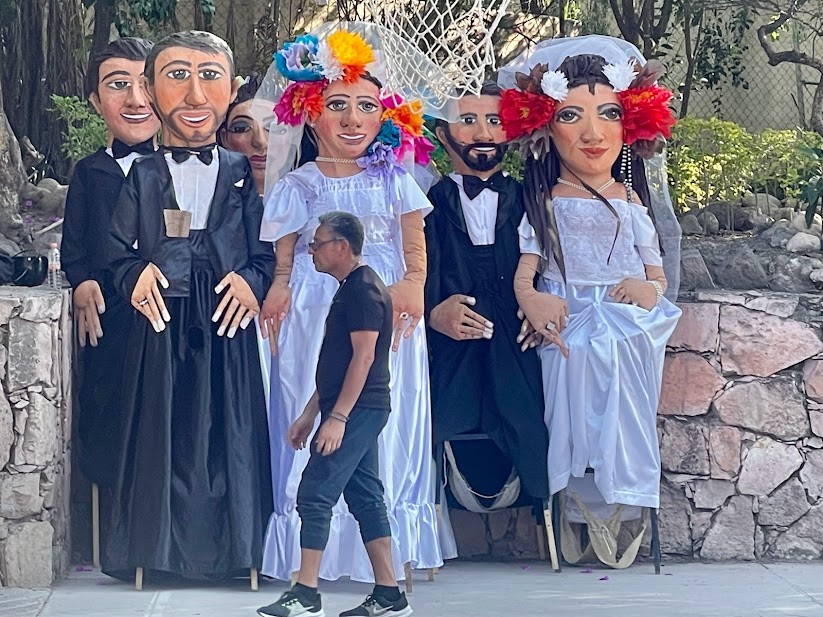
Hermes Arroyo walks past a collection of his mojigangas on the old basketball court, awaiting their chance to lead wedding parties through Parque Juarez on Friday evening.
Moppit the Philosopher Dog is pretty insistent that I take her for a walk, no more than 10 minutes after she finishes her 5 p.m. dinner. She is a creature of habit. Moppit starts a huff-snorting sound around my ankles if I’m not reaching for the leash, the kind of sound a woman makes when the husband comes home late smelling of booze and perfume and mumbles “biznish shmeeting.”
lately, it has been in the high 80s around 5 p.m. here in San Miguel de Allende, so I try to reason with her.
The popular Colonia San Antonio art walk, MyStudio/MiEstudio, will be back bigger and better than ever this year, July 16 and 17, from noon to 5 p.m. on both days.
Like so many events, the tour of neighborhood studios and galleries went on hiatus during the Covid lockdown. It returned last October as a down-sized two-day pop-up art show at the Institutio Allende, Ancha #22, attracting about 30 artists.
This year, MyStudio/MiEstudio returns to the neighborhood streets and organizers are expecting the biggest show yet – more artists, more studios, more galleries, more sponsorship opportunities, more restaurants, and cafes.
“There will also be a preview exhibit at Instituto Allende,” confirms Instituto director of operations Zara Fernandez, the event organizer with Peter A Davis.
“This is a very well-attended community event,” says Fernandez. “Visitors will want to lunch and shop all through Colonia San Antonio during this event.”
In the last couple of years, San Antonio has enjoyed a boom in restaurants, cafes, bakeries, tiendas, and especially a stunning array of street murals, and is gaining a reputation as one of San Miguel de Allende’s most walkable neighborhoods.
My Studio Art Walk got its start in 2013 as the San Antonio Open Studios Art Walk. The event has undergone a couple of changes in name and changes in organizers but the goal has always been the same — to connect the rich wealth of artists in San Antonio with the greater community.
A few years ago, the art walkabout felt like something out on the frontier. Even so, by 2019 there were 51 artists exhibiting in the Colonia and the event drew thousands of people. It has grown into a highly anticipated opportunity to meet with artists in their studios, homes, and galleries, talk with them about their work, and even pick up some prized pieces at surprisingly good prices.
Organizers anticipate that many participating sponsor restaurants and eateries will offer specials during the event.
The variety of art on offer has grown as well.
“In their studios, you will see a broad variety of materials and an eclectic expression of these materials,” says Fernandez. “Paintings are large and small, abstract and figurative. Clayworks and sculptures are varied. Jewelry embraces beautiful beading, and recycled and unconventional metal pieces. Photography ranges from traditional to digitally manipulated. You will see mixed media mandalas, weird wonderful masks, calligraphy with collage, printmaking, and drawing.”
MyStudio/MiEstudio will be printing up 5,000 colorful maps of the Colonia with the locations of all artists and participating restaurants, cafes, and shops – all marked and numbered for an easy stroll through the neighborhood.
To enhance the exposure of the exhibitors, MyStudio/MiEstudio will create short interview videos with each registered participant. Interviews will be held at the Instituto Allende on June 12th and 13th from Noon to 5 pm. The Instituto Allende website NEWS section will also carry bios of the exhibiting artists and examples of their artwork.
An outreach program to encourage native Mexican artists living in Colonia San Antonio to exhibit their art during MyStudio/MiEstudio has been revived. The entry fee ($850 pesos) will be waived for eligible participants.
The deadline for all artists to submit applications and fees is June 10.
To qualify as an exhibitor, artists must live and/or work in Colonia San Antonio, and have done so for at least the past six months. Those who lived in San Antonio before the Covid pandemic and showed in previous MyStudio/MiEstudio events are also eligible to exhibit.
For more details, contact MyStudio/MiEstudio at mystudio@instituto-allende.edu.mx .
This is how we sometimes feel the first time we head out into the public square after quarantining at home for 18 months. These two are currently hanging out in Parque Juarez, through Dia de Muertos.
She’s right, you know, my new friend from the housewarming party the other night: I haven’t written on the blog in a long time.
I owe you all an apology, if, indeed, you actually missed me.
If not, then, hi! Welcome (back) to my blog.
You know how these things happen — someone starts a blog and it goes great for a while, then a pandemic strikes, and life as we know it is suspended. So the writer begins writing interior monologues, surreal short stories, overly long recollections about that dream from last night, and, in the worst of cases, poetry.
As far as hurricanes go, Earl wasn’t a great hurricane. Certainly, it wasn’t the worst, hardly the worst of the seven hurricanes of 2016.
But it was our hurricane.
Most hurricanes that year sounded like the cool kids in high school — Alex, Bonnie, Colin, Danielle, Fiona. And then, “Oh, look. It’s Earl. Quick, spread out so he doesn’t come sit at our table.”
Earl might have started as an under-achiever but he was the first full fledged hurricane to reach the western Caribbean in four years. Earl plodded slowly through Belize and the lower Yucatan, making a mess for sure but after a dip in the Gulf of Mexico, he turned into a mean and wet bastard of a tropical storm that killed at least 45 people in Mexico from mudslides.
Fields of mustard seed brighten the walk to the Presa along Camino a San Miguel Viejo.
Sometimes you just have to get out there and walk. Anywhere will do. Just walk.
Most mornings, that’s me walking Moppit, struggling for control over the master/pet dynamic with a willful and intelligent opponent.
I want to go left, she wants to go right. We both freeze in our tracks and engage in a game of blink, staring into each other’s eyes with fiercely competitive stares. It is Moppit who decides when she’s had enough of this walking nonsense and communicates her desire by sitting firmly on her tush. It is Moppit who sets the pace, decides what needs to be sniffed or peed upon. For my every step forward, she executes a complex zigzag pattern worthy of her genetic heritage.
She is a sniffer, a searcher, a chaser, a marker of vast territory.
Of all the words to describe this peculiar existence we are in today, I have the most trouble with “quarantine.” I simply can not recall this word when describing how we are living these days.
It is blocked from my memory. Unlike the actual quarantine which we live minute by minute in our homes.
Ah well, I’m not here to summarize 2020 — nor analyze. I can offer no grand insights, survival tip, recipes, bromides, earned wisdom, nor life lessons. It happened. It ran over us and didn’t even honk the horn or stomp on the brakes. There were no skid marks. We just took the full brunt of its force.
And here we are. Hello, 2021. Show us what you’ve got.











 Musings, Magic, San Miguel and More