

On Tuesday, A SpaceX Falcon 9 rocket launched, “the company’s 12th rideshare mission to a sun-synchronous orbit. Onboard are a variety of customer satellites, including 35 satellites integrated by Exolaunch along with 36 SuperDoves and Pelican-2 from Planet Labs PBC.”
On Wednesday, SpaceX launches its “sixth, suborbital flight test of its fully integrated Starship rocket, a combination of the Ship upper stage (S33) and the Super Heavy booster (B14). SpaceX plans to catch the Super Heavy booster using the chopsticks on the launch tower, but will make a final determination on the catch following liftoff and stage separation.”
On Thursday, a Blue Origin New Glenn rocket will launch the company’s previously delayed Blue Ring spacecraft, which is capable of both hosting and deploying multiple payloads.
(Source: spaceflightnow.com See update at bottom of this page.)


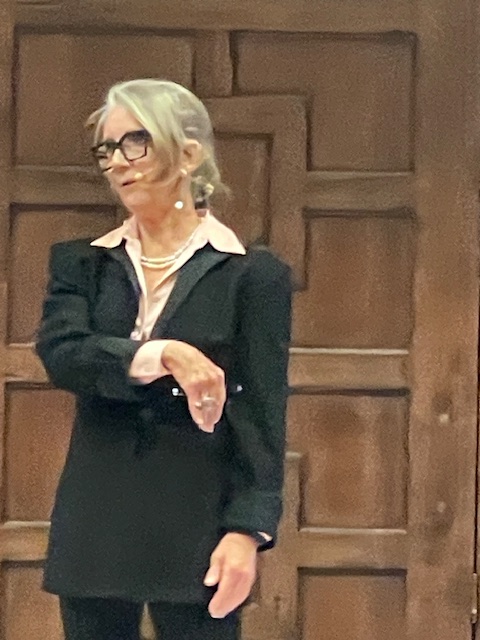
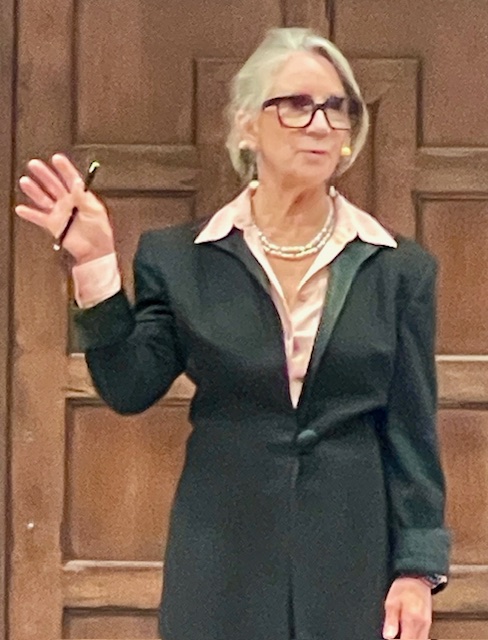

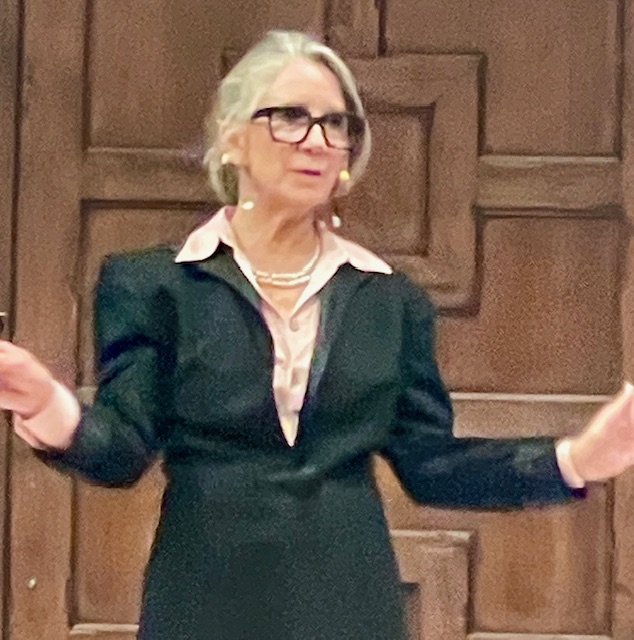

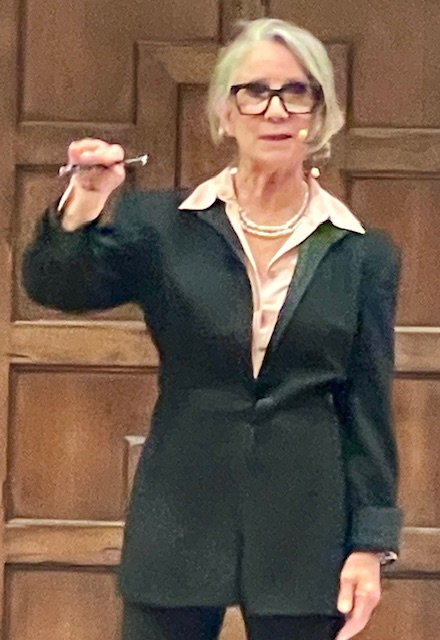
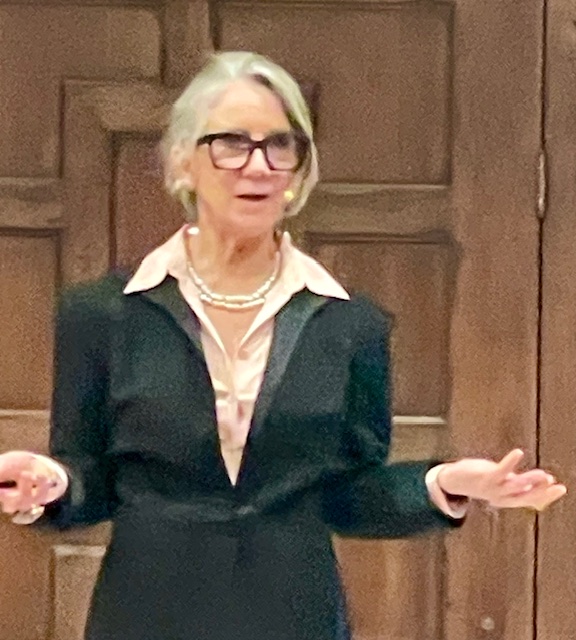
Also on Tuesday, space and security expert Dr. Nancy K. Hayden discussed the future of outer space and the increasingly heavy and chaotic traffic that is shooting out of planet Earth like hair plugs out of Elon Musk’s head.
Her talk for the i3: ideas that inform and inspire‘s Conversations with Big Thinkers lecture series at La Casona Event Center was first promoted as “Space: Brave New World or Wild Wild West?” Somewhere along the line, out of respect for the growing congestion on the extraterrestrial freeways surrounding Earth, she added a third possibility — “Close Encounters” — to that title.
Dr. Hayden is an expert in space policy and technology with a background in scientific research and national security and she painted a vivid, if complex, picture of the many scenarios facing us as more and more players jump into the space race.
It seems that unless you have a rocket launching into space, or a payload riding on someone else’s rocket, you don’t have a seat at the table with the Big Boys and Girls for the biggest game in town. “Town” being our universe, as we know it so far.
It’s getting crazy. Sixty countries or entities now have space programs. The space economy was $344 billion several years ago. It has now doubled.
To put a fine point on it, Dr. Hayden noted that Catalonia, a contentiously autonomous region of Spain with only 8 million people, has a space program that launches “nanosatellites” into space from Kazakhstan’s Baikonur Cosmodrome.
So far, the Catalan Space Agency has launched three. The goal? Better and faster Internet coverage in the northeast of Spain, mostly.
More 5G for Catalonians!
Faster Tik-Tok for the people!
Can similarly populated New York City be far behind?
The reasons for the proliferation of space activity are numerous.
For one, the cost of getting there is going down. Big players like China, Russia, the EU, India, and Japan are challenging U.S. dominance in the arena. The boom in private companies like Space X and Blue Origin is enabling smaller players to piggyback payloads and the competition is pushing down costs.
“It’s like calling up Uber to get on someone else’s rocket,” Dr. Hayden quipped.
The prospects for commercialization from asteroid mining, data transmission, technological advances, colonization, space tourism, spycraft, weather management, cellphones and GPS data, scientific research, strategic security concerns, and more are pushing investment dollars into space. Billionaires can buy only so many yachts and houses on terra firma, after all. That excess has to go somewhere.
The result is a pretty crowded field up there with 1.7 million pieces of space trash, around 3,000 inoperable satellites, and 12,000 identifiable objects hurtling around the planet at 17,500 miles an hour (depending on the altitude), Dr. Hayden observes.
As she speaks, it is easy to see an entire future episode of “Star Trek” in which the USS Enterprise spends the entire 48 minutes stuck on an on-ramp to the Great Intergalactic Highway as supercharged lunar tour buses and commuter trains speed past the lumbering behemoth.
More disturbing would be an episode in which a stray wingnut from a Starlink satellite pierces the skin of the spaceship at 17,500 mph and takes out the chief engineer, two headwaters in onboard restaurants, and pulverizes the main oxygen-fabricator-thingamabob.
Chaos ensues.
Not so crazy.
Dr. Hayden noted that the path of the International Space Station had to be adjusted 429 times last year to avoid oncoming space debris. And the scary bit, nobody is tracking all of the stuff hurtling around.
So, who’s in charge here?
Great question.
From Dr. Hayden’s presentation, I get the feeling the answer is nobody. And everybody.
If you go back to the heady 1960s when the Great Space Race began, the U.S. and Russia were the only two competitors. Russia got to space first. We got to the moon.
And that’s where it sat.
The superpowers looked to the way nations managed the oceans when the Era of Sail, Colonization, and Global Trade began and found an adequate model for space. Through a series of treaties, we agreed not to kill each other, blow up Earth from space, or bump into each other’s beeping and blinking satellites.
It took five treaties to make it all work, the last of which was formulated in 1985.
People went around claiming “Space is for everyone!”
And some took it seriously.
China, which never learned how to play nice wants to dominate space. Russia and India would like to, also. So do the billionaire bro-boys. Nearly all see the diminishment of the U.S. space program as the stepping stone to their end games.
“To date,” sighs Dr. Hayden, “there’s not a lot of governing in space.”
There’s four trends pushing the throttle on space exploitation – commercialization, congestion, innovation, and contestation, she said.
With an eye cast toward 2035, Dr. Hayden says that if the exponential expansion of space activity continues, all of the players will be experiencing close encounters – jostling for real estate, dodging hyper-fast space debris, bumping into each other with galactic elbows akimbo.
One alternative is the “Brave New World” in which all parties approach the abyss as they once did in the 1960s and agree on rules of governance. Peace will reign and stability will promote productive advancement in commercialization, exploration, colonization, mineral extraction, and tourism.
Of course, it could all go to hell and space becomes the “Wild Wild West” with claim jumpers, space barons, the equivalent of gold rushes, technology rustlers, space varmints, and some extremely interesting bawdy houses on the outskirts of Martian colonies (I imagine).
It all starts back here on Earth where the China/Asian universe is beginning to surpass the West in research and development. Well-matched superpowers might keep space aggression and hegemony in check but China’s advancements make everyone else nervous.
The West will go through five election cycles; China will go through (fewer) regime changes. Technological advances will catch everyone off guard and perhaps propel the space race to a whole new level unforeseen today.
The one constancy that I got out of all this is that the volume of space debris will continue to grow, like hikers’ garbage on the trail to the top of Mount Everest. Some day, Earthlings will be able to stand on the Pacific Ocean Garbage Patch and see its mirrored reflection in space.
Unless something is done.
Maybe Space Debris Mitigation is the next big growth field for budding scientists on Earth. The Chinese have toyed with moving defunct satellites into a “graveyard orbit” – out of harm’s way.
Are you ready for “Star Trek: Sanitation Engineers 2055”? Think of it: huge spaceships vacuum up dead satellites and rockets and recycle rare metals and other materials. The junk goes in one side and pre-fab self-contained space colonies come out the other, ready for transport to the Moon as retirement homes.
It could happen.
Main image was generated by Artificial Intelligence, inspired by excerpts from Dr. Nancy Hayden’s talk as part of the i3 “Big Thinkers” lecture series.
Launch update from Semafor: New Glenn, the massive rocket built by Jeff Bezos’ space company Blue Origin, successfully reached orbit in the first real challenge to Elon Musk’s SpaceX. Blue Origin has struggled to maintain SpaceX’s pace and its first launch represents a step forward, although plans to land its booster were unsuccessful. Bezos wants to use New Glenn to deploy a constellation of internet satellites to compete with Starlink, and like Musk has a longer-term eye on colonizing other planets. SpaceX itself delayed the next test launch of its enormous Starship rocket until today, but its workhorse Falcon 9 yesterday took off carrying two lunar landers, a sign that the space race is now between private companies rather than countries.
 Musings, Magic, San Miguel and More
another good blog-story-report !!!
LikeLiked by 1 person
Thanks, Memo.
LikeLike
Enjoyed this Bob. I’d gotten tickets, forgetting we’d be out of the country. Thanks for the fun recap!
LikeLike