

Let’s just get right to the point that is on everyone’s minds: Are we barreling headlong into the dystopian patriarchy depicted by Margaret Atwood in “The Handmaid’s Tale”?
Says Atwood: “I don’t think we’ll get the uniforms.”
Ba-boom.
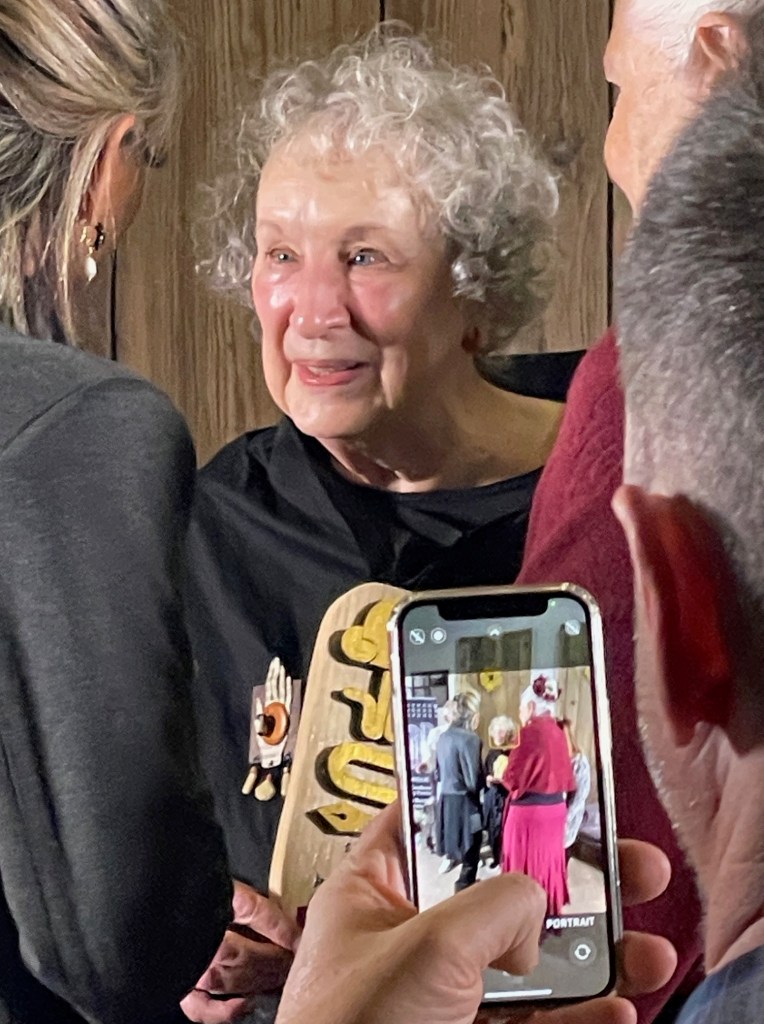
That was last night at the red-hot fundraiser for The San Miguel Writers’ Conference & Literary Festival, held in a converted 18th-century barn-turned-event hall called Foro el Obraje.
As hoped, Atwood delivered the goods with just the right partner in conversation – the battle-hardened war correspondent, Martin Fletcher. Hey, not just anyone can – or should – sit down for a public one-on-one with the feisty grand dame of dystopian literature.

Don’t let those pixieish eyes, coquettish tones, and high cheekbones fool you. She does not suffer fools nor those who would lob fawning softballs her way.
Fletcher was savvy enough to fire off a question or two then step aside and let Atwood have the floor. Of course it wasn’t about him, and when it was, he was genially self-deprecating.
Right off, Fletcher – who had stints for NBC in Palestine, Kosovo, and Rwanda among others – claims he had to look up the word “dystopia.” Boy, did that open Atwood’s eyes. And there was a twinkle in Fletcher’s as he “confessed” this.
Right. The title of the night’s event was “From Fiction to Reality: Has Our Dystopian Future Arrived?” A question that almost got answered.
Fletcher’s caution is legit. There are as many potential dystopias out there as there are utopias. It is good to know which one you are referring to.
And let’s be honest, with the impending inauguration of Donald Trump, the word “dystopia” is getting thrown around an awful lot. By now, even he might know what the word means.
As for the “Handmaid’s Tale” as oracle, Atwood had a telling anecdote, regarding the mercifully obscure film that was made of the novel in 1989. It debuted at the Berlin Film Festival, close on to the tumbling of the Berlin Wall.
It debuted twice, once in the West and then in newly liberated East Berlin. In the West the debut was celebratory with all the accompanying parties and hoopla, she said. In the East, the audience was hushed and attentive, severe, and serious.
She asked them why.
“This movie,” she was told, “has been our life.”
A chilling thought. Perhaps the question for the night should not have been “Has our dystopian future arrived?” but “When did our dystopian future arrive?”
Atwood says she didn’t set out to write a prescient novel, a prophecy fulfiller.
She just wanted to write something that wasn’t from the then-currently dominant male perspective, which usually involved submissive and scantily clad female characters.
Not a surprise, since the top science fiction writers of the day were all men. “Guys were doing all the writing,” she lamented.
It took the election of Ronald Reagan and the subsequent dismantling of the social contract to set Atwood on the path to Gilead.
“I just wanted to write a book like the male dystopias but from a woman’s point of view,” she said.
While the book has its legions of fans, Atwood has suffered her share of haters. “Not everybody loves me,” she acknowledges, while hardly making it sound like a lament.
When the book first came out, Atwood says there were three responses. In the United Kingdom, they called it “a jolly good yarn.” In the United States, the reaction was split 50-50 with half saying it couldn’t possibly happen here in the “leading liberal country in the world.” And finally, in her native Canada, the reaction was “How long have we got?”
Not long, it seems.
She is toying with the idea of writing a piece called “It’s Better In Gilead.” Atwood ticked off examples from the current regressive Right, especially Florida, which are far more repressive than in her fictional patriarchal theocracy.
As for the current right-wing movement, “it is not Christian!” she asserts. “If you actually read the Bible, and a lot of them have not … they’re not real Christians.” She blasted the Right for its emphasis on vengeance and “frying in hell.” The real Jesus, she said, “was about forgiving your neighbor, doing unto others as you would have them do unto you.”
The current Christian National movement is populated by “zombies,” says Atwood.
“I’m waiting for the real Christians to stand up,” she said to applause.
And she has some news for the MAGAs, “The price of eggs won’t be coming down.”
Periodically, Fletcher tried mightily to nail Atwood down on the specifics of our future. Might she tell us what will happen?
“I’m not a prophet,” she asserted. “I’m just old and very patient.”
She did offer this advice: “Give it (the Trump reign) three months and we’ll know what more we’re in for.” You can’t tell at the very beginning because it is “a struggle for the cheese” among all the incoming mice (or rats, if you will). People will be struggling for power and the rewards of victory, rather than over ideology.
Pretty soon, it will shake out into one of three scenarios, predicts Atwood:
- Game of Thrones
- Macbeth
- Julius Caesar.
Although, she says, “it is great that the U.S. wants to join Canada,” a reference to Trump’s plan to make Canada the 51st state. “You’ll get 10 new states and two territories added … and Republicans will never get elected ever again.”
She did add, regarding Trump, “If I were him, I’d sit with my back to the wall. We seem to be undergoing a Machiavellian Renaissance.”
For those desolate souls who follow the news closely – and that includes the journalists who write it – Atwood has some tepid words of encouragement: “The pen is mightier than the sword but only in retrospect. In time of war, the sword wins.”
And what can we do about it?
Atwood is firm on this: Don’t do as she says.
“I’m not an activist. I’m so old, I don’t give a shit. … I’m a writer with opinions who will not shut up.”
As Atwood notes, she has few consequences at this point in her life, unlike people who work for a living, have families, and must live and interact in society. “I can’t tell them how to behave,” she said. ”People have to tell themselves what they can afford to do.”
And what she herself is doing is working on a memoir. At 85 years old, this sounds like the coda to a prolific and much-lauded career.
In classic Atwood, “Writers don’t get old, they just get worse. … I’m not worse yet” but the time is right to turn from novels to memoirs.
Also classic, she says “a memoir is what you remember; a biography is what others dig up on you.”
While Atwood doesn’t seem the type to leave skeletons in her closet – she promises it will be filled with “stupid things I did and catastrophes”– the physical limits of bound pages means a bunch will be left out.
“I offered my publishers two volumes. They wanted one.”
Why?
“Because second volumes don’t sell. All the good stuff is in the first book.”
It’s in the earlier “anxious” years when you do the stupid stuff and have the most catastrophes, she explained, which makes them the most interesting. “As you get older you do fewer stupid things,” said Atwood, “not because you don’t want to but because you lack the opportunities.”
Still, that memoir is currently clocking in at 772 pages. There are so many editors around the world that want a hand in it – because she is translated into so many languages – that she had to assign a “Mary Poppins editor.” All revisions must go through this one supercalifragile-editor and all must agree before the notes are handed to Atwood.
After 18 books of poetry, 18 novels, 11 books of nonfiction, nine collections of short fiction, eight children’s books, two graphic novels, and a number of small press editions of both poetry and fiction, she can demand that sort of thing.
Successful people’s problems?
Seems much easier when nobody cares what you are writing and you have to beg for the attention of an editor.
At the beginning of the evening, Margaret Atwood was presented the inaugural San Miguel Award for Literary Excellence, from Festival Founder Susan Page and executive director Jodi Pincus.
Fletcher got in the icebreaker: “I’m impressed. Is that your first literary award?”
Atwood laughed and called him a “naughty person.”
On the contrary, in a closet there is a big box filled with “metal junk,” she said. She and her partner, the late novelist Graeme Gibson would pick through it and decide which “would make the best murder weapon.”
“Do you have a favorite murder weapon?” Fletcher asked dryly.
“A potential favorite,” she demurred
If I heard correctly, Atwood offered up the pointy Canadian Maple Leaf from Canada’s Walk of Fame plaque.
If you are curious, Margaret Atwood was inducted into the Walk of Fame in 2001 and her plaque is located on the north side of King Street in Toronto.
If you happen to notice the plaque missing, alert the Royal Canadian Mounted Police.
Or maybe MAGA headquarters.
Somebody is in for it.
.
 Musings, Magic, San Miguel and More
“Handmaid’s Tale” with the Republic of Gilead, is streaming on several networks like Prime and Hulu and has received 13 Emmys!
LikeLiked by 1 person
Yes, the streaming version is quite a success. Atwood says she likes it very much. The showrunner/creator for the program Bruce Miller introduced himself with an apology for having “one penis too many,” which she found hilarious and endearing. His point was that the series would remain true to her female perspective. Miller told her that he’d hired lots of women for the script room. Then with dismay he said, “I thought they would all agree.”
LikeLiked by 1 person