

Even as the Pulitzer Prize-winning Hedrick Smith was navigating “the road ahead for American Democracy” during his i3 talk on Tuesday, even more Bozos were being added to the Trump Clown Car up ahead.
A once-respected doctor turned TV pill-shill was nominated to oversee Medicare, Medicaid, and the Affordable Care Act.
The empress of a studio wrestling empire was nominated as Secretary of Education.
And the hits keep on a coming.
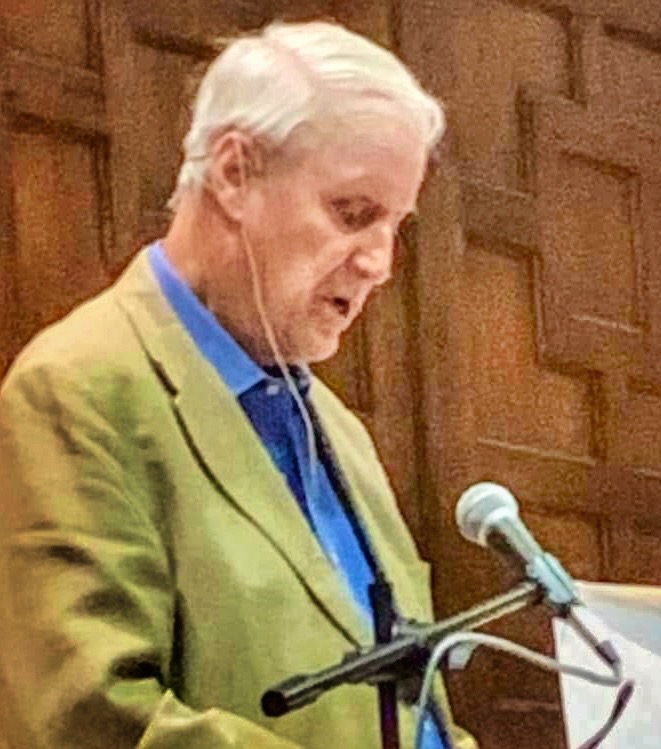
Can you blame Smith for sometimes saying “I honestly don’t know” when asked to gaze into his crystal ball?
Actually, he does know.
Quite a bit.
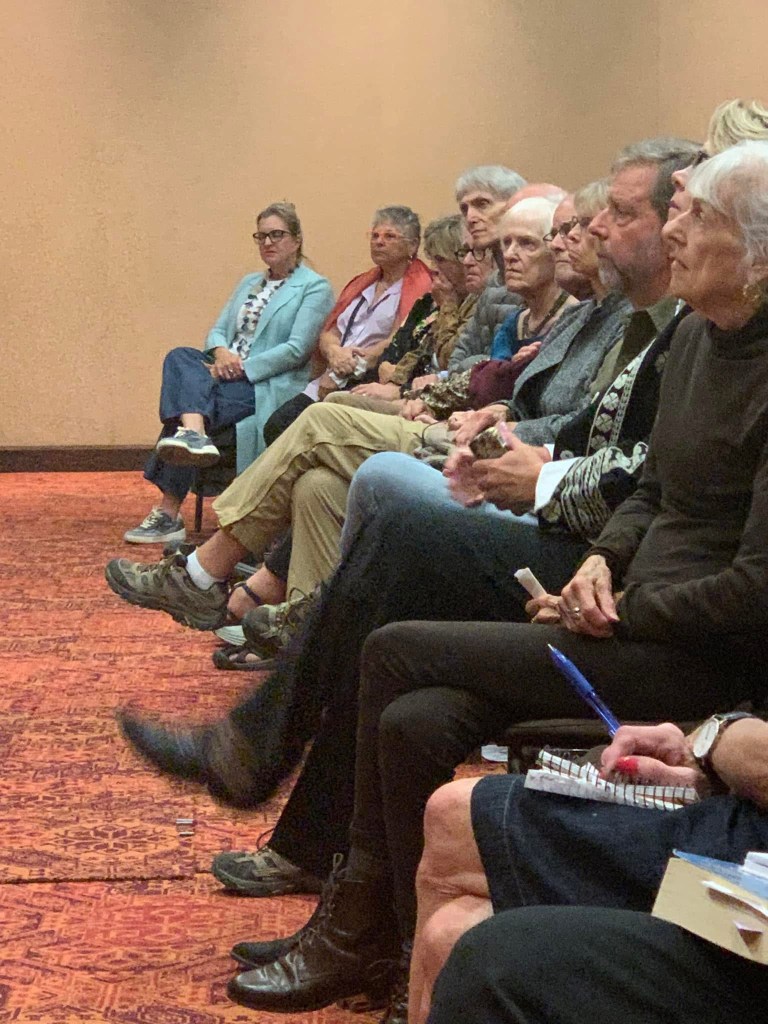
And his insights were equal parts invigorating, infuriating, and insightful as he spoke to a packed house in the La Casona Hotel Convention Center in San Miguel de Allende.
This was Smith’s third trip to the podium at i3 (“Ideas that Inform and Inspire”) since its founding nearly eight years ago, the most of any speaker. He fits the criteria, of “conversations with big thinkers” and his meaty talks fill the seats.
As Smith looks down the road of Democracy the word that comes to mind when contemplating its future is “dicey.”
He doesn’t mince words.
The topic of Smith’s talk was set long before the recent election. Short of ripping up his speech and starting over, Smith has been in deep research and revision, right up to the day of his talk.
“This is the moment our founding fathers feared,” he says. Right-wing forces are creating the “despotism of a demagogue.”
The imagery was that of Julius Caesar crossing the Rubicon to depose the Roman Senate and declare himself emperor.
In the twinkle of an eye, Rome went from a republic to an empire.
“Trump,” said Smith, “is now acting like a dictator.”
And that cabinet of department heads and secretaries he’s appointing? “A wrecking crew,” said Smith. “Grievance settlers.”
Even with his decades of experience covering Washington and global politics, Smith feels the same sense of apprehension as we do over the bulldozing and railroading, what he calls a “political blitzkrieg.”
There is the strategy of intimidation that is trying to force the Senate to abdicate its own powers and responsibilities and turn them over to the president.
There is Trump’s talk of declaring a national emergency on the very first day in office. The mass deportation of immigrants. Which will likely start with a targeted deportation.
There is the talk of using military funds to build mass detention facilities and even the use of the military to achieve these goals.
“But the Senate has not capitulated,” said Smith, as a low exhalation of relief spread around the room like a chilled wind.
To the relief and surprise of many, the Republicans chose John Thune of South Dakota to lead them next year. He was not Trump’s first choice, nor First Advisor Elon Musk’s. They had been shopping for a more malleable leader, a more compliant mouthpiece, like Speaker Mike Johnson (La) in the House.
Others, like GOP Sen. John Cornyn of Texas, have dismissed Trump’s suggestion that Congress take a ten-day recess so that he could appoint his Cabinet and others without requiring background investigations and Senate hearings — the traditional advise and consent.
Smith thinks Trump would use any protest as a pretense to invoke the Insurrection Act and call a national emergency, affording him tremendous powers that have built up piecemeal over the decades as Congress has ceded them during times of war and crisis.
“We need to remain attentive, engaged, and cool,” cautioned Smith.
Smith pivoted to a topic that is on many minds just now: “How did we get here?”
First off, the election was not the overwhelming vote of confidence that Trump claims. He has no golden ticket through popular support, no mandate, to do what he will.
In the end, he may have barely 50 percent of the vote, possibly less when all of California is finally counted.
Nonetheless, the Republicans have made big gains in the Rust Belt States, “which the Democrats erroneously call the Blue Wall.”
There is no sure “wall” after this election.
But why?
“Half the country is very angry,” says Smith. They are still feeling the pain of inflation. Only 26 percent said the government is heading in the right direction while 67 percent see it as “off-track.”
“Of the two-thirds who say the economy is bad,” said Smith, “69 percent voted for Trump.”
“Incumbency,” he noted, “is an enormous drag.” (He interjected that despite the numbers, he personally feels Joseph Biden has been the most productive president in his lifetime, at least since Franklin D Roosevelt.)
Into the shoes of a very unpopular president, stepped Vice President Kamala Harris pretty late in the game.
That didn’t help.
Two key points that Smith feels didn’t help either:
- Turnout: “7.5 million Democrats sat out the election,” he said. “While Trump picked up 2 million from his previous run.” The turnout in key battleground states Pennsylvania, Wisconsin, and Migchigan was “devastating.”
- Flat-out male bias against a woman president: White male votes in the seven key swing states voted decisively for Trump. By Smith’s calculations, “Kamala Harris lost 5 million votes just for being a woman.”
Smith returned to the threats to Democracy by returning to 1838, when a young Abraham Lincoln warned an audience that “American democracy will die by suicide” at the hands of a leader of a mob, not a constituency, at the helm, who will be very good at exploiting the weaknesses in the system.
The full quote in Lincoln’s 1838 speech to the Young Men’s Lyceum of Springfield, Illinois:
“At what point then is the approach of danger to be expected? I answer, if it ever reach us, it must spring up amongst us. It cannot come from abroad. If destruction be our lot, we must ourselves be its author and finisher. As a nation of freemen, we must live through all time, or die by suicide.”
Congress is doing its part by ceding the powers granted to it by the Founding Fathers as they tried to balance the strengths of the three seats of power – the Presidency, the Congress, and the Judiciary.
Congress has authority over the military and control of the budget. If it has the courage to hold on to them. In his first term, Trump wanted to use the Insurrection Act to send 10,000 U.S. troops against Black Lives Matter protesters. Cooler heads prevailed.
There were guardrails in place back then. Brave men and women in offices who refused to look the other way or cave into the pressures exerted by Trump.
That’s not likely to happen this time, says Smith, if Congress rolls over on his appointees.
Trump may also invoke the Alien Enemies Act of 1798 to justify rounding up millions of immigrants and forcing them into detention camps until their cases are sorted out or they are expelled from the country.
“Trump has often referred to ‘an invasion of illegal immigrants’ ‘ Smith noted. “That is not an accident.”
To quell the “invasion,” Trump will invoke the Alien Enemies Act. He has said as much.
To quell the likely outrage and protests when he does, Trump will invoke the Insurrection Act and call out the military.
“There is a tinderbox of such laws piled up for Trump to use,” warned Smith.
Not incidentally, he added, the Supreme Court recently ruled that the president of the U.S. can not be held to criminality in the commission of the duties of his office.
The guardrails, as they say, are off.
“Who will stop him?” Smith asked, not so rhetorically.
His surprise card? Senate Republicans. They hold a narrow majority and in the past, three GOP Senators actually voted to indict Trump.
“Do we have enough Constitutional Republicans to stand up to Trump?” Smith asked.
Anyone? Anyone?
“Good people can do the right thing,” he added.
There are other ways and means in defense of Democracy.
“Surprisingly for Democrats, the filibuster is now one of the most wonderful things” at their disposal, he noted.
Democratic governors have already been organizing resistance. Some are hardening the protections around state rights. Many are forming an association – strength in numbers, that sort of thing. They are exploring the “locuses of power that can be exercised.”
Smith believes that Democratic governors will be filing suits against undemocratic and oppressive actions the way Republicans have been for the past four years.
“We are late in the game,” says Smith. “Politics is about to slip past us. We need to go back (to the warnings) of Abe Lincoln. Our actions need to be hewn from the solid quarry of reason. Not emotion.
“Stay engaged. This is all for our kids and grandkids.
“Let’s roll up our sleeves and get to work.”
As a bit of a postscript, the 91-year-old Smith notes that in his storied career with the New York Times and CNN’s “Frontline” and into retirement, he’s given as many as 400 speeches.
“Never have I given a speech where I felt so concerned,” he said.
“I don’t believe in fairy tales, but I am hopeful. I’m hanging in there. I’m not going to stay quiet.”
And neither should we.
.
 Musings, Magic, San Miguel and More
Thanks Bob. A few years ago we heard Mr Smith speak at i3. That was a powerful presentation. From this report of yours I got a tiny bit of hope learning of the Democratic governors.
Much of the Country seem pissed about the inflation resulting from the Covid emergency. They voted their pocketbooks without concern for democracy nor the vengeful criminal they put in charge. Doubt they will be happy for the effects their thoughtlessness will have on their children and family.
LikeLiked by 1 person
Excellent BobSent from my iPhone
LikeLiked by 1 person
Thanks for this article, Bob. An insightful and well written memorialization of a fascinating talk. And, 91?! Impressive!
Janet
>
LikeLiked by 1 person
A fine review, Bob. Thank you. Disturbing as a measure of all inferred. Whew.
Jim Smith — smithjmilton@aol.com
LikeLiked by 1 person