
An old friend sent me a list today of all the former employees of the Wilson Publishing Company who would be attending a reunion in the next week or so.
The list spans more than 40 years. I was surprised to find that I know or recognize nearly half the names. Each name sent me into fresh reverie, triggered a sweet memory of another era.
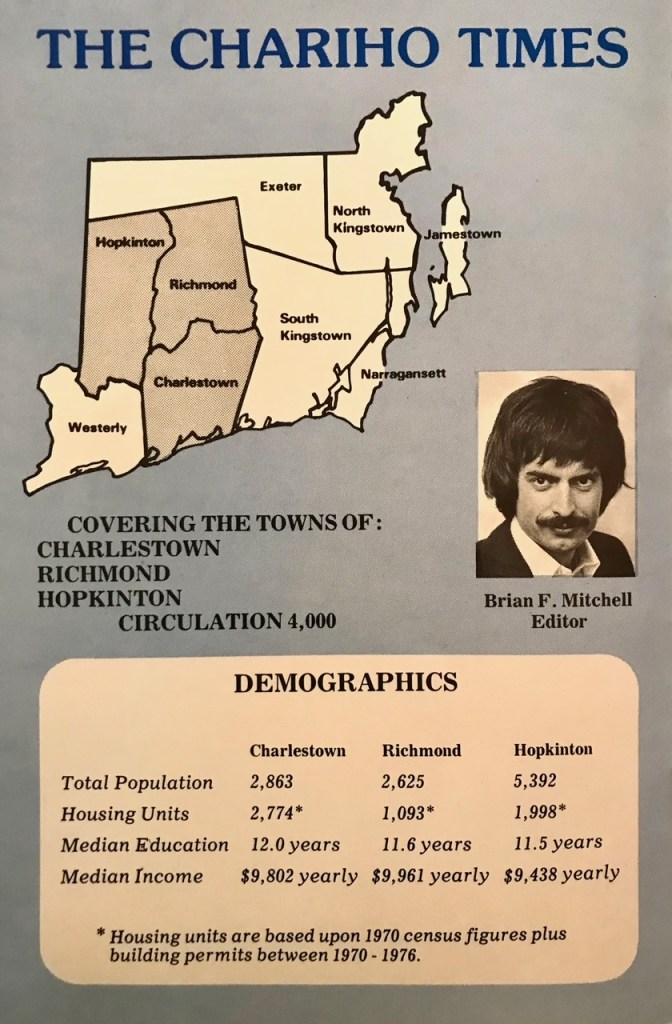
My friend, Brian Mitchell, like me, was an editor of one of Wilson’s several weekly newspapers in Southern Rhode Island. Brian’s was the newest of the three and he got to create his paper from scratch – a most challenging and yet, enviable, task.
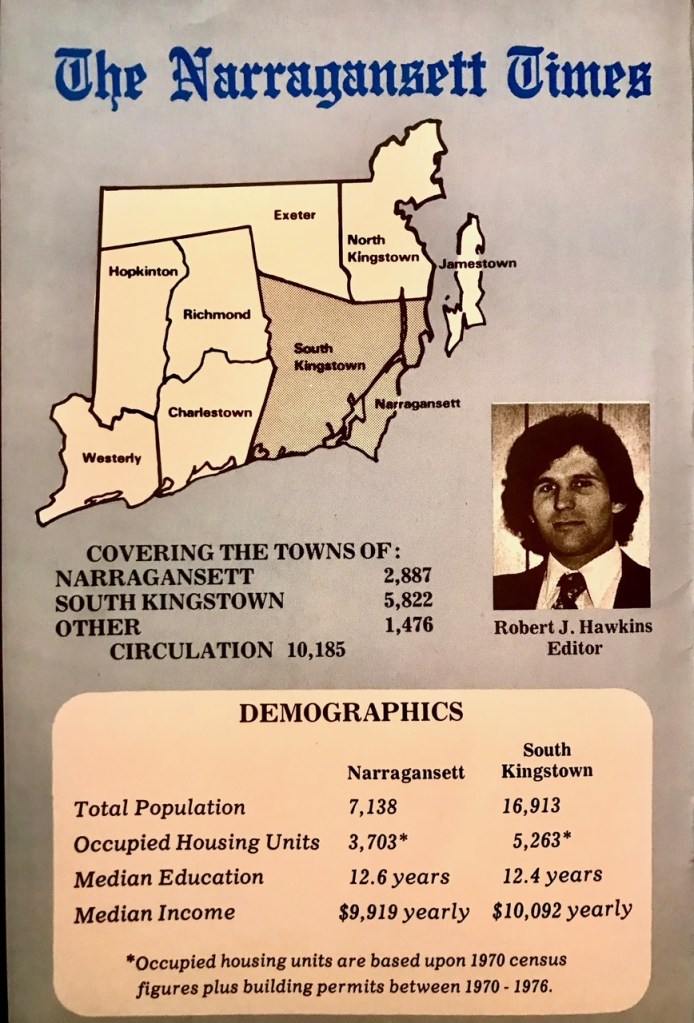
Mine was a hand-me-down, more than 100 years old but well-cared for – the flagship paper of the little Wilson empire, The Narragansett Times.
I had my own set of challenges running a 10,000-circulation newspaper in a university town in New England, not the least of which was I had no right to be there in the first place.
For one, I’d just graduated from that university. To suggest – and I’m sure someone must have – that I hadn’t the slightest idea how to run a newspaper would be a fair statement. I started wearing a tweed sportscoat and smoking a pipe because that seemed like the things a country newspaper editor would do.
How did I get to that point? As I said, I was a student at the University of Rhode Island, studying journalism and urban planning, with some vague ideas about pursuing a career in making cities liveable or writing about those who did.
I was older than most students. My Vietnam-era “gap year” turned into four as I tried to outwit my draft board while pursuing an amateur career playing Rugby in Washington DC. I hit bottom in Lawrence, Mass. working second shift for a fabric mill loading trucks and train cars in the dead of winter.
It was an eye-opener. I watched the carefree lifestyle and dreams of my co-workers disappear as they bought furniture, stereos, cool clothes, and cars on credit with exorbitant interest rates that they wouldn’t meet in a lifetime. The cool clothes, cars, and stereos got the girlfriends. The girlfriends got pregnant.
Every one of them dreamed of moving out of the mill town to some exotic place known collectively as “Florida.” Instead, they got babies.
My foreman, a few years older than most, went down that road. Every time he heard one of these kids talk about buying a stereo on credit, he’d sigh, “another nail in the coffin.” Nobody listened.
Honestly, that scared me back to college.
At the University of Rhode Island, I qualified for an “older first-time student” program because I said I’d never been to college before. (OK, I’d never taken college seriously before. Kind of the same thing.)
I gave myself three years. Get in, get it done, skip the social life – which I didn’t need because I was already married. To handicap the challenge, I got a full-time job, which made sure there was no time for boozing, breathing, or breeding.
During the summer between my second and final years at URI, I stopped on campus to ask a friend for some union-organizing tips. I wanted to help some co-workers at a restaurant. I didn’t think they were exploited, but they did.
Instead, I bumped into Wilbur Doctor, the head of the journalism department, a man capable of looking simultaneously exasperated and bemused while striking terror into the hearts of those he perceived as coasting toward a career in journalism.
Wilbur looked somewhat bemused and exasperated to see me in his secretary’s office. “There’s a reporter’s job open at The Narragansett Times,” he said briskly, squinting over his half-glasses. “You ought to apply.”
Then, realizing to whom he was fobbing off this valuable piece of intel, Wilbur added, “And don’t procrastinate.” And he was gone.
For once, I didn’t. One problem was that my press clips were pretty thin and hardly impressive. My one big “investigative” story ran over five columns in the school newspaper. Only, somebody got the equally-lengthed columns mixed up. It sort of read like a Jack Kerouac or Hunter S. Thompson piece on acid. I got compliments on my unique non-linear style.
All the same, I got the job.
Being summer, I was the only one who applied.
The editor was Gerry Goldstein who just oozed smooth competence. His assistant editor was Angelo Cataldi who was something of an unmade bed. A sharp-tongued teddy bear and acerbic writer, Angelo still wore his Little League ballcap to Yankee and Red Sox games. He knew how to juice a dull story (for better or worse) and make it readable.
Half-jokingly, Angelo once told me to never let the truth get in the way of a good story. Then he rewrote my sappy and dull story of an on-campus male-sensitivity group into a gathering of male chauvenist pigs. (Angelo also went on to a seven-figure career as a highly opinionated sports radio talk-show host in Philadelphia, a match made in heaven.)
Gerry knew how to tell a story that would pull in readers. A couple of years later, when Gerry wrote for the competing Providence Journal-Bulletin, I got a scoop on a little dog that had been bound with wire and then set aflame. That it would not die, won the hearts of the people who worked in the animal shelter. They fought for its life. But they needed funds for operations.
I wrote the story up and it ran that Thursday and the response was pretty good. Donations started rolling in. We were feeling pretty good about ourselves.
Then Gerry got a hold of the story and dubbed the pup, “Crispy Critter.” After that, the dog became a Providence Journal story. And I learned a few lessons from a real pro.
Gerry and Angelo were great mentors and they turned my school board beat into a full-time job by the start of my final year at URI. The newspaper was a master class for a guy like me and the Narragansett Times had a long and distinguished tradition among New England newspapers. (John F. Kennedy was rumored to be a secret backer of the paper.) People took their newspapers seriously back then and there was no shortage of academics who could write scorching letters to the editor if you messed up.
That was pressure.
Toward the end of my last year at URI, the publisher had new carpet laid in the fairly dowdy newsroom and banned coffee from our desks. Legend has it that Gerry blew up, gave Wilson a verbal drubbing, and quit. I think there had to be more to it — but banning coffee, as any journalist will tell you, is an act of war.
Gerry moved across town to the regional office of the Providence daily and became both my bane and inspiration for the next four years.
Angelo was quickly named editor and in mere weeks got his acceptance letter from Columbia’s graduate journalism program where he went on to make New Yorker movie critic Pauline Kael’s life miserable. He despised pretentious people and writing.
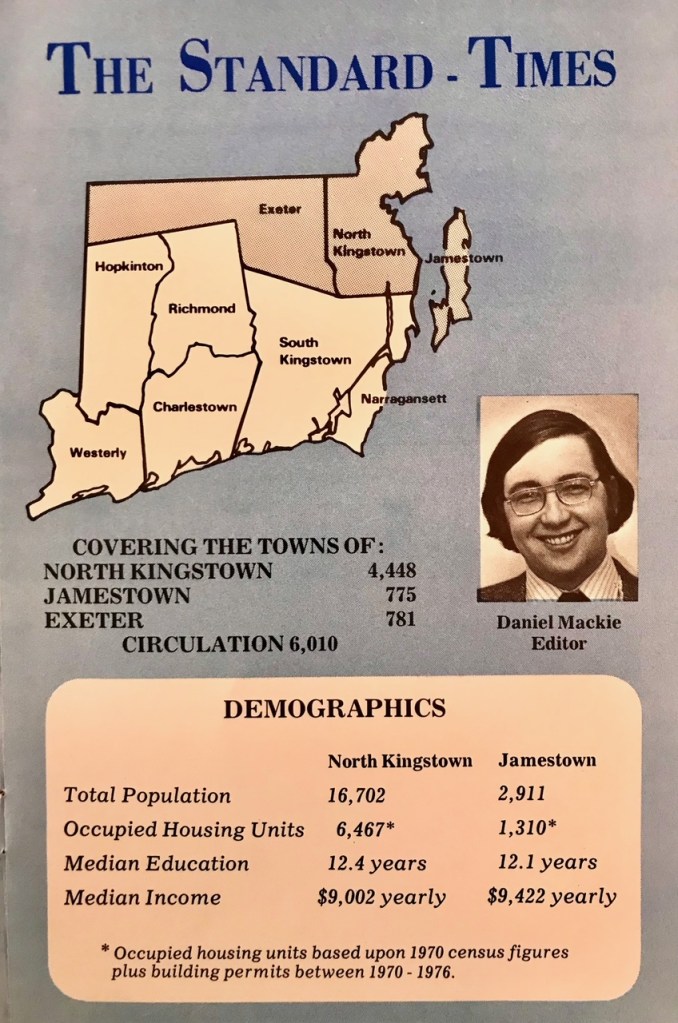
In a single blurry moment, I got my diploma and was named acting editor of the Times. It felt more like being sucked up a vacuum tube than being promoted. But there was a support system. Rudi Hemp, then editor of our third paper, The Standard-Times, was named managing editor – and a veteran writer who happens to be the same age as me, Marcel Dufresne, was brought in as my assistant editor.
In reality, Marcel was a co-editor. We back-stopped each other on everything. Every news decision at the paper went through both of us. I was reactive. Marcel was reflective. Marcel thought deeply about news, its impact and ethics, and its purpose. He was also a mentor to our growing staff. That was his most natural tendency.
No surprise that he went on to a distinguished career as an investigative journalism professor at the University of Connecticut.
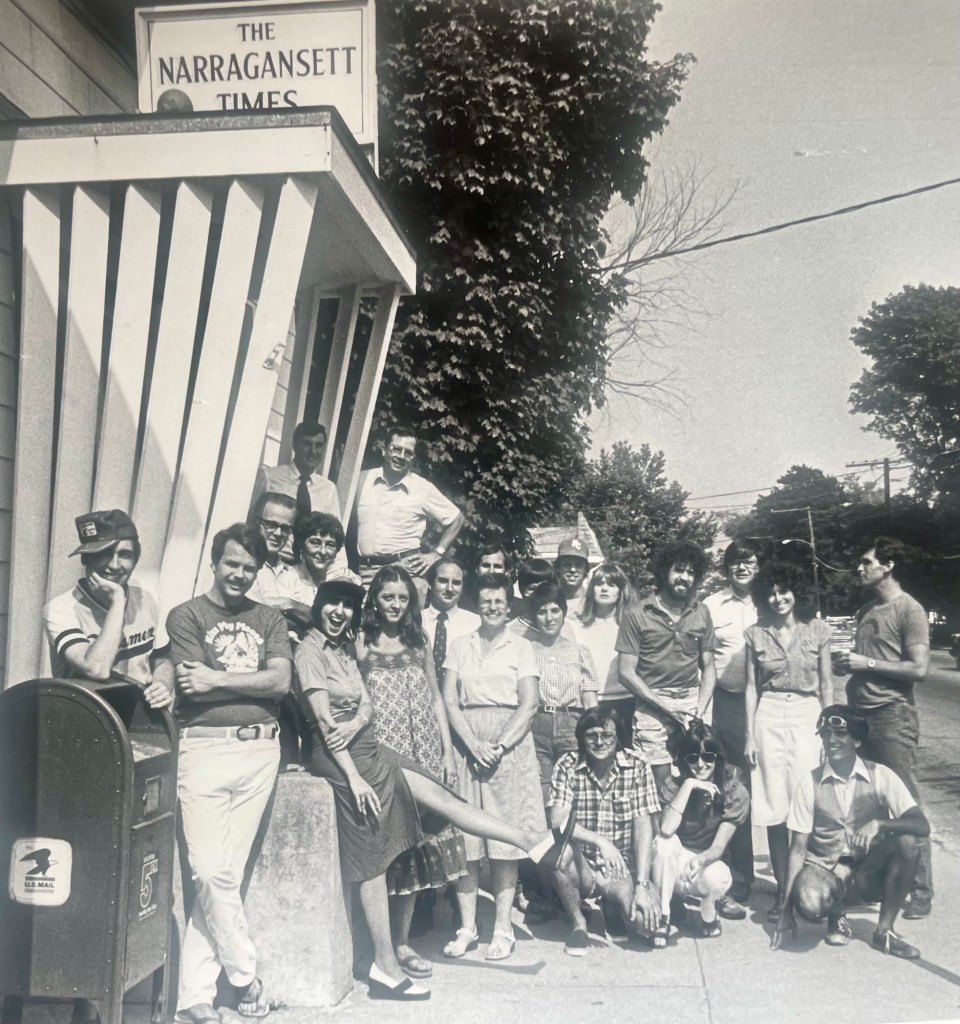
The people who worked on that paper seemed to find their way in the door through some cosmic intercession. We felt called to the performance of journalism. We were all young and enthusiastic. We all loved newspapers. We loved working with each other. We all loved news and especially loved publishing it first.
Listening to the presses ramp up and hit full scream, printing the first issue of The Narragansett Times with my name in the masthead, was both mystical and teary eyed. (Decades later, I brought my three young sons to watch the last issue of the San Diego Tribune roll off the presses. It felt the same but drenched in profound sadness.)
The Providence Journal was a daily newspaper but we made it our holy mission to publish something fresh and new and previously unread every Thursday morning. Sometimes that meant writing straight through Wednesday night.
As the paper rolled off the presses early in the morning, I’d sometimes drive down to the fishing village of Galilee (across the channel from Jerusalem), grab a bag of crabcakes from George’s, then hop on the next ferry to Block Island. On a deserted beach, I’d sip a beer and munch on the cakes, scribble on a legal pad, and scream or laugh depending on how the week went.
As dusk rolled in like an Atlantic fog, I walked back to town to sip a glass of wine on a hotel porch while the bright lights of the last ferry home appeared on the horizon.
The next day, we’d start it all over again.
All good things end. That’s just life.
Our end came shortly after returning from Boston where we had dominated the New England Press Association’s annual news contest. Not only among weeklies. Our staff collected more awards than any newspaper ever. Awards that meant something, because the standards were high and the competition was formidable.
Still in a state of euphoria on Monday, we came in to find that our staff was to be cut by a third for reasons of economic efficiency. Or something like that.
The publisher, Rick Wilson, was a good guy and had given us every opportunity to succeed over the years. And we did. Heck, he took a chance on me. This was just beyond understanding.
A few people went to the Newspaper Guild to talk about unionizing and the Guild was all for it. The publisher brought in King and Ballou, a Kentucky law firm that specialized in destroying unions. It was simple and brutal divide-and-conquer – the lawyers sewed suspicion and dissent among employees, and bribed others with jobs and raises and promises.
I opted in with the Guild because by definition of management – to effectively hire, fire, or recommend – I had done none of those things when my staff was laid off. King and Ballau didn’t agree. The publisher didn’t agree. And the labor board didn’t agree.
The union lost.
My days were numbered. An offer came in from the daily newspaper in New London, Connecticut, and I took it.
For one year.
An offer came in from a San Diego newspaper, the timing of which bordered on the cosmic. I felt I had to go. I was being called.
The next thirty years were spent enjoying every minute of my time with what became the San Diego Union-Tribune but always wondering – always – what higher purpose “called” me there.
I never did find out.
But I also never stopped thinking back fondly on those early years when we were all filled with too much enthusiasm, too much naivete, too much ambition, too much idealism, and too much love for newspapering.
Or, maybe it wasn’t too much. Maybe that’s what the best days of your life are supposed to be like.
Well, we had it for a while. Didn’t we.
I’d love to be at that reunion but I don’t need it to know that I still love each and every one of those people who came into my life during those glory days at The Narragansett Times.
Knowing them, knowing they will be together, that is enough.
 Musings, Magic, San Miguel and More
Nice job, Hawk
LikeLiked by 1 person
Thanks, Rudi!
LikeLike
Excellent piece. I can smell the ink and hear the clatter of newsroom phones, shouts and manual Underwoods.
LikeLiked by 1 person
Thanks, Steve! We did start out in the typewriter era. My assistant editor Marcel was was legendary for the massive amount or re-write (aka cut and paste) he performed on a story. There could be as many as a dozen pages and strips of paragraphs glued atop each other. If there was anyone ever built for the word processor era, he is the guy!
LikeLike
Marcel here. Just love the piece beyond words, Bob. I do think my glue use may have been what got me (and others in the newsroom) through some of those late nights. And yes, I did embrace computers – but saved my typewriters.
LikeLiked by 1 person