Showing up late for a party stoned and tipsy wasn’t very original in late-1969, though I was getting damned good at it — and tired of it all — a rudderless college drop-out, dodging the draft, hiding out in Washington D.C. in the shadow of the Selective Service.
I was fast becoming a mess.
Nobody at John and Linda’s party noticed – even when I stumbled back against the bookshelf and slid to the floor while Jenny from West Virginia badgered me with her latest career dilemma: Airline stewardess? Or a psychologist?
First off, this was no Ikea bookcase. It was old, solid, built into the walls, and stacked to the ceiling with, well, books. John was a manager at Brentano’s Book Store. More than a manager, John was on a fast track to the top. He was also engaged to the daughter of the chain’s CEO.
Linda was not that daughter.
Linda was simply the woman John fell in love with while other people were making plans for him.
If you’d ever met Linda, you would understand.
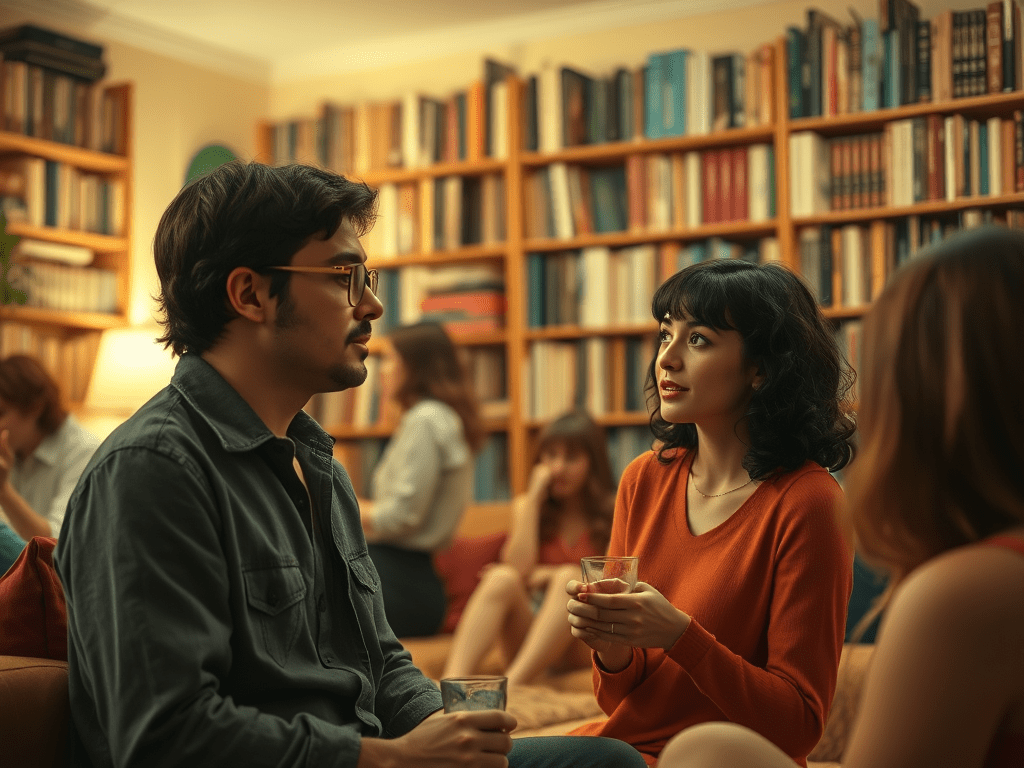
John was English, winsomely handsome with a head of dark curly hair that canopied a bright mind. He wore black-frame glasses. A young Michael Caine. Linda was a military brat with a beautiful nose, doe eyes, and a crystal-bright intelligence that hinted at hippie rebelliousness. Let’s say, a young Barbra Streisand.
They led an idyllic life in their book-filled O Street apartment. They attracted a smart, attractive crowd to their home. It was a Sixties-style salon — lots of good music and weed, great talk about politics, books, and art.
Like I said, I was just a lost soul, drawn into their universe. What they saw in me, I couldn’t figure out.
Linda called me “Bobby.” Something nobody else did, ever. For some reason, I warmed to it. OK, I can be a Bobby. Not a Hawk or a Bob or Robert or Hawkins. A Bobby.
Eventually, Brentano’s transferred John to San Francisco, possibly in a failed attempt to get his arranged marriage back on track.
Linda stayed behind. It would be six months before she could quit her job and fly west. During that time, I assumed the role of big brother. Think of me as the guy who does the voice-over in a nostalgic romantic movie — not memorable, not totally forgettable. Maybe George Peppard in “Breakfast at Tiffany’s”?
I’m sure I was a little in love with Linda. Well, who wasn’t? John and Linda shared a powerful bond that time, distance, and the flighty Sixties couldn’t snap. It was the coolest love story within 10 blocks of O and 21st, in my opinion. And that was pretty much our whole universe back then.
On that freezing winter night, as the party roared in their first-floor apartment, I sat outside on the granite steps in the snow, sucking on a bottle of Reisling, a go-to drunk in those days. It was a disappearing act: Take a slug of dry white, disappear a little more. Another hit, fade still more. Bottle empty, suitably invisible to join the party.
I walked in. It was hot, crowded, and loud.
A blast of dry heat and the dry wine felt like a one-two punch, and almost immediately, the room started spinning.
My first thought was, “Oh, no. Not this again.”
Again. Like the other agains. The agains that were gaining frequency.
It started last April. Two deeply Christian, beguiling, and beautiful daughters of a Southern Baptist minister threw me a birthday party. Perhaps it was the unattainability of it all, but I really had it bad for Tina, the younger of the two.
It was supposed to be a surprise party. The invitation was for dinner and I had shown up way too early, so Tina took me shopping for groceries.
Still too early, she suggested we walk across P Street to Boccaccio’s Pub, the unofficial headquarters of my Rugby team.
This was exciting because Tina didn’t drink. Me, being 19, I assumed that drinking was part of the romantic ritual that led us all down the well-trod road to the Garden of Earthly Delights. I suggested something with vodka and grenadine — sweet, with a non-alcoholic taste. Excellent yet effective for seducing a Baptist minister’s teetotaling daughter.
Three times I ordered us a pair of these drinks — I had been really early — and three times she sniffed it, sipped it, then suggested I finish it, as well as my own. Which, as best I can recollect, I did.
I remember walking up the stairs to their apartment, opening the front door, and hearing a thunderous “Surprise!”
Moments later, I passed out.
I can say I slept in her bed that night, alone. Just me and a gorilla-sized hangover.
So, yeah, I was feeling one of those moments again at John and Linda’s.
That was when I backed up against that bookshelf and slowly, casually, oh, so coolly, slid my way to the ground. “Mission accomplished. The ego has landed.”
I must have hit the shelves pretty hard. This thin, little book dislodged from a high shelf and plopped into my lap.
I stared at it vacantly as Jenny-with-the-career-crisis rolled on.
The book was Richard Brautigan’s “In Watermelon Sugar.” Large type, lots of whitespace, some drawings, too. Only 138 little pages. It begged me to read it right then and there.
Jenny didn’t even notice that I’d cracked open the book, such was the intensity of her latest dilemma.
Until then, I had no idea people could imagine such a surreal world as this. “In Watermelon Sugar” was hypnotic. Transcendent. A revelation. The first book I’d read fully since high school. Why didn’t they assign books like this in high school?
Brautigan sent me into an alternate universe. The transformation, as much physical as intellectual. And I was now quite sober. Even more remarkably, Jenny was still weighing her career options. Maybe she’d left and returned. I had no idea.
“You’ll make the right decision,” I assured her. And walked away. (Ultimately, she went back to Wheeling to make babies with her high school boyfriend.)
I thanked John and Linda for their hospitality. “Great, great party,” I enthused. “Can I borrow this book?”
I stepped out of their O Street brownstone and into a different world. It was snowing again. Tiny white flakes were drifting through the thick canopy of towering shade trees that lined our two blocks of heaven.
On both sides of the street, windows were lit. People could be seen moving about.
Right then, I hallucinated. Or, maybe, it was a revelation. These trees? They are a roof. These buildings? One giant home in which all the rooms open inward onto the Great Commons — O Street.
We were all one big family. The motorcycle gang at the west end, the young government careerists, the hippies, the foreign students, the guy with the mysterious past, the gays, the retired gynecologist who wrote porn, the draft dodgers, the drunks, and the two beat cops.
Kind of like Sesame Street. Only grittier and with sadder stories and more struggle, and Harleys parked side-by-side.
It was euphoric. That book lit a fever in my brain.
“I can read books!”
“I like reading books!”
“Give me more. More! More!”
I replaced drinking myself to death with reading myself to life. Not right away. This was no miracle. But book by book, windows opened. Fresh air flowed in and replaced the stench of a dead-end life.
For a short while, John became my new dealer, supplying me with books and the names of authors. I started easy enough — a lot of Kurt Vonnegut, Robert A. Heinlein, everything from Brautigan, and Tom Wolfe. There were books from John Barth, Ken Kesey, John Fowles, and Thomas Pynchon.
Gabriel Garcia Marquez opened a rich vein into Latin America. I mined the works of Carlos Fuentes, Jorge Amado, and Mario Vargas Llosa. I slogged through Günter Grass and Hermann Hesse, and was captivated by the “The Autobiography of Benvenuto Cellini.”
As well as Emile Zola — “Germinal” from his epic Rougon-Macquart series and his biography “Zola! Zola! Zola!” Greatest work-ethic of any author, ever.
Aleksandr Solzhenitsyn, Bel Kaufman, Marshall McLuhan, Norman Mailer — among others — occupied space on a burgeoning bookshelf. I even had copies of Mao’s “Little Red Book” and a Mikhail Bakunin text on anarchy, but mostly for show.
I began reading The Washington Post and The New York Times.
These authors, these books, these newspapers, were the muscle that helped me push open the door to intellectual curiosity. It took all of them and lots more to get me where I am today. My gratitude knows no bounds.
I wish I could have told Richard Brautigan this before he killed himself.
During that same winter that Brautigan’s book landed in my lap, I met Grace, a fragile woman with a terribly broken heart. She invited me to drive with her to Northern California and start a new life. She, too, was a fan of Brautigan.
What would have happened if I had taken her up on that offer? Could I have met Brautigan? I might have had the chance to tell him, “Your little book saved my life. What you write has meaning. People love you.”
Maybe I could have saved his life. Returned the favor.
Linda eventually reunited with John in San Francisco, and they got married. We kept in touch for a while, but my odyssey had only begun, and in a time when social media was nothing more than telephone calls and writing letters, we lost touch.
Two years later, I moved to Cape Cod with a group of friends. We were going to set up an artisan collective — weave baskets, make stunning pottery, paint, and write shattering stories of beauty, pain, and truth.
But everyone scattered at the end of the summer, as happened on Cape Cod in those days.
I got married and went back to college, this time in Rhode Island.
For a writing class in the Summer of 1974, I typed up this very same story, mostly as I am telling it to you now. It all felt like a dream by then — John and Linda, the book falling into my lap, crawling back to literacy, finding purpose in life.
The phone rang, just as I pulled the first draft out of the typewriter.
I can hear her voice, still.
“Bobby? It’s Linda! I’m here with John. We were just sitting here talking about you and decided we had to call you! Where are you? What have you been doing? We went through six phone numbers to find you!”
Swear to god.
We kept in contact after that, and my wife and I visited with Linda and John on our first trip to California later that same year.
Then I moved to San Diego, alone, and Linda invited me to San Francisco, to her second marriage.
I lost track of John until the earthquake of 1989. There, on network television, a man who had almost been crushed by a cascading brick facade near North Beach was being interviewed. It was John.
I reached out, and we spoke and e-mailed for a while. Then our lives, again, went their separate ways. One last time, I guess.
From time to time, I revisited “In Watermelon Sugar,” too. But it wasn’t the same.
It did what it needed to do at the time. I like to think that the magic moved on to help some other lost and confused kid. Maybe magic travels like that, from book to book, title to title, looking for lost souls.
And when you least expect it, and most need it, a book that can change your life falls right into your lap.
(The image was created by an artificial intelligence program based on this story, but is in no way reflective of the reality of the time. )