Composer Hoppé takes audience on a memorable journey with the help of some talented friends
The theme of Michael Hoppé’s annual San Miguel de Allende concert on Wednesday night was “Together!” And, indeed, even inside the expansive and nearly full Teatro Angela Peralta, it was a cozy affair.
That was largely due to the artist’s engaging reminisces between each of the 21 compositions that were performed and the music itself which is endlessly appealing on so many emotional levels.
But Hoppé had a subtitle to offer: Encouragement. You could see it in the five talented musicians who took turns performing with the maestro and in his own recollections on the trajectory of his career.
At so many points, Hoppé could have veered off to become a career military officer or a Hollywood music agent or a record company mogul.
Thank god, he chose otherwise.
And thank god, there were folks right there to show him the error of his ambitions. People who recognized his talents for composition.
And thank god, they spoke up and gave Hoppé the juice he needed to press on.
Otherwise, what would Wednesday night have been like?
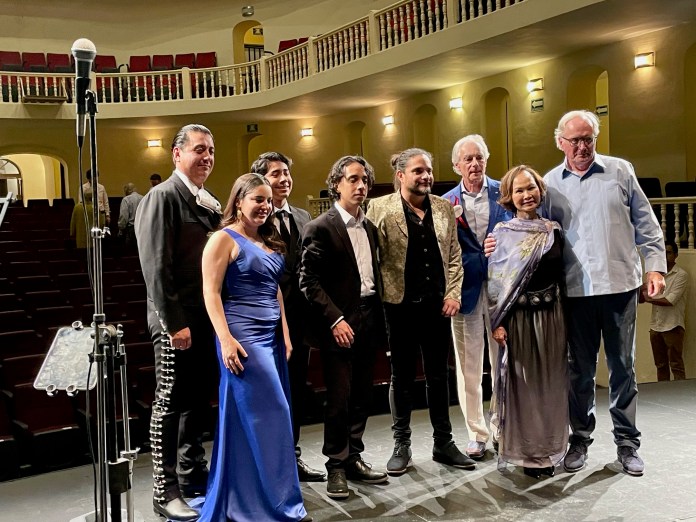
From left: Emiliano Cadena, Kristell San German, Josue Guzmansilva, Axel Caporal, David Mendoza, Patrick McCurdy, Hannah McCurley, and Michael Hoppé.
What it was was transcendent.
If you are familiar with Michael Hoppé’s music, you know that it can be both gently sad and inspirational at the same time. It is both introspective and bursting with optimism.
If you attended the Covid-delayed premiere of his “Requiem” last year, you know just what I mean. We walked out of that performance in awe of our own frailty and yet, so ready to embrace this time we have left on this planet.
Here’s an example from Wednesday: “Forever.” It was the last of six compositions performed with the hugely talented violinist David Mendoza.
So very sad. Melancholic, even.
And yet.
As I so often do, when I listen to Hoppé’s music, a story begins to unfold beneath the surface. I started to think, “This could have worked in one of those Neil Simon movies, when the guy loses the girl or the girl loses the guy.”
Only, the bottle of Cabernet has about two-fingers worth of red left inside and the sun is just peeking up over the apartment buildings across the way, and through the haze, she realizes that it would never have worked out. In fact, it had been terrible for so long that she just couldn’t have seen it on her own. The wine helps. And so does the dog that just slipped into her lap and licked her chin until a laugh erupts.
Roll credits. End music.
It should not surprise you that Hoppé has done well composing music for movies.
It is not surprising that I see my own movies when his music unreels.
A fabulous cantante ranchero from Queretaro, Emiliano Cadena, also sees something else quite unexpected in Michael Hoppé’s music. He asked permission to interpret a few of Hoppé’s compositions. He received the composer’s encouragement.
Right after Hoppé and Mendoza performed “Forever,” Cadena came to the stage and sang his own version, reworked as a ranchero. He dedicated it to his son José Antonio Solano Ramirez who died two years ago, a statement that took your breath away and did not release it until the song was done.
One song can serve two maestros.
Cadena also sang the only song on the program not written by Hoppé, “Inventame.”
Again, encouragement is a beautiful thing. Hoppé has mentored all of the musicians who performed this night, to some degree.
The young cellist Josue Guzmansilva opened the show with Hoppé on several compositions.
The first, “Some Other Time” became part of Hoppe’s “Requiem.” The second, “Gold Leaves” was originally used in the fifth episode of the TV series “The Sopranos.” Their third was one of Hoppé’s few compositions “with rhythm in it” – “Moon Ghosts.”
Guzmansilva and Hoppé were joined on stage by violinist Axel Caporal. To them, Hoppé entrusted one of his most sentimental songs, ”The Parting.”
In his telling of it, PolyGram records sent him to Hollywood with an armful of songs for a Gene Hackman movie “Misunderstood” being produced by Peter Gruber. Only, Gruber didn’t can for any of them.
On impulse, Hoppé offers his own composition and it is an immediate hit.
PolyGram tells him he can sell music or compose it but not both. When he tells wife, Monica, that he wants to write music for movies in Hollywood, she encourages him as well.
The violinist Caporal and Hoppé perform a Ken Burns-inspired “Lincoln’s Lament” which would have fit well in the “Civil War” documentary series. They also performed “Missing You” which languished unfinished until Hoppé’s wife Monica pushed him to complete the song.
“Monica hears everything that I play,” he confided after Caporal had left the stage.
“She loves this,” he added before launching solo into one of his most recognizable songs, one inspired by San Miguel nights, “Beneath Mexican Stars.”
Hoppé gifted the audience with several more at the keyboard, “Renouncement” which was inspired by a short poem that he read; “Beloved,” inspired by his father’s photos of the Queen Mother at age 12; and a charming Asian-inspired “Dokdo” which was repurposed in his “Requiem as the Agnus Dei.
The last came about after a trip to Korea was met by the tinkling of wind chimes “in an Asian key.” You just never know where the inspiration will come from.
Since Michael Hoppé lacks the talent for vocals (his own admission, not mine. I suspect by this point he could do anything he chose, musically), the soprano Kristell San German was invited to the stage to vocalize the flute composition “Lilies on the Lake” with Hoppé at the keyboard.
Again, at a pivotal point in Hoppé’s career, he received strong encouragement from the flutist Tim Wheater who pressed him to veer from his 400-client music consultancy and become a composer. “Lilies” did the trick and last night was performed – not as a piano/flute duet but piano and vocalese. A stunning debut performance.
San German also sang “Pie Jesu” written in honor of Monica’s mother when she died. This too became part of the eight-movement “Requiem.”
David Mendoza lent his most articulate violin to the next two San German performances, “Angele Dei” (“I was channeling Verdi in his early days”) and “Ave Maria.” The last came about because Hoppé’s mother had asked Monica for the lyrics and they sat on the piano for weeks until Michael decided “to have a go at it.
Marvelous how these things come about.
David Mendoza remained on stage to perform with Michael and celebrate their deep creative friendship.
The first, “Dreaming in Blue & Yellow,” is a timely tribute to the brave people of Ukraine.
“David and I have played many recordings together,” said Hoppé. “I couldn’t think of a better player to do this.”
Next was the soaring and sonorous solo “Invocation” which Michael Hoppé composed for the violinist. As David performed, reaching into the melancholic depths of the piece, Hoppé sat at the keyboard with eyes closed, orchestrating as he does for all the musicians with his right hand, the slightest of smiles escaping from his lips.
Yes, encouragement, once again. The maestro and the violin master.
They returned to the night’s theme with the Gershwin-ish and peppily eponymous “Together” which Hoppé and Mendoza recorded together last year. That was followed by “Forever” in both its traditional and ranchero forms, which brings us full circle on the night.
Well, the last was the traditional “Children’s Waltz” which has become the theme song of the night’s benefactor, The Children’s Art Foundation, established by Hannah McCurley in 2010 to bring art lessons to kids in outlying communities.
Michael Hoppé has been performing this benefit concert for them for nine years.
If the Art Foundation and Michael Hoppé are a match made in heaven, we are all the richer who get to experience his artistry, even if only once a year.
Thank you, Michael Hoppé.
And if I can add more encouragement at this point: More concerts! Please!


 Musings, Magic, San Miguel and More
Bravo
LikeLiked by 1 person