
There is a comedy – a musical sitcom – about a powerful man who believes he has the right to do whatever he wants to women.
It’s a sequel, in fact, that gives off a sort of a bro-boy’s “Your body, my choice” vibe.
But the women in this comedy are smart and savvy, with a sort of a “Me too” vibe. They know how to stand up to power in clever ways. They know how to work the angles on the patriarchy.
And, no, it is not called “Trump’s Second Term.”
The musical is actually an opera and it was written in 1786. A huge hit in its day. Now, it is considered one of the greatest operas of all time.
Apparently, things haven’t changed all that much in the last 239 years.
The opera is Mozart’s “The Marriage of Figaro” with a libretto by Lorenzo Da Ponte.

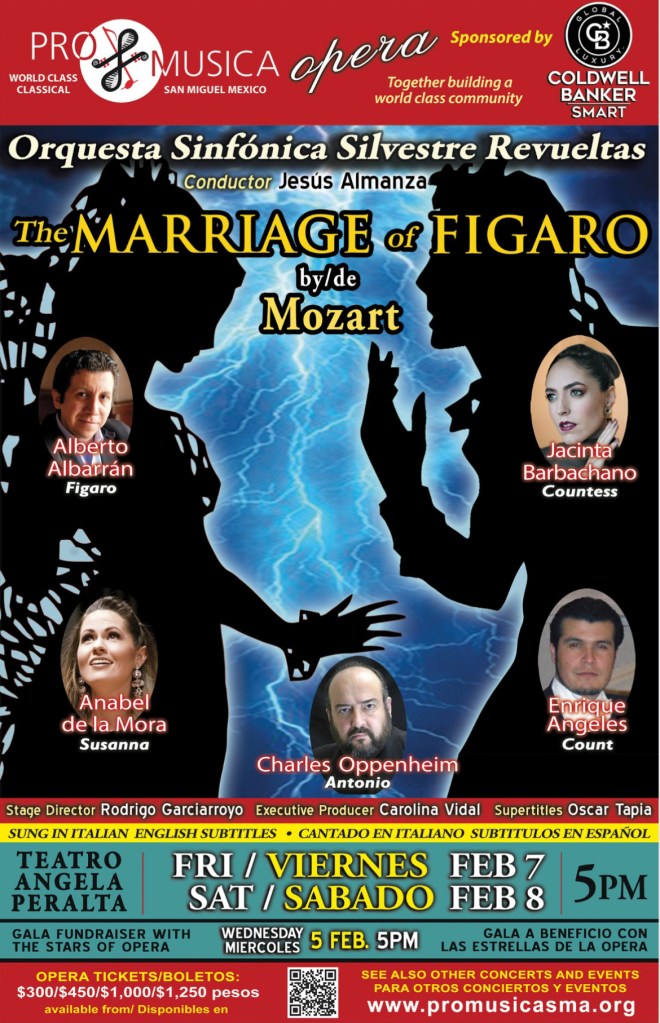
It was indeed the musical sitcom of its day, an opera buffa, and we get to experience it in San Miguel de Allende on February 7 and 8 in Teatro Angela Peralta, as part of the Pro Musica International Concert and Opera Series.
The modern connections in “Figaro” are uncanny.
For example, self-censorship was as common back then as it is now. The original play that inspired Mozart’s “Figaro” was banned in Vienna because it was critical of the powers of patriarchy. So Mozart stripped out the polemics and replaced them with an angry aria against unfaithful wives.
Mozart’s opera got the green light from the emperor.
The fact that it is a sequel sounds so Hollywood, doesn’t it? At least he didn’t call it “Barber of Seville II: Romancing the Throne.”
The fact that both Rossini and Mozart appropriated the original works of the French playwright Pierre Beaumarchais and turned them into operas has a very contemporary feel. (In Hollywood, plagiarism is called homage.)
Beaumarchais actually wrote a trilogy around Figaro, starting with “The Barber of Seville,” which Rossini appropriated. More recently, Beaumarchais’ less-well-known third play (“The Guilty Mother”) was turned into the opera “The Divorce of Figaro” by the Welsh Opera Company.
The middle opera, “The Marriage of Figaro” takes place in a single, manic day some years after “The Barber of Seville.”
Figaro (Alberto Albarran) is now the personal valet to Count Almaviva (Enrique Angeles) and his beloved Susanna (Anabel de la Mora) is the maid of Countess Rosina Almaviva (Jacinta Barbachano). In “Barber of Seville,” Figaro helped engineer circumstances that enabled the Count and Rosina to marry – despite the counter efforts of Rosina’s guardian, the grumpy old doctor/lawyer Bartolo (who wants to marry her for her dowry.)
And now Figaro and Susanna are planning their own wedding.
But there is a hitch.
The once idealistic and love-smitten Count has developed a roving eye, and it is roving right toward Susanna. He wants to exercise a “right” which he previously banned, called “droit du seigneur.”
In short, it is the “right” of nobility to bed down any subject they choose, especially on the eve of a woman’s wedding.
Yep. That was a real thing. (See where the modern “Your body, my choice” comes from?)
Figaro thinks he’s a far more clever man than the Count and so he hatches a plot to thwart his lusty ambitions. Countess Rosina and Susanna hatch a better plan of their own. (Never send a man to do a woman’s job.)
The results are gleefully chaotic. A series of mistaken identities and comedic confusions, cross-dressing, swapped identities, mistaken identities, mixed messages and signals, over-heard plottings, misunderstood messages, late-night liaisons, pratfalls, plots, face slaps, and – holy cow – you’d think you’ve fallen into a wacky Shakespearean comedy like “Midsummer Night’s Dream” or “A Comedy of Errors.”
Or maybe the Marx Brothers. A night at the opera, anyone?
In one scene, the Count is peeved at Figaro for all his machinations and orders him to marry the elderly crone Marcellina to whom Figaro owes money that he can not repay. This pleases Bartolo (who employs Marcellina as his housekeeper) because Figaro thwarted Bartolo’s plans to woo Rosina – back in “Barber of Saville.”
See how crazy it gets?
It gets crazier.
It turns out, Bartolo and Marcellina had an illegitimate son years ago. A long-lost illegitimate son.
You’ll never guess who that turns out to be.
Running ragged through the plotline of “Figaro” is the substory of a young page, Cherubino, who has the uninhibited libido of youth and a desire to execute it – prolifically. He has a lustful eye for Countess Rosina, which comes to the attention of the Count – but comes to naught … in this play.
The Count tries to send the randy young Cherubino off to military service – another thing thwarted by the women in his life.
But … in Beaumarchais’ third “Figaro” play, “The Guilty Mother,” a now-older Cherubin and Rosina have a one-night affair after which Rosina spurns his passion. A love-besotted and miserable Cherubin voluntarily joins the military and sends himself off to war.
It does not end well.
Less of a comedy than “Barber of Seville” or “The Marriage of Figaro,” I’d say.
Last year, Pro Musica mounted “The Barber of Seville” to the delight of many. Perhaps this was the incentive to present the sequel, “The Marriage of Figaro” this year.
A wonderful cast has been assembled, including Anabel de la Mora as Susanna, Jacinta Barbachano as Countess Rosina, Alberto Albarran as Figaro, and Enrique Angeles as the Count. The opera will be directed by Rodrigo Garciarroyo.
The opera is sung in Italian with English and Spanish supertitles.
What a wonderful and rare opportunity to enjoy one of the finest operas ever written – and have a good laugh at the expense of the aristocracy.
Ticket details and information on the Pro Musica 2024-2025 season is found here.
 Musings, Magic, San Miguel and More
Pingback: Soprano Barbachano has grown from flirty teen boy to a young maiden to savvy Countess Rosina in ‘Figaro’ | Musings, Magic, San Miguel and More