

“(His) gift for artifice notwithstanding, he’d spun such dense layers of fabrication that inevitably he lapsed into self-contradiction.” – “Fantasia for Piano” By Mark Singer, Sept. 10, 2007, New Yorker magazine.
When the end came, it was a mere shadow of the audacious and raucous life that led up to it.
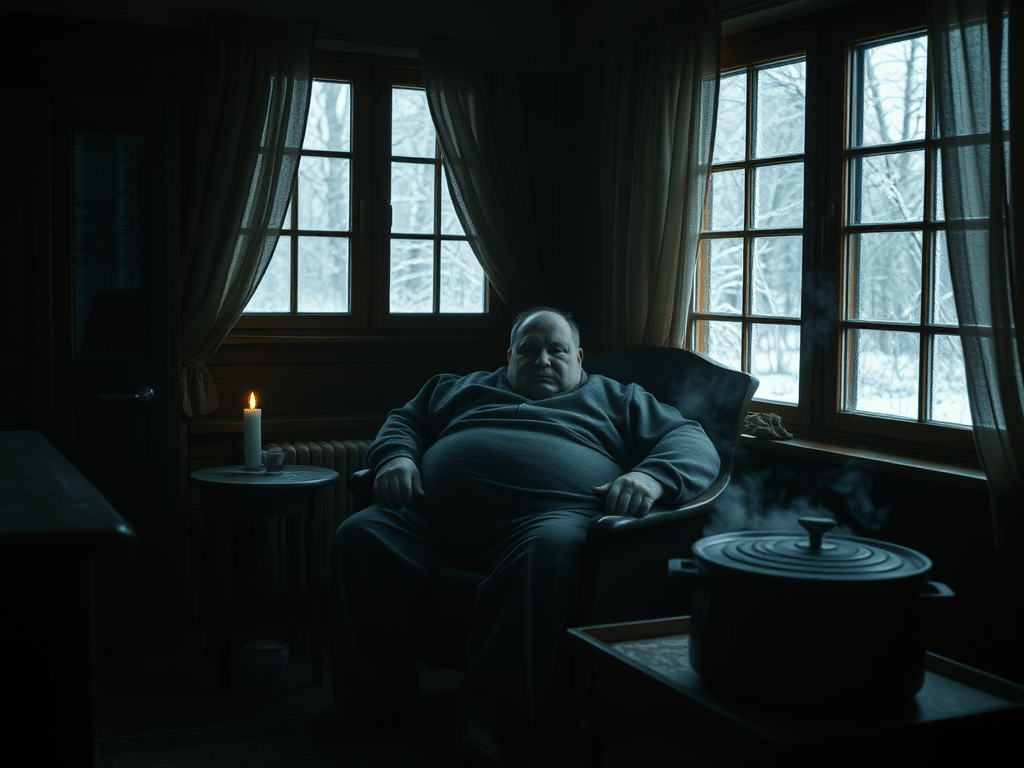
How sad. Imagine a man who promiscuously craved attention his entire life dying alone in a cold and dark room in a cold and dark dacha in the midst of a most unforgiving Russian winter.
Or nearly alone. With him was the sullen old nurse who spoke little English and seemed to know more about boiling cabbage than ministering to a dying man. In her defense, boiled cabbage was valued more by her people than this corpulent and grotesque American who knew only how to complain.
“Everything,” she often told her husband as they ate dinner in the dacha kitchen. “There is nothing in this existence which is not out to make his life miserable. Just ask him. Jesus Christ did not suffer as much for all Mankind as this man thinks he suffers when the temperature drops just a few degrees.
“Never have I seen such a miserable man. But then, I do not know any men who have fallen from such great heights.” She paused in thought as her husband slurped cabbage stew. “He must have been an awfully bad man to now be so all alone.
“Where is his wife? Where are his children? Where are all the people he calls friends?”
The husband looked up over his enormous spoon and observed that he wasn’t completely alone. “Those two circus clowns who spend their time drinking all his liquor and dancing with the whores in the village are still here. And it has been two years!”
The wife and cabbage boiler laughed. “Where can they go? Not back to their own country. They work for the great Putin and have done so since this pompous old toad arrived. I am told their orders were simple, “Take care of him or go home to your motherland.”
“Are they not welcome in the great America?” asked the husband. “I thought Mother Liberty welcomed all these days.”
“I hear things,” replied the wife. “Even a warm and generous mother would not welcome these two with open arms.”
“Was he not the leader of the America at one time?” asked the husband. “Surely powerful men in such a powerful country do not rule alone? Where are his servants? Where are his allies? Where are the underlings who fulfilled his orders?”
But the husband was just egging on his wife. They’d all heard the stories in the village where, unlike in this drafty old house, there were such modernisms as the Internet, satellite TV, and WiFi.
The husband always wondered why this house remained an isolated island while the waves of modern technology washed all around it and through the village, a mere stone’s throw away.
He must have been wondering aloud because the wife replied – “Or perhaps,” he mused ruefully, “she is reading my mind again.” – “Apparently these things are considered dangerous in his hands. It was Putin himself who said to keep this house disconnected from the rest of the world.”
She burst out laughing. Or as much as she laughed, which was more of a choked “Harrumph” with an exclamation point at the end. “That old fool, dangerous? What a joke. In two years here, I have learned enough of his language to know that he has no idea what he is saying.
“We have babies and teenagers in the village who make more sense.”
The story of the dying man held great interest with the townspeople. Not so much his ascent to power. As Russians, they had more than enough stories about that in their own culture. It was the descent, the fall from grace, the loss of power – these in their great Chekhovian fashion held their interest more.
Like in all great Chekhov short stories – and his was only a tawdry short story in the grand scope of life – it was the failings of character, the lies, the greed, the lack of empathy, the disdain for others, the megalomania, the corruption that power brings, the slavering devotion to others in power, even the immodest perceptions of himself, and the clownish vanity.
In the end, such stories boil down like cabbage to one thing: betrayal. It starts with betraying your own principles. Then you betray those in your inner circle who believe in you. And finally, you betray the masses. You are not the Messiah. Just another corrupt politician.
Yes, the whole village followed this man’s tale of descent with great interest. They sat in coffeehouses and smoked and shared nuggets of information gleaned from the swirling stories of this man’s life.
“I understand that even as president of the most powerful country in the world, he deferred to our leader and those of North Korea, Saudi Arabia, China, and even Hungary and Brazil. Unthinkable!”
“Not only did he defer, he curried their adulation! He must have been a very lonely child indeed.”
“But didn’t the people worship him?’
“Some did, yes. But mostly he was a false god, propped up by vast sums of money. With enough money to hand out, you can fill any house of worship with devotees.”
To this, there was much laughter and rattling of coffee cups around the table.
“Has he no family?”
“Ah, this is where the tragedy is strongest. He had many wives and mistresses and whores. And some children. And yet, it is said that in the end, he was a cuckold of Russian intelligence. They say his last wife was in the employ of Russia. It was not love. It was a transaction.”
“Yes!” exclaimed another. “Look at her now. She is the toast of Moscow TV and parties with the Kremlin bosses!”
“Yes!” chortled an old crone. “She is living off the millions of rubles she got for that book that no living person ever bought!” She was on a roll. “American politicians always make millions off their unsold memoirs!”
As Russians love a good dose of cynicism, this comment drew much laughter.
“But his children. Surely he had children. Do they not dote upon him as good children should?”
“Good children? Perhaps there is your answer,” replied an old woman smoking a pipe. “Just the other day, our FOX/Russia channel said that his grown children chose to live in Oman and Saudi Arabia when the end came. Of course, they can’t visit him. Or won’t. Who knows?”
That thought stilled the murmurs in the room. “Most interesting,” she continued, “FOX/Russia says it is unable to make contact with his eldest daughter and her husband, a financier of some sort. They fled to Saudi Arabia and have not been heard from since.”
There were knowing nods all around the room. In Russia, when people disappear, there is no mystery around the circumstances. But Americans, powerful ones, live their lives in the sunlight, and usually die there. Powerful Americans don’t just disappear. Not without serious and ultimately tragic reasons.
“Perhaps,” suggested a quiet man in the corner, “the answer may be in what you said, ‘financier of some sort.’ Those kinds were forever disappearing when our Putin came to power.”
“So how did this great man end up here?” asked a relative newcomer to the coffee house.
Everyone laughed. They knew the jokes.
“After the fourth attempt on his life, he decided to move to Russia for his own safety. He knew that when Putin wants someone dead, he usually succeeds on the second try,” offered one man.
A woman cut into the laughter, “Also, when Putin buys something of value, he rarely casts it away. Just like all his useless oligarch friends!”
The real end, which was less interesting than the jokes, was more democratic. The man lost his election. Very badly. And while that was humiliating enough – his many allies in the Christian right and Russia assured him that they had a lock on the vote counts – it was the realization that without power, his last years would be spent in a dozen different courtrooms, paying for his many sins.
In truth, his exit strategy had been planned for years. He never intended to live out his life in “public service,” whatever that was. He was owed enough favors. And with all the “assassination” attempts, he could reasonably claim that living in the United States was too unsafe.
And so he did.
To Putin, he was still an idiot but no longer a useful one. Better he talks to himself in an isolated estate in Russia than to the American press. Putin knew the man’s politics of grievance could easily be re-targeted at so many on the world stage – himself included – who had now turned their backs.
Keep your assets close, lest they become your enemies, Putin likes to say.
While the village people spoke knowingly of this mysterious visitor in their midst, few could say they ever had seen him.
“To my knowledge, he’s never come into the village,” said one.
“And he’s never been seen walking in the woods,” said another, “Even when it isn’t winter.”
“His nurse says there are no books in the house, no television, no Internet. He does not write on paper. He only sits in a chair by the fireplace and talks to himself,” a third one said.
“Not anymore, he doesn’t,” said a voice from the door.
They all turned to see the nurse and her husband, brushing off some of the fresh falling snow.
She added, “His miserable soul went in search of a happier place to live just two hours ago. Honestly, he seemed relieved when he realized what was happening.”
“So, no visits from ghosts of politics past, present, or future?”
Even in death, Russians find reason to laugh. Why not? It is the one thing that the country has in abundance.
“No,” said the nurse, “but he was talking like a madman to someone in the end.”
“So? Some final words for Chekhov’s most brilliant tale? Some hope for redemption? Some regret? A sudden enlightenment that you can entertain us with?”
The old nurse looks grimly at the gathering.
“You are like greedy fish in the carp pond,” she said. “If it is morsels of enlightenment you want, I have none.”
“Please!” They cried out, “Please! What did he say? Finish our story!”
The nurse let out a huge sigh of resignation.
“He turned to the two American clowns and all he said was, ‘Make sure they comb my hair.’ ”
They were stunned. “Not Chekhov. Not very Chekhov,” murmured the people around the table.
One by one, they got up, made their excuses, and headed for their homes. Would they tell their families of this tragic ending to the village’s most celebrated mystery?
Probably not.
Such an ignominious ending is beneath the Chekhov tradition which they all revere. What lessons could they share with their children? There was not even a good joke in the punchline.
No, best this man be forgotten here as quickly as he was in his own America. Neither martyr nor saint. Not even a worthy sideshow that would draw tourist dollars to the village. Who wants a T-shirt with “Make sure they comb my hair” emblazoned across the chest?
And quickly enough, it was as if the man never existed.
Related stories …
 Musings, Magic, San Miguel and More
That was a splash of cold water to my face to help calm my nerves over this ongoing saga that is so hopelessly relentless. Hawkins, you are a brave insightful and may I say, courageous writer. Thank you.
LikeLiked by 1 person
Thank you. A boy’s gotta have dreams ….
LikeLike