

“Go sit on a rock, and children will find you.” That’s the simple counsel of Elsmarie Norby, the founder of Ojalá Niños, a rural San Miguel de Allende program that encourages scores of children to explore their artistic side.
In Elsmarie’s case, it wasn’t really a rock. “I opened my gate,” she says.
Elsmarie moved to the rural community of San Miguel Viejo in 2007 and built a house like no other in the community. It had floors. It had windows. It had furniture. It had a kitchen with modern appliances. And it had a front gate.
Nowadays she says she was “a very strange person” to the residents. Especially strange to the children who would peer into her yard through the front gate. She didn’t know she was such an object of curiosity, an outlier, really. Not at first.
Elsmarie recalled the first time she invited the neighborhood kids in. “They stood frozen at the entrance … then entered wide-eyed. They had never seen a refrigerator, furniture, art on the walls …”
(Photo below: Elsmarie Norby with Kim Malcolm of Aurora Books.)
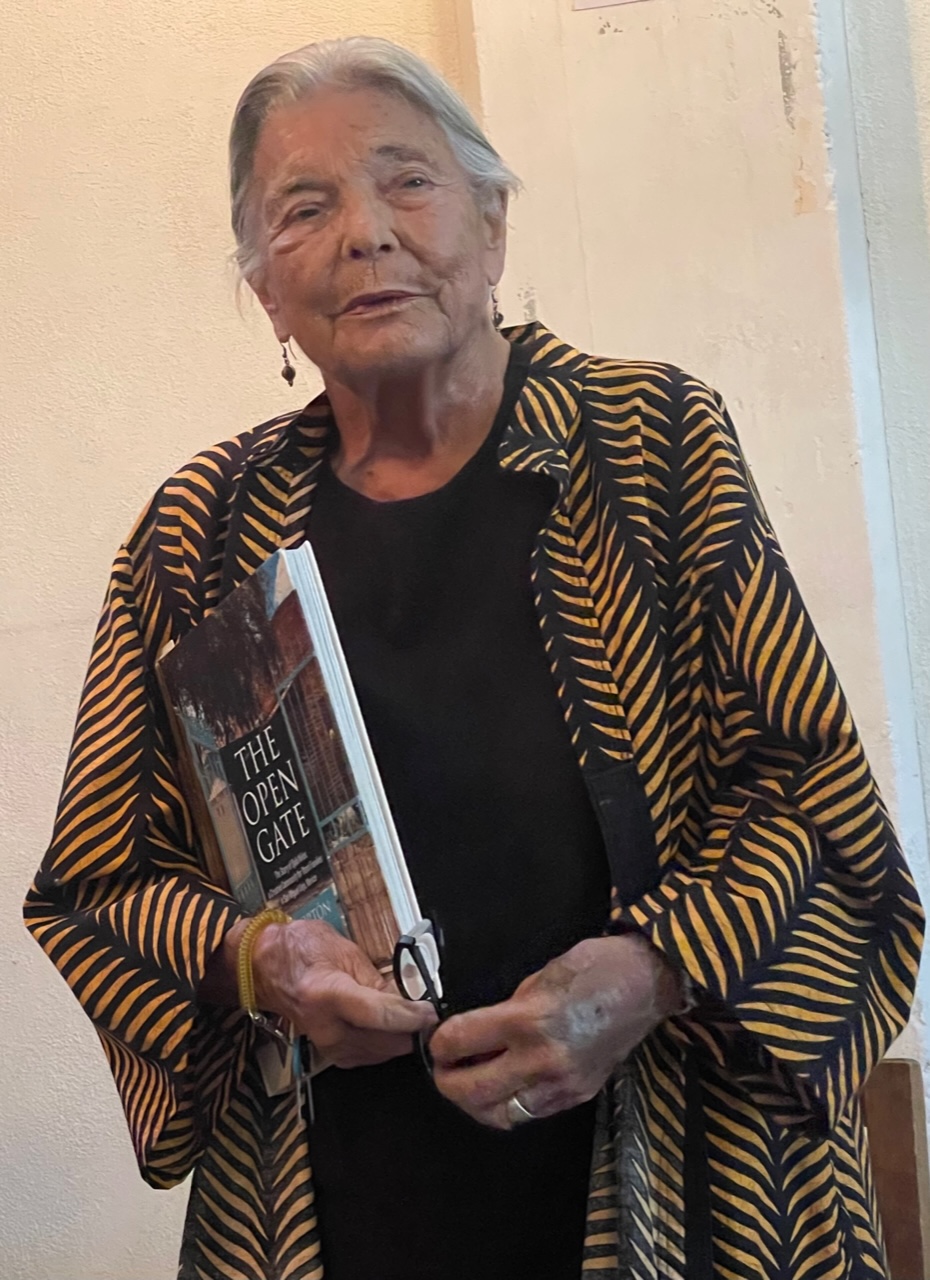
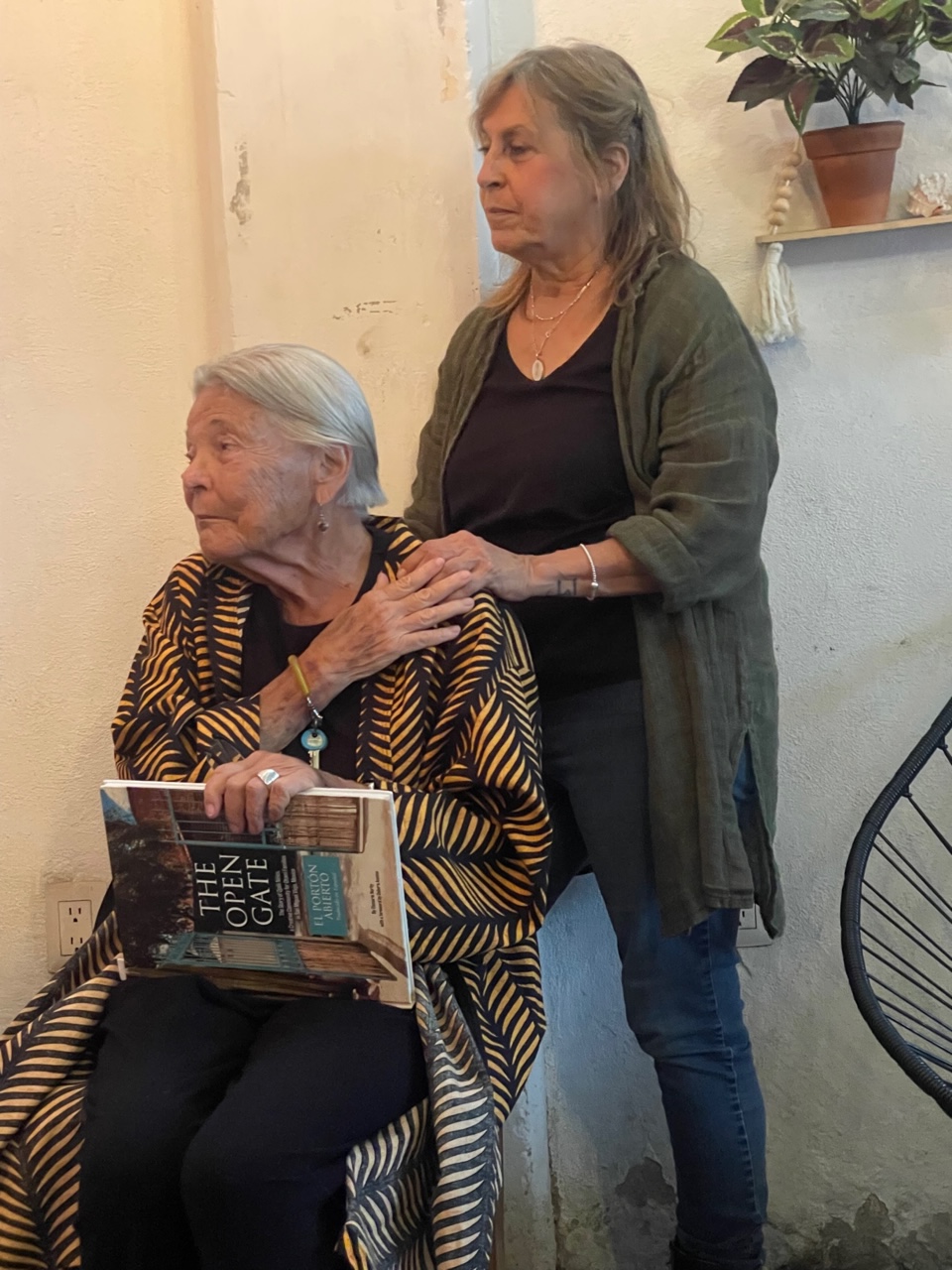

Her stories and photographs are collected in a new book, “The Open Gate” ($75, available on order from Aurora Books in Colonia Guadalupe. The book is a fund-raiser for Ojalá Niños). Kim Malcolm of Aurora Books sponsored the well-attended reading and book signing on Sunday. The stories in the book are observations of the lives of the children who came to Ojalá Niños — their growth and hers. As Elsmarie coyly said, “They are observations of why I am here. Many of them end with me asking, ‘What am I doing?'”
If she didn’t know back then — and she didn’t always — she does now.
Elsmarie’s stories are filled with discoveries and growth — hers and the children’s. They are filled with the lessons of a woman who suddenly finds herself with a third or fourth “career” — a Pied Piper of creativity in a neighborhood filled with the “forgotten ones.”
Indeed, this is how her own indigenous neighbors described themselves. “We are the poor. We are the forgotten.”
How could she, how could she ever, fit into such a community?
The lessons she learned over the years have become valuable parables for anyone seeking to be a better expat, a better partner in their community, and a good citizen in a foreign country.
One of my favorites, which Elsmarie told on Sunday, has to do with how we perceive each other and the assumptions we make. It starts with her encounter with an elderly couple slowly walking on the side of the road as she was driving into San Miguel.
She slowed down her car and offered them a ride. The couple looked at her and said nothing. The man stepped up and gingerly put his hand on her car. It dawned on Elsmarie that they had no idea how to get into the car, that they had never been in a car.
Even though she drove slowly and carefully, the couple in the back seat were clearly “a bit frightened.”
While this experience dashed any preconceived assumptions she might have had about her neighbors, she also learned that their perceptions of her were far different than what she imagined.
“Do you live alone, madam?” asked the man. “Very sad.”
And she’d thought she’d had it all. “I was the ‘other’ to them,” she observed. Many of her stories are about the struggle to not be the “other,’ and to better understand the culture in which she lived.
On Sunday, Elsmarie recalled the experience of two neighborhood kids, Pablo and Martin, whom she took to an exhibition of children’s art at a home in downtown San Miguel, a place as far away from their lives as Mars or Paris.
Their reaction puzzled her. She couldn’t read them. And they said nothing, gave nothing away.
That night at home, Elsmarie consoled herself with the fact that she had at least exposed them to a new experience. “Well,” she sighed, ” they did see the art.”
One of Elsmarie’s principles over the years has been to not teach, only to guide. That is, she puts opportunities in front of children in the form of art supplies, music, language classes, and the like — and then gets out of the way.
With Martin and Pablo, she didn’t know if she was in the way or out of the way.
The next night the two young boys showed up at her house. Pablo was carrying a bag filled with paper.
“It contained hundreds of penciled drawings” she recalls.
“These are Martin’s,” he told her.
“I do this when I am bored,” added Pablo. “I didn’t know it was called art.”
You begin to see the scope of the challenge confronting Elsmarie.
For a long time, Ojalá Niños was just the neighborhood kids showing up on Wednesday afternoons to draw, listen to music, look at art, enjoy popcorn, and leave the overwhelming poverty of their own lives behind. It was a shoestring operation with an improvised plan.
As the program grew, offerings were sometimes dependent on the talents of the volunteers. If a watercolor artist showed up, the day’s program included watercolor painting. If a sculptor showed up, fingers would dip into clay that day.
Ojalá Niños grew, of course, as word spread and volunteers found their way to the San Miguel Viejo house. Wednesdays at Elsmarie’s grew from nine kids to 120 and is now an everyday operation with a board of directors, a budget, a slate of volunteers, and a global reputation. They now offer tutoring, language classes, life-skill classes, sewing workshops, and women’s health and well-being classes.
“We now have the children of the original children,” says Elsmarie.
But Elsmarie’s early tenants still stand: Provide a space to learn and provide guidance. Then get out of the way.
“Find good and praise it,” says the 83-year-old Juilliard-trained pianist.
“Children become artists when they are handed materials. Stand back and let them create. … Art is natural for them. Art doesn’t need teaching.”
When Elsmarie Norby first moved to San Miguel, she and a friend organized several children’s choirs, particularly at the local orphanages. The transformation was astonishing, she recently told me. Children walked in with sloped shoulders, downcast eyes, and barely audible voices. After a few weeks, they walked tall, made eye contact, and sang with powerful voices.
The children in Ojalá Niños experienced similar transformations. Some are now teachers. Others have gone on to university and challenging careers.
After 14 years in San Miguel Viejo, Elsmarie’s health forced her to move back into San Miguel in a home where her own children could visit and even care for her. She is frail but still a force of nature.
On occasion — less so now that she isn’t as mobile — some of the 600 kids who have passed through Ojalá Niños or the scores who sang in her choirs would come up to her and say “Remember me?” They are adults now, but still and forever, her children.
“If you look into someone’s eyes for four seconds, you have a responsibility to them,” she says.
Perhaps Elsmarie Norby’s greatest gift is that she chose to never look away, regardless of who was standing at her gate, looking in.
_____________________________________________________________________
Put more magiIf you enjoyed this post, consider subscribing and passing on e (in the red circle). Feel free to share this post!
 Musings, Magic, San Miguel and More
A little too much exaggeration and self-aggrandizement here, and it’s insulting to the poor folks who live in San Miguel Viejo. The houses in San Miguel Viejo, even predating Mrs. Norby’s entrance, did have floors, windows, refrigerators, and even art on the walls. And even the elderly and the poorest there have ridden in cars.
LikeLike
If there was any aggrandizing, perhaps it is mine. Elsmarie spoke of her own experience and her own neighbors. The first children that came to her house in 2007 had never been in such a place. They often told her as much and their behavior underlined that. In our conversations she never suggested her’s was the only house like that, only in her immediate neighborhood.
As for the elderly couple, that is Elsmarie’s recollection of a very specific encounter. It is entirely possible that they had never ridden in a car. It is her memory. We should respect that as such.
It is difficult to write a memoir without someone accusing you of self-aggrandizing but I have to say that Elsmarie doesn’t play that game. Like I said, if it strikes you as a bit too much, perhaps that is my own enthusiasm slipping in around the edges. I personally feel that Elsmarie Norby accomplished an enormous amount of good in the community, often in the early years with very little support. The last thing she would do is insult her neighbors of nearly two decades and on whom she lavished great love and respect.
LikeLike
Such a great article about such a great person. I had to forward it to my mother.
LikeLiked by 1 person
Wonderful story. Thanks for sharing.
LikeLiked by 1 person
Thank you!
LikeLike
That was an inspiring story. Good on you to contantly seek out the positives.
LikeLiked by 1 person
I met Elsa when I was in SMA for 6 months a few years ago. She is the most incredible expat I have ever known. I admired immensely her ability to connect in a genuine way in her neighborhood. I will always cherish the Wednesdays I spent helping kids with their sewing as well as the many afternoons Elsa and I sat on her porch talking. What a legacy she has left in Ojala ninos.
LikeLike
Thank you for sharing your memories, Denise.
LikeLike
Thanks…this was a touching retrospective.
I worked as a volunteer at Ojala Niños fora couple of years prior to the pandemic, teaching children how to build models of buildings, interiors, and so forth. It was both enjoyable and enlightening. They learned but I learned, too: more about children´s capacities, and the shortcomings of the public education system here in Mexico.
LikeLiked by 1 person